
Assembly Line | Optiwise
Learn how assembly line management works, what challenges manufacturers face, and how ERP supports material readiness, line balancing, QC, and production tracking.
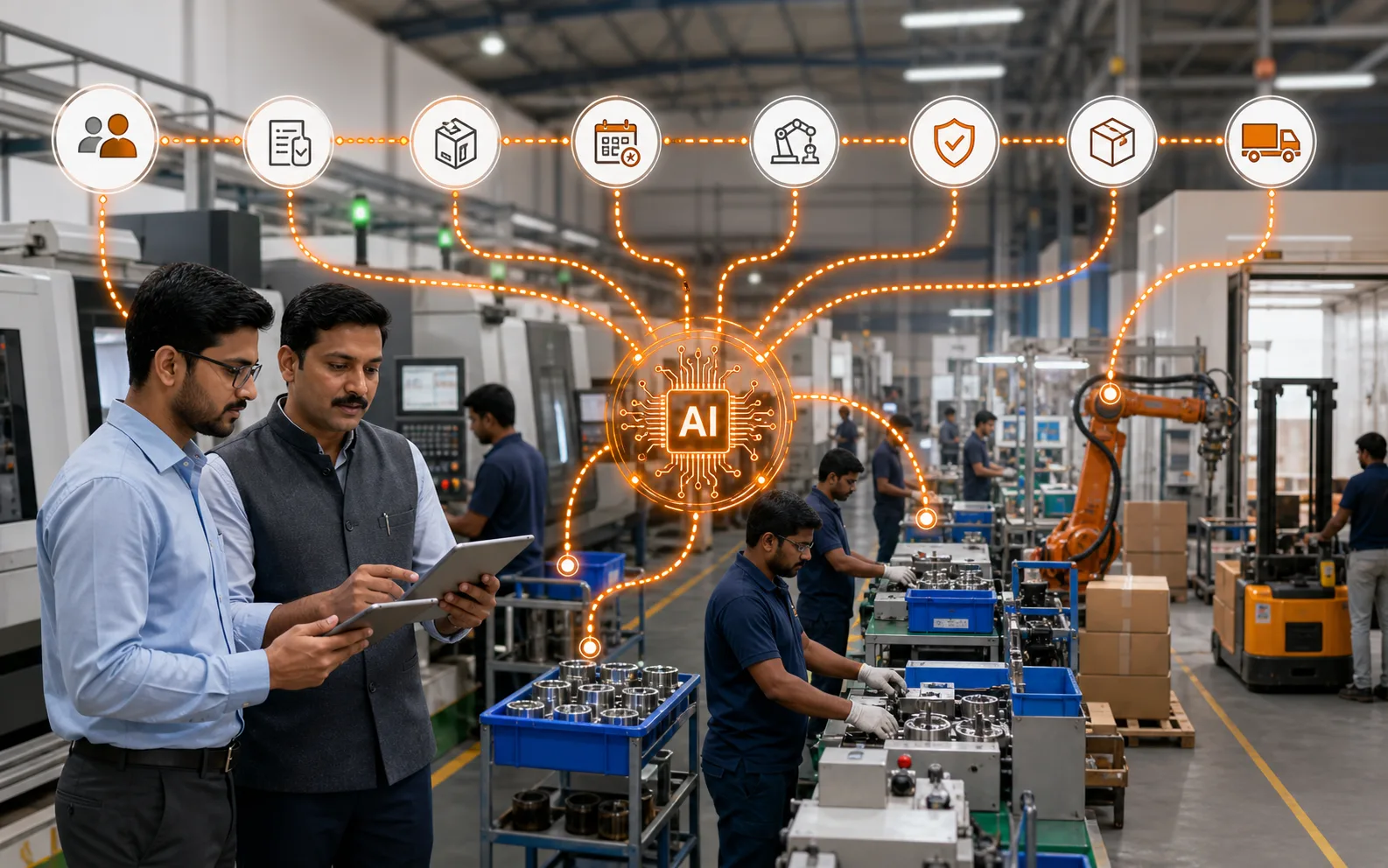
Assembly Line Management: Keeping Flow, Material, and Quality in Sync
An assembly line looks efficient when every station moves in rhythm. Parts arrive on time. Operators know the next task. Quality checks happen before defects travel too far. Finished goods move out without waiting. But when one station lacks material, one process takes longer, or one quality issue repeats, the entire line feels the impact.
Assembly line management is the discipline of keeping people, material, machines, workstations, and quality checks aligned. For growing manufacturers, this becomes difficult when planning runs on spreadsheets and updates happen after the shift is over.
AICAN Optiwise helps manufacturers connect assembly planning with BOM, inventory, work orders, routing, QC, and production status.
What Is an Assembly Line?
An assembly line is a production setup where a product moves through a sequence of workstations. Each station performs a defined task, and the final product is completed step by step.
Assembly lines are common in equipment, electronics, furniture, machinery, consumer goods, automotive components, and many engineered products. The complexity can vary, but the core challenge is the same: keep the line moving without losing quality.
Key Challenges in Assembly Lines
The first challenge is material availability. A missing fastener, sensor, bracket, wire, label, or packaging item can stop the line even if major components are available.
The second challenge is line balancing. If one workstation takes much longer than others, work piles up and the line slows down.
The third challenge is quality control. Defects found late are more expensive to correct than defects caught at the right checkpoint.
The fourth challenge is visibility. Supervisors need to know what is running, what is delayed, what is short, and where bottlenecks are building.
Why BOM and Routing Matter
Assembly depends heavily on accurate BOMs and clear routing. BOM tells the system what parts are needed. Routing tells the system what sequence of operations is required. If either is wrong, the line suffers.
For example, if a subassembly is missing from the BOM, material planning will not prepare it. If a QC step is missing from routing, the defect may travel downstream.
How ERP Helps
ERP helps assembly line control by connecting work orders with material requirements, issue to production, routing, QC checkpoints, and production progress. Supervisors and planners can see what is ready, what is pending, and what needs attention.
AICAN Optiwise gives manufacturing teams a connected view so assembly work does not depend only on manual coordination.
Practical Assembly Line Metrics
Manufacturers should track planned versus actual output, station-wise delays, material shortages, rework, rejection, downtime, and WIP. These metrics help identify whether the issue is material, process, quality, or capacity.
The goal is not only to speed up the line. It is to make flow reliable.
Founder’s Note
At AICAN, we believe assembly efficiency depends on what happens before the line starts. If material, BOM, routing, and QC are not prepared, operators are forced to solve planning problems on the floor. Optiwise is built to bring readiness into view earlier.
FAQs
What is an assembly line?
An assembly line is a production setup where a product moves through sequential workstations, with each station performing defined tasks.
Why do assembly lines stop?
Common reasons include material shortages, unbalanced workstations, quality issues, machine downtime, and unclear work instructions.
How does ERP help assembly lines?
ERP connects BOM, inventory, work orders, routing, QC, and production tracking so teams can manage readiness and bottlenecks.
What should manufacturers track on assembly lines?
Output, delays, material shortages, WIP, rework, rejection, and station-level bottlenecks are useful metrics.
Where can I learn more?
Visit AICAN Optiwise and About AICAN.

Related Posts

Kanban System | Optiwise
Learn how a Kanban system works in manufacturing, where it helps, where it fails, and how Optiwise connects Kanban signals with inventory, purchase, and production planning.
12 Jun 2026Read more →Erp In Operations Management | Optiwise
Learn how ERP improves operations management by connecting planning, inventory, purchase, production, quality, dispatch, finance, and reporting.
12 Jun 2026Read more →ERP for FMCG Companies in India
A practical guide to ERP for FMCG companies in India, covering distributor orders, batch tracking, expiry, inventory, production, schemes, costing, and reporting.
11 Jun 2026Read more →
Optiwise, Odoo, Acumatica and Business Central for Manufacturing
Compare manufacturing workflows in Optiwise, Odoo, Acumatica and Dynamics 365 Business Central. See what your factory can run in Optiwise.
11 Jun 2026Read more →