
ERP for Job Shops: Quote-to-Job Change Control
ERP for Job Shops: Quote-to-Job Change Control. Use a worked factory test, explicit inputs and exception checks before rollout.

ERP for Job Shops: Quote-to-Job Change Control helps you choose ERP for high-mix custom fabrication. Use one real order, one normal path and one exception in the evaluation.
A custom frame is quoted from drawing revision A. Revision B changes material thickness after purchase; planning records the effect on stock, cost, route and promised date.
Make the operational decision explicit
Keep estimate assumptions, customer revisions, purchased material, route steps and actual job records connected.
Optiwise connects sales, purchasing, inventory, production, quality, subcontracting and dispatch records in role-specific workflows.
ERPNext manufacturing documentation is the external process or control reference for this guide: https://docs.frappe.io/erpnext/user/manual/en/manufacturing. It does not prove an Optiwise feature or outcome; our product statements come from the current product record.
| # | Input | Evidence |
|---|---|---|
| 1 | Quote assumptions and revision | Owner and definition |
| 2 | Material and outside work | Authoritative source |
| 3 | Route and capacity | Acceptance rule |
| 4 | Actual quantity, time and quality | Exception owner |
Run the workflow with accountable roles
- 1. Quote assumptions and revision. Name the person who owns the record and decision.
- 2. Material and outside work. Use a current value from the representative order.
- 3. Route and capacity. Write the pass condition before the demo or rollout.
- 4. Actual quantity, time and quality. Assign correction and escalation responsibility.
Reconcile the test by hand. When the system result differs from the source record, classify the gap as master data, timing, transaction ownership, permissions or configuration before changing the workflow.
Test exceptions before rollout
- Customer changes scope
- Material is reusable
- Job pauses for approval
For each exception, record the expected status, permitted action, approver, correction path and audit evidence. A fast normal path does not compensate for an uncontrolled exception.
Connect the page to the next buyer task
review the product workflow, check the supporting module, prepare implementation inputs, read the related guide, open the detailed workflow guide, book a connected demo. Ask us to run the scenario with your roles and representative records, including the exception and correction path.
Questions to settle in the demo
What should we prepare?
Prepare one representative order, the four inputs above and a complication your team encounters today. Remove confidential values if needed while keeping the record relationships intact.
What is a passing result?
Accept the workflow when the normal path and exceptions leave a complete, role-appropriate record that another person can reconcile. Keep capability validation separate from any promised business result.
Job shop and custom fabrication businesses do not run like repetitive mass production factories. Every order may be different. Drawings change. Materials vary. Labour hours are difficult to estimate. Customer approvals matter. Rework can quietly eat margins.
That is why a generic ERP often feels uncomfortable for fabrication companies. The best ERP for job shops must handle flexibility without losing control.
What Makes Job Shop Manufacturing Different
In a job shop, the product is often made to order. Work depends on customer drawings, specifications, site conditions, available machines, skilled labour, and changing priorities.
A fabrication order may pass through:
- Enquiry and drawing review
- Cost estimation
- Quotation
- Material planning
- Purchase
- Cutting
- Welding
- Machining
- Surface treatment
- Assembly
- Inspection
- Dispatch
- Installation support
The workflow is not always linear. ERP must support this reality.
Must-Have ERP Features for Job Shops
1. Enquiry and Quotation Management
Custom fabrication starts before production. The quotation must consider material, labour, machine time, subcontracting, transport, wastage, and margin.
A good ERP should preserve quote assumptions so the team can compare estimated cost with actual cost later.
2. Flexible BOM and Routing
Standard BOMs are useful for repeat items, but job shops need flexible BOMs. A job may require one-time material lists, drawing-based changes, or revision control.
Routing should also be flexible because the same product may use different machines or processes depending on availability.
3. Job Costing
Job costing is critical. If you only know revenue but not actual job cost, you may repeat unprofitable work.
ERP should help track:
- Material consumed
- Labour hours
- Machine usage
- Outside processing
- Rework
- Scrap
- Transport
- Overheads
This helps owners understand which jobs are profitable and which customers create hidden cost.
4. Material Planning
Fabrication often suffers from small missing items: plates, fasteners, bought-out components, consumables, or special grades.
ERP should connect job requirements to inventory and purchase so shortages are visible early.
5. Stage-Wise Production Tracking
Managers need to know where each job stands. Is cutting complete? Is welding pending? Is machining delayed? Is inspection done?
Stage-wise tracking reduces the daily chaos of asking supervisors for updates.
6. Quality and Inspection Records
Custom fabrication often requires inspection reports, dimensional checks, material certificates, or customer approvals. ERP should store quality records against the job, not in disconnected folders.
7. Delivery and Dispatch Visibility
Fabrication orders can be bulky, staged, or dispatched in parts. ERP should show what is ready, what is pending, and what can be shipped.
Common ERP Mistakes in Fabrication Businesses
The biggest mistake is choosing ERP built only for standard production. Another mistake is ignoring estimation and costing. Many fabrication businesses discover too late that their ERP can track inventory but cannot explain job profitability.
A third mistake is over-customizing the system before stabilizing basic job tracking.
How Optiwise Supports the Workflow
AICAN Optiwise can support MSME fabrication businesses by connecting enquiries, quotations, purchases, inventory, production stages, quality checks, dispatch, and management dashboards. For custom work, the value is not just recording orders. It is making job progress and cost visible before margins disappear.
AI-assisted visibility can also help managers identify delayed jobs, pending purchases, or bottleneck stages without manually chasing every supervisor.
FAQ
Is standard ERP suitable for job shops?
Only if it supports flexible BOMs, custom job tracking, costing, stage-wise production, and changes. Pure repetitive manufacturing ERP may not fit well.
Why is job costing important in fabrication?
Because custom jobs can look profitable at quotation stage but lose money due to material variance, labour overruns, rework, or subcontracting.
Can ERP handle drawing revisions?
A good ERP should at least help track revision references and related job changes. For advanced engineering control, integration with document management may be needed.
What should fabrication businesses implement first?
Start with enquiry, quotation, job card, material planning, stage tracking, and job costing. These usually create the fastest visibility.
Final Thought
The best ERP for a job shop is not the one with the most modules. It is the one that understands that every job has a story: estimate, material, labour, change, inspection, and delivery.
If your ERP can capture that story clearly, your fabrication business can quote better, plan better, and protect margins better.

Related Posts

Will AI Create More Jobs Than It Destroys?
Explore whether AI will create more jobs than it destroys, with a practical view of manufacturing, automation, new roles, reskilling, and business transformation.
13 Jun 2026Read more →Manufacturing AI vs. Hiring More Workers
Compare manufacturing AI with hiring more workers and learn when automation, better systems, training, or additional people are the right answer.
7 Jun 2026Read more →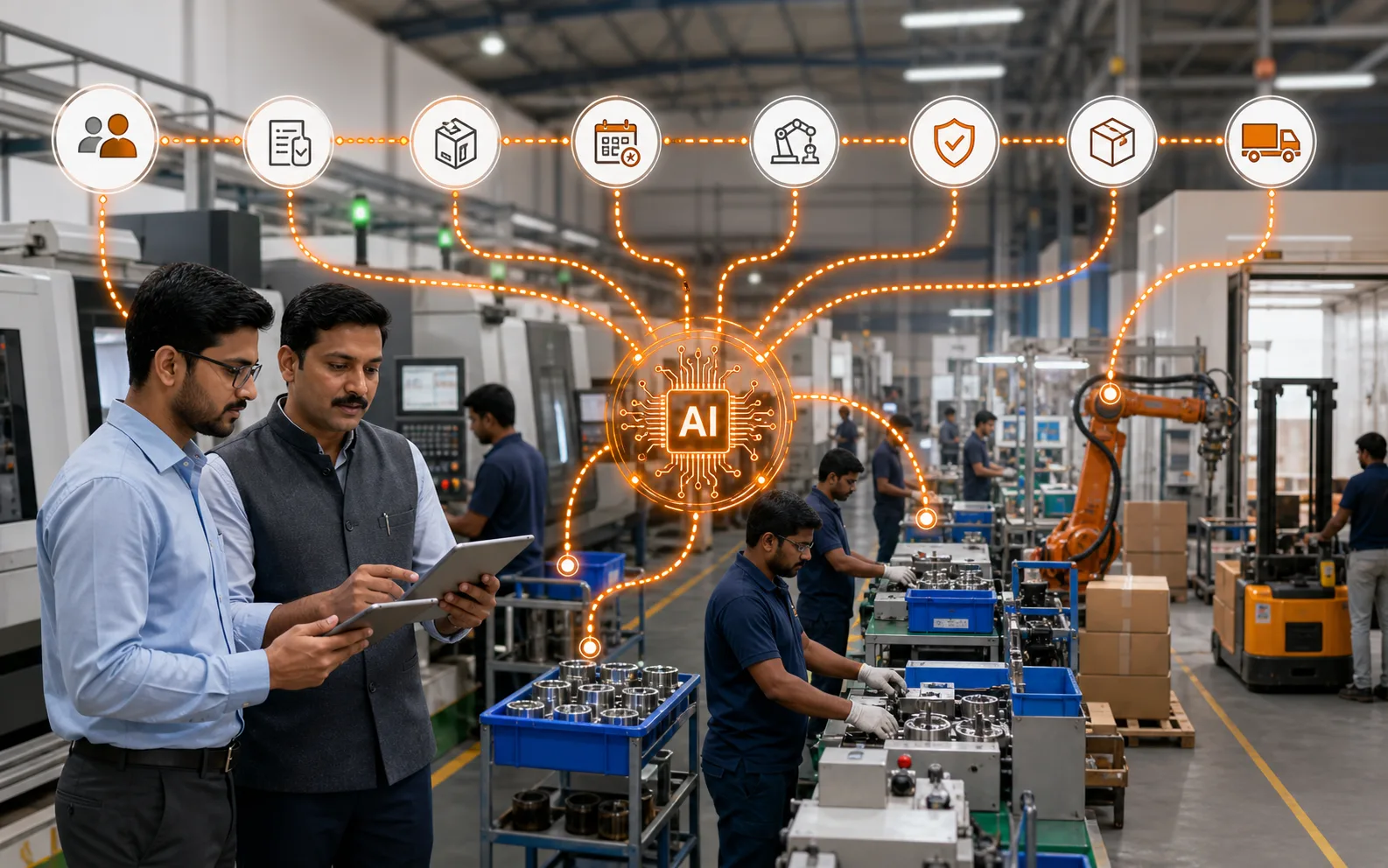
Will AI Replace My Production Planning Job?
Understand how AI affects production planning jobs, what tasks may change, and how planners can become more valuable with AI-supported scheduling and visibility.
6 Jun 2026Read more →Do I Need Special Skills to Use AI in Manufacturing?
Learn what skills manufacturing teams need to use AI, including process knowledge, data discipline, prompt clarity, review judgment, ERP understanding, and change readiness.
6 Jun 2026Read more →