
Cnc Machining | Optiwise
Learn CNC machining meaning, process, machine types, benefits, cost factors, production planning needs, and how AICAN Optiwise supports CNC manufacturers.
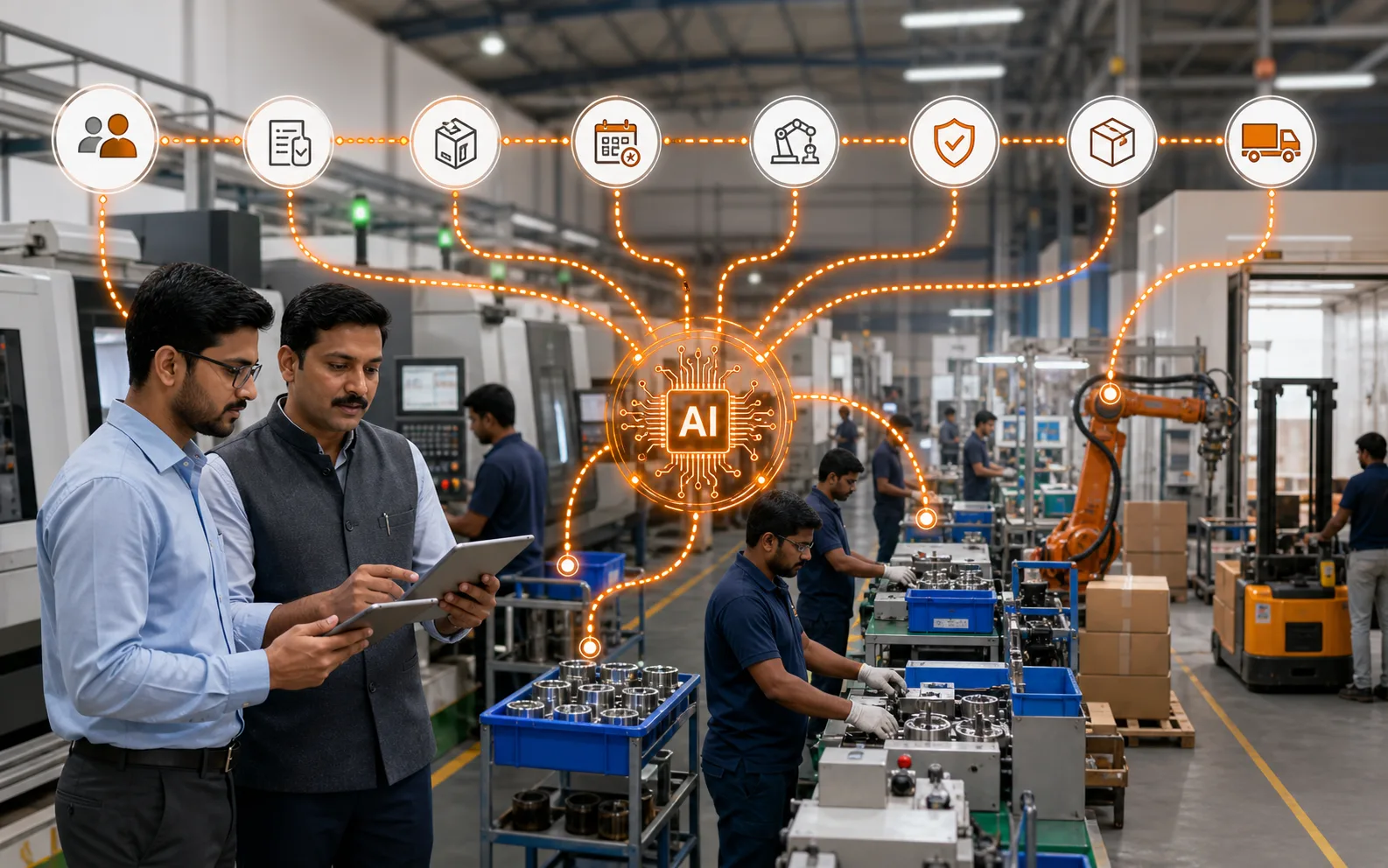
CNC Machining: Meaning, Process, Benefits, and Production Control
CNC machining looks precise from the outside because the machine follows code. But the business around the machine is still full of planning decisions.
Which job should run first? Is material available? Is the right tool ready? Has the drawing revision changed? How much cycle time is realistic? Is inspection capacity available? Which customer order is due tomorrow? How much WIP is sitting between operations?
CNC machines can be accurate. CNC businesses still need operating discipline.
CNC machining is a manufacturing process where computer-controlled machines remove material from a workpiece to create precise parts. It is widely used in automotive, aerospace, engineering, medical equipment, electronics, tooling, and industrial manufacturing.
AICAN Optiwise helps manufacturing SMEs, including machining businesses, connect inventory, purchase, production planning, work orders, dispatch, and reporting.
What Is CNC Machining?
CNC stands for Computer Numerical Control.
CNC machining uses computer-controlled machine tools to cut, drill, mill, turn, grind, or shape material into required dimensions.
The machine follows programmed instructions, often created from CAD and CAM systems. The program controls tool movement, cutting speed, feed rate, depth of cut, and machining path.
CNC machining is valued because it can produce accurate, repeatable parts with tight tolerances.
How CNC Machining Works
A typical CNC machining flow includes:
1. Design
The part is designed using CAD software or engineering drawings.
2. Programming
CAM software or manual programming converts the design into machine instructions.
3. Material Preparation
The correct raw material is selected, cut, and prepared for machining.
4. Setup
The operator sets the workpiece, fixtures, tools, offsets, and program.
5. Machining
The CNC machine performs operations such as milling, turning, drilling, boring, threading, or finishing.
6. Inspection
The finished part is checked against required dimensions and quality standards.
7. Dispatch or Next Operation
The part may go to assembly, finishing, heat treatment, coating, or customer dispatch.
Common Types of CNC Machines
CNC milling machines
Used for cutting and shaping material with rotating tools.
CNC turning centers
Used for cylindrical parts where the workpiece rotates against cutting tools.
CNC routers
Used for wood, plastics, composites, and softer materials.
CNC grinding machines
Used for finishing surfaces and achieving tight tolerances.
CNC plasma and laser cutting machines
Used for sheet cutting and profile cutting.
Multi-axis CNC machines
Used for complex parts requiring machining from multiple angles.
Materials Used in CNC Machining
CNC machining can work with many materials, including:
- Mild steel
- Stainless steel
- Aluminium
- Brass
- Copper
- Tool steel
- Engineering plastics
- Nylon
- Delrin
- Titanium in specialized applications
Material choice affects tooling, speed, cycle time, surface finish, and cost.
Benefits of CNC Machining
High Precision
CNC machines can produce tight tolerances and repeatable dimensions.
Repeatability
Once a program and setup are stable, repeated parts can be produced consistently.
Complex Geometry
CNC machines can produce shapes that are difficult with manual machining.
Better Productivity
Automation improves output compared with fully manual processes.
Lower Human Error
The program controls tool movement, reducing variation from operator handling.
Flexible Production
CNC is useful for prototypes, batches, and repeat production.
CNC Machining Cost Factors
CNC machining cost depends on:
- Material cost
- Machine time
- Setup time
- Tooling cost
- Programming complexity
- Tolerance requirement
- Surface finish
- Batch size
- Inspection requirement
- Rework or rejection risk
- Operator skill
A small design change can affect cycle time and cost significantly.
Production Planning Challenges in CNC Shops
CNC shops often manage many jobs with different drawings, materials, tools, and delivery dates.
Common challenges include:
- Material shortage
- Tool availability
- Machine loading
- Setup time estimation
- Drawing revision control
- Inspection bottlenecks
- Customer priority changes
- Subcontract operations
- WIP tracking
- Dispatch commitment tracking
These are business-process challenges, not machine-control challenges.
How ERP Helps CNC Machining Businesses
ERP helps CNC businesses manage the operational flow around machining.
A useful system can help with:
- Customer order tracking
- Material requirement planning
- Purchase follow-up
- Stock visibility
- Work order creation
- Production status
- Operation-wise progress
- Dispatch readiness
- Reporting and dashboards
Optiwise by AICAN helps teams reduce dependency on manual job cards, scattered Excel sheets, and repeated follow-up calls.
Improving CNC Shop Control
Manufacturers can improve CNC operations by:
- Maintaining clean item and material masters.
- Tracking raw material and bought-out items accurately.
- Recording work orders clearly.
- Planning machine load realistically.
- Tracking setup and cycle time.
- Separating rework and rejection data.
- Keeping drawings and revisions controlled.
- Reviewing WIP daily.
- Connecting dispatch commitments with production status.
- Using reports to identify bottlenecks.
Founder’s Note
At AICAN, we see CNC machining businesses as precision-driven but often coordination-heavy. The machine may be advanced, but the business still suffers if material, planning, inspection, and dispatch are not connected.
With Optiwise, we help manufacturers bring operational clarity around the machine: what is planned, what is pending, what is short, and what is ready.
Learn more about AICAN at About AICAN.
FAQs
What is CNC machining?
CNC machining is a manufacturing process where computer-controlled machines remove material from a workpiece to create precise parts.
What are common CNC machining operations?
Common operations include milling, turning, drilling, boring, threading, grinding, and cutting.
Why is CNC machining important?
It provides precision, repeatability, productivity, and flexibility for manufacturing complex parts.
What affects CNC machining cost?
Cost depends on material, machine time, setup, tooling, tolerance, finish, batch size, inspection, and rework risk.
How does Optiwise help CNC manufacturers?
AICAN Optiwise connects inventory, purchase, work orders, production status, dispatch, and reporting for better CNC shop control.

Related Posts

Kanban System | Optiwise
Learn how a Kanban system works in manufacturing, where it helps, where it fails, and how Optiwise connects Kanban signals with inventory, purchase, and production planning.
12 Jun 2026Read more →Erp In Operations Management | Optiwise
Learn how ERP improves operations management by connecting planning, inventory, purchase, production, quality, dispatch, finance, and reporting.
12 Jun 2026Read more →ERP for FMCG Companies in India
A practical guide to ERP for FMCG companies in India, covering distributor orders, batch tracking, expiry, inventory, production, schemes, costing, and reporting.
11 Jun 2026Read more →
Optiwise, Odoo, Acumatica and Business Central for Manufacturing
Compare manufacturing workflows in Optiwise, Odoo, Acumatica and Dynamics 365 Business Central. See what your factory can run in Optiwise.
11 Jun 2026Read more →