
Common Implementation Bottlenecks and Fixes
A practical guide to the most common bottlenecks in factory computer vision projects, including lighting, data, integration, operator adoption, and ROI tracking.
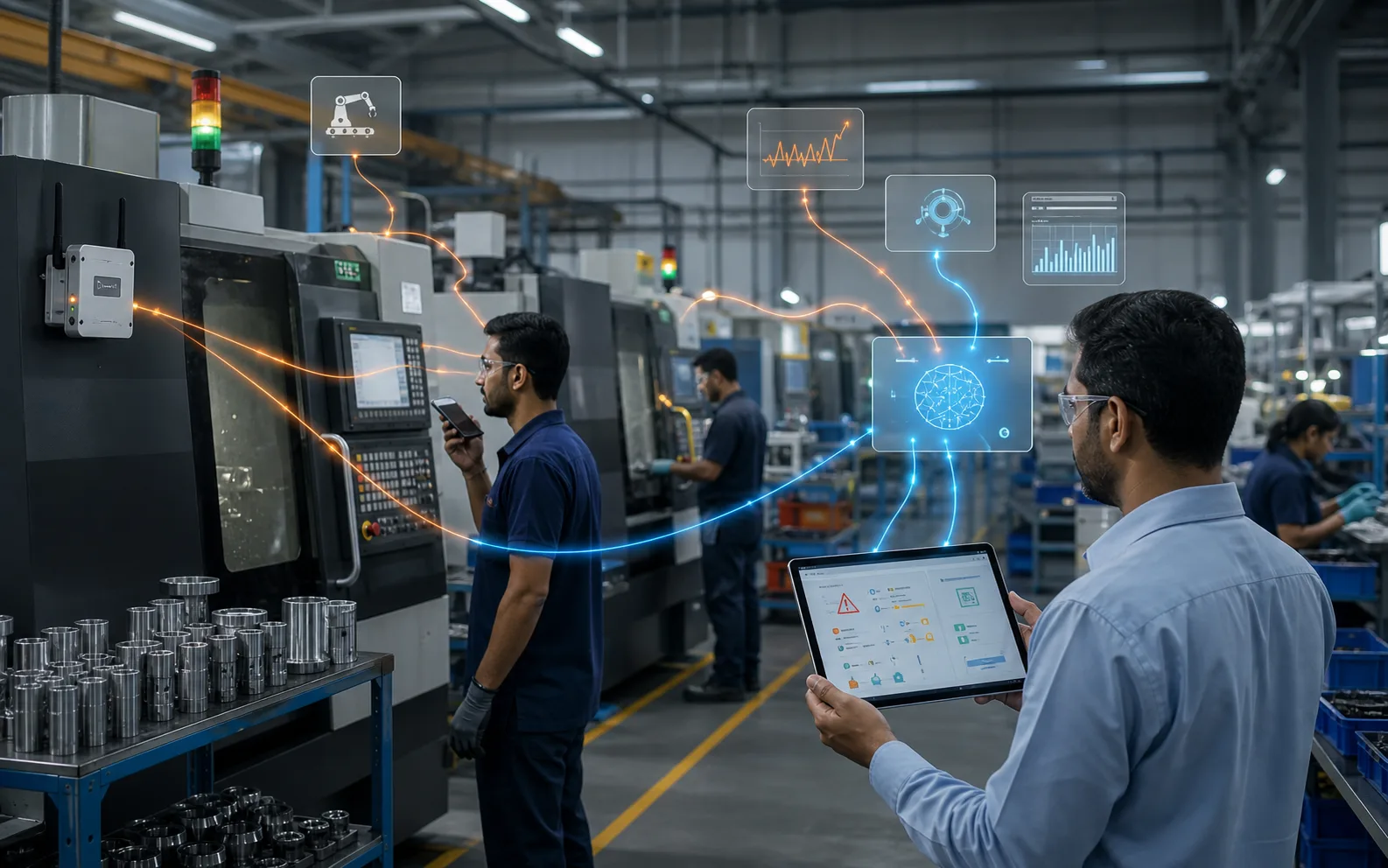
Common Implementation Bottlenecks and Fixes
Computer vision projects rarely fail because the camera cannot see anything. They usually struggle because the factory environment is messy, the process is not defined, or the system is not connected to everyday work.
A demo can look perfect on a table. A production line is different. Parts move. Lighting changes. Operators rotate. Dust collects. Fixtures shift slightly. Defects appear in forms that were not present in the training images. The ERP, quality process, and shopfloor habits all have to absorb the new signal.
That is why manufacturers should treat computer vision as an implementation program, not a purchase order for cameras and AI models.
The good news is that most bottlenecks are predictable. If a factory knows where projects usually slow down, it can plan better, avoid frustration, and get value faster. A connected manufacturing system like AICAN Optiwise can help because it keeps the vision project tied to production, quality, inventory, and action tracking rather than letting it remain a standalone technical experiment.
Bottleneck 1: The Inspection Problem Is Not Specific Enough
Many factories begin with a broad statement such as “we want to improve quality” or “we want AI inspection.” That is too vague for implementation.
Computer vision performs best when the first use case is specific. For example:
- Detect missing fasteners after assembly.
- Verify label presence and orientation before packing.
- Identify surface scratches above an agreed threshold.
- Confirm correct component placement on a fixture.
- Detect wrong colour, shape, or part variant.
- Check whether a package contains the expected item count.
The bottleneck appears when the team expects one system to solve every visual defect at once. The model may need different lighting, camera placement, image examples, and decision rules for each defect type.
The fix is to define the first use case tightly. Write down the defect, inspection location, decision rule, expected action, and business impact. A narrow pilot does not mean a small vision. It means the factory is building proof on a controlled foundation.
Bottleneck 2: Poor Lighting and Camera Placement
Lighting is one of the least glamorous parts of computer vision, but it is often the difference between a stable system and a frustrating one.
Factories have shadows, reflections, dust, vibration, sunlight variation, machine guarding, and moving operators. A human inspector can adjust their head or angle. A camera cannot unless the setup is designed correctly.
Common lighting and placement issues include:
- Glare on metal, plastic, or glossy packaging.
- Shadows from fixtures or operator movement.
- Inconsistent ambient light across shifts.
- Parts appearing at slightly different positions.
- Camera vibration near machines.
- Background clutter that confuses detection.
The fix is to treat imaging as an engineering task. Before model training, stabilise the image. Use controlled lighting where possible, fixed camera mounts, repeatable part presentation, clean backgrounds, and proper shielding from environmental variation.
A useful question is: would ten images of the same good part look almost identical? If not, the model will have to fight unnecessary variation.
Bottleneck 3: Not Enough Real Defect Examples
Computer vision needs examples. If the factory has many good-part images but very few defect images, the system may struggle to detect rare or unusual faults. This is common because factories naturally try to prevent defects, so the defect library may be small.
Some teams underestimate this bottleneck. They assume the model will understand every defect from a few photos. In reality, defect appearance may vary by material, angle, lighting, supplier lot, tool wear, or production condition.
The fix is to build a structured image dataset over time. Capture good parts, borderline parts, known defects, false rejects, and missed defects. Label them carefully. Review them with quality and production teams, not only technical staff.
It is also important to define what should not be detected. For example, a harmless surface variation may look dramatic in an image but may be acceptable by customer specification. Without clear acceptance criteria, the system can create too many false alarms.
Bottleneck 4: False Rejects Create Operator Resistance
If a vision system stops production too often for acceptable parts, operators will lose trust quickly. Once trust drops, people may bypass alerts, delay acknowledgements, or treat the system as a nuisance.
False rejects are not only a technical problem. They are an adoption problem.
The fix is to tune thresholds with production reality in mind. Start by separating critical defects from advisory warnings. Not every visual variation should trigger the same response. Some issues may need immediate line stop. Others may need supervisor review or quality sampling.
Also involve operators early. They often know which variations are normal, which issues repeat after changeover, and where the system may create unnecessary friction. Their feedback can improve the setup and increase ownership.
A good implementation asks: what should happen when the system detects a defect? If the answer is unclear, the alert will create confusion instead of action.
Bottleneck 5: The System Is Not Connected to Quality Workflow
A camera detection is only the beginning. If the event is not connected to a workflow, it becomes another isolated notification.
Factories need to know:
- Which production order or batch was affected?
- Which station generated the alert?
- Who acknowledged it?
- Was the part rejected, reworked, or released?
- Was a root cause action opened?
- Did the same defect repeat later?
Without this connection, managers may see a count of defects but not the operational story behind them.
This is where AICAN and AICAN Optiwise become relevant. The stronger value comes when vision signals are connected with production, inventory, quality, and reporting workflows. That allows teams to track action, not just detection.
The fix is to design the response workflow before go-live. Decide how alerts are classified, who owns them, what statuses are used, and where evidence is stored.
Bottleneck 6: No Baseline for ROI
Many factories want ROI from computer vision but do not measure the starting point. Without a baseline, the project may succeed operationally but still struggle to prove business value.
Before implementation, measure the current process:
- How many inspectors are involved?
- How much time is spent on the target inspection?
- What defects escape to final inspection or customers?
- How much rework is linked to the target defect?
- How long does it take to identify and respond to the issue?
- How often do teams debate the cause because evidence is incomplete?
After implementation, compare the same metrics. Do not change the definition halfway through the project.
The fix is simple but often skipped: create a before-and-after measurement sheet before installing the system. Agree on what counts as success and what will be reviewed after 30, 60, and 90 days.
Bottleneck 7: Trying to Automate a Broken Process
Computer vision cannot rescue an unclear process by itself. If material flow is chaotic, part presentation is inconsistent, defect standards are unclear, and quality ownership is weak, the vision system will expose the mess rather than solve it instantly.
That exposure can be useful, but only if management treats it honestly.
The fix is to stabilise the surrounding process. Standardise part positioning. Define inspection criteria. Train operators on responses. Keep master data clean. Ensure production orders, batches, and quality statuses are reliable. Digital visibility works best when the physical flow is disciplined.
This is why vision projects should involve production, quality, maintenance, IT, and management together. A camera project owned by only one department often becomes slow when the real bottleneck belongs to another team.
Bottleneck 8: Weak Change Management
People are part of the system. If inspectors fear replacement, operators fear blame, and supervisors see the system as extra reporting work, adoption will be weak.
The fix is to position computer vision as a support tool. It helps inspectors focus on judgement and analysis. It helps operators catch issues earlier. It helps supervisors see patterns faster. It helps management make decisions from evidence.
Training should include what the system does, what it does not do, how alerts are handled, how false positives are reported, and how improvement feedback is captured.
A system that learns from shopfloor feedback becomes more trusted. A system imposed without explanation becomes resisted.
A Practical Implementation Checklist
Before starting, manufacturers should confirm:
- The first defect use case is specific.
- Lighting and camera placement are tested on the real line.
- Good, bad, and borderline examples are collected.
- Defect categories and acceptance rules are documented.
- Alert response workflow is agreed.
- Operators and inspectors are included in testing.
- Baseline metrics are captured.
- Integration with production and quality systems is planned.
- Review cadence is defined for the first 90 days.
This checklist will not eliminate every surprise, but it will prevent the most common delays.
Where AICAN Optiwise Helps
AICAN Optiwise helps manufacturers treat computer vision as part of operations. The goal is not just to detect defects, but to create traceable quality actions, connect events to production context, and help teams improve the process over time.
For factories evaluating vision projects, the question should be: after detection, what happens next? If the answer is clear, the implementation has a much better chance of becoming useful.
You can learn more about the company and its manufacturing focus on About AICAN.
Founder’s Note
Most technology projects slow down where the real factory begins. That is not a bad thing. It means the system is meeting the truth of the shopfloor.
The factories that succeed are usually not the ones that buy the most complex system first. They are the ones that define the problem clearly, involve the people who live with the process every day, and connect detection to action. That is the practical standard we care about at AICAN.
FAQs
What is the biggest bottleneck in computer vision implementation?
The biggest bottleneck is usually an unclear use case. If the defect, inspection point, decision rule, and response workflow are not defined, the project becomes slow and difficult to measure.
Why does lighting matter so much for computer vision?
Lighting affects image consistency. Shadows, glare, reflections, and ambient light changes can confuse detection. Stable lighting makes the model’s job easier and improves reliability.
How can factories reduce false rejects?
Factories can reduce false rejects by improving image consistency, refining acceptance criteria, collecting more borderline examples, tuning thresholds, and involving operators in review.
Does computer vision need ERP integration?
Not always for a small pilot, but integration becomes important when the factory wants traceability, production context, quality actions, and management reporting. AICAN Optiwise is designed around this connected workflow need.
How long does a computer vision project take?
Timing depends on use-case complexity, data availability, hardware setup, and integration requirements. A focused pilot can move faster than a broad deployment that tries to cover many defects at once.

Related Posts

Kanban System | Optiwise
Learn how a Kanban system works in manufacturing, where it helps, where it fails, and how Optiwise connects Kanban signals with inventory, purchase, and production planning.
12 Jun 2026Read more →Erp In Operations Management | Optiwise
Learn how ERP improves operations management by connecting planning, inventory, purchase, production, quality, dispatch, finance, and reporting.
12 Jun 2026Read more →ERP for FMCG Companies in India
A practical guide to ERP for FMCG companies in India, covering distributor orders, batch tracking, expiry, inventory, production, schemes, costing, and reporting.
11 Jun 2026Read more →
Optiwise, Odoo, Acumatica and Business Central for Manufacturing
Compare manufacturing workflows in Optiwise, Odoo, Acumatica and Dynamics 365 Business Central. See what your factory can run in Optiwise.
11 Jun 2026Read more →