
How Can I Connect Factory Machines to ERP?
Learn how manufacturers can connect factory machines to ERP using controllers, PLCs, gateways, sensors, barcode scans, shopfloor terminals, and practical integration workflows.

How Can I Connect Factory Machines to ERP?
You can connect factory machines to ERP by capturing machine signals through controllers, PLCs, gateways, sensors, edge devices, barcode systems, or operator terminals, and then linking that data to production orders, material, quality, operators, and dispatch context.
The important word is context.
A machine can tell you it is running or stopped. ERP can tell you which job was planned, which material was issued, which operator was assigned, which quality check is pending, and which customer dispatch depends on the output. The value comes when these two sides connect.
For manufacturers, AICAN Optiwise helps turn machine-related data into operational visibility across production, inventory, quality, and planning.
Start with the Business Problem
Before connecting machines, define the business problem.
Common goals include:
- Track machine utilization.
- Reduce downtime.
- Monitor CNC or VMC output.
- Improve OEE.
- Capture production counts.
- Track cycle time.
- Reduce manual production reporting.
- Improve maintenance planning.
- Connect quality issues to machine conditions.
- Protect dispatch commitments.
The integration method should follow the goal. Do not connect machines simply because the data exists.
Identify Machine Types and Capabilities
Make a machine inventory.
Record:
- Machine name and number.
- Machine type.
- Controller type.
- Age of machine.
- Available communication ports.
- PLC availability.
- Network readiness.
- Signals available.
- Criticality to production.
- Current reporting method.
This helps decide which machines can be connected directly and which need sensors or operator input.
Choose the Right Integration Method
Common integration methods include:
- Direct machine controller integration.
- PLC data capture.
- Industrial gateway or edge device.
- Sensor-based monitoring.
- Power signal monitoring.
- Barcode or QR scanning.
- Operator terminal reporting.
- Hybrid machine signal plus human reason-code entry.
Modern machines may support richer data. Older machines may only support basic running and idle status. That is still useful if connected to the right workflow.
Connect Data to Production Orders
Machine integration should be linked to production orders.
Without this link, the system may show machine status but not production impact.
A useful workflow connects:
- Work order.
- Part number.
- Operation.
- Machine.
- Operator.
- Planned quantity.
- Actual quantity.
- Cycle time.
- Downtime.
- Rejection.
- Quality status.
This allows the ERP to show whether the job is progressing, delayed, or at risk.
Capture Downtime Reasons
Machines can automatically show when they are stopped, but they may not know why.
The ERP workflow should capture reason codes such as:
- Breakdown.
- Setup.
- Tool change.
- No material.
- No operator.
- Program issue.
- Quality hold.
- Waiting for inspection.
- Maintenance.
- No plan.
This often requires operator or supervisor input. Keep it simple so users actually report it.
Include Quality Status
Machine output should connect with quality status. Production count alone can be misleading if rejected parts are included as successful output.
The system should track:
- Produced quantity.
- Accepted quantity.
- Rejected quantity.
- Rework quantity.
- Inspection pending quantity.
- Defect type.
- Quality hold reason.
This helps calculate usable output and supports root cause analysis.
Handle Older Machines Practically
Older machines may not have modern connectivity. That does not mean they are impossible to include.
Options include:
- External sensors for running/idle status.
- Power monitoring.
- Operator terminals.
- Manual job start and stop.
- Barcode scanning for work orders.
- Supervisor confirmation.
- Edge devices that capture limited signals.
Start with the signal that matters most. For many factories, knowing running time, idle time, and downtime reason is already valuable.
Design the Data Flow
A practical machine-to-ERP flow may look like this:
- ERP releases production order.
- Operator scans or selects the job at the machine.
- Machine signal captures running and idle status.
- Operator records downtime reason when required.
- Quantity produced is captured automatically or entered.
- Quality checks update accepted or rejected quantity.
- ERP updates WIP, production progress, and dashboards.
- Planning and dispatch see risk earlier.
This flow connects machine activity to business action.
Avoid Integration Overload
Do not begin by connecting every machine with every possible data point.
Start with:
- Bottleneck machines.
- High-value machines.
- Machines causing frequent dispatch delays.
- Machines with high downtime.
- Quality-critical processes.
- Areas where manual reporting is unreliable.
A focused pilot helps the factory learn what data is useful and how users respond.
What Dashboards Should Show
Machine-to-ERP dashboards should show:
- Machine status.
- Job running.
- Planned vs actual quantity.
- Running time.
- Idle time.
- Downtime by reason.
- Cycle time variance.
- Rejection and rework.
- OEE or utilization.
- Dispatch risk.
Dashboards should help supervisors act, not only help management view historical charts.
How AICAN Optiwise Helps
AICAN Optiwise helps manufacturers connect machine activity with ERP workflows. This supports better production tracking, utilization monitoring, downtime analysis, quality linkage, and planning visibility.
AICAN builds for practical factory operations. You can learn more at About AICAN.
Founder’s Note
Machine integration sounds technical, but the real problem is operational: can the factory see what is happening early enough to act?
Start with a useful question, connect the minimum reliable data needed to answer it, and build from there. That approach creates more value than a complex integration that nobody uses properly.
FAQs
How can machines be connected to ERP?
Machines can be connected through controllers, PLCs, industrial gateways, sensors, edge devices, barcode scans, operator terminals, or hybrid workflows.
Do all machines support direct ERP integration?
No. Some modern machines support richer data, while older machines may need sensors, gateways, or operator-based reporting.
What data should be sent to ERP?
Useful data includes machine status, job reference, production quantity, running time, idle time, downtime reason, cycle time, operator, and quality status.
Why is production order linkage important?
Production order linkage connects machine activity to the actual job, part, customer demand, material, quality, and dispatch impact.
How does AICAN Optiwise help machine integration?
AICAN Optiwise connects machine data with manufacturing workflows so teams can use it for production visibility, downtime control, quality tracking, and planning decisions.

Related Posts

Kanban System | Optiwise
Learn how a Kanban system works in manufacturing, where it helps, where it fails, and how Optiwise connects Kanban signals with inventory, purchase, and production planning.
12 Jun 2026Read more →Erp In Operations Management | Optiwise
Learn how ERP improves operations management by connecting planning, inventory, purchase, production, quality, dispatch, finance, and reporting.
12 Jun 2026Read more →ERP for FMCG Companies in India
A practical guide to ERP for FMCG companies in India, covering distributor orders, batch tracking, expiry, inventory, production, schemes, costing, and reporting.
11 Jun 2026Read more →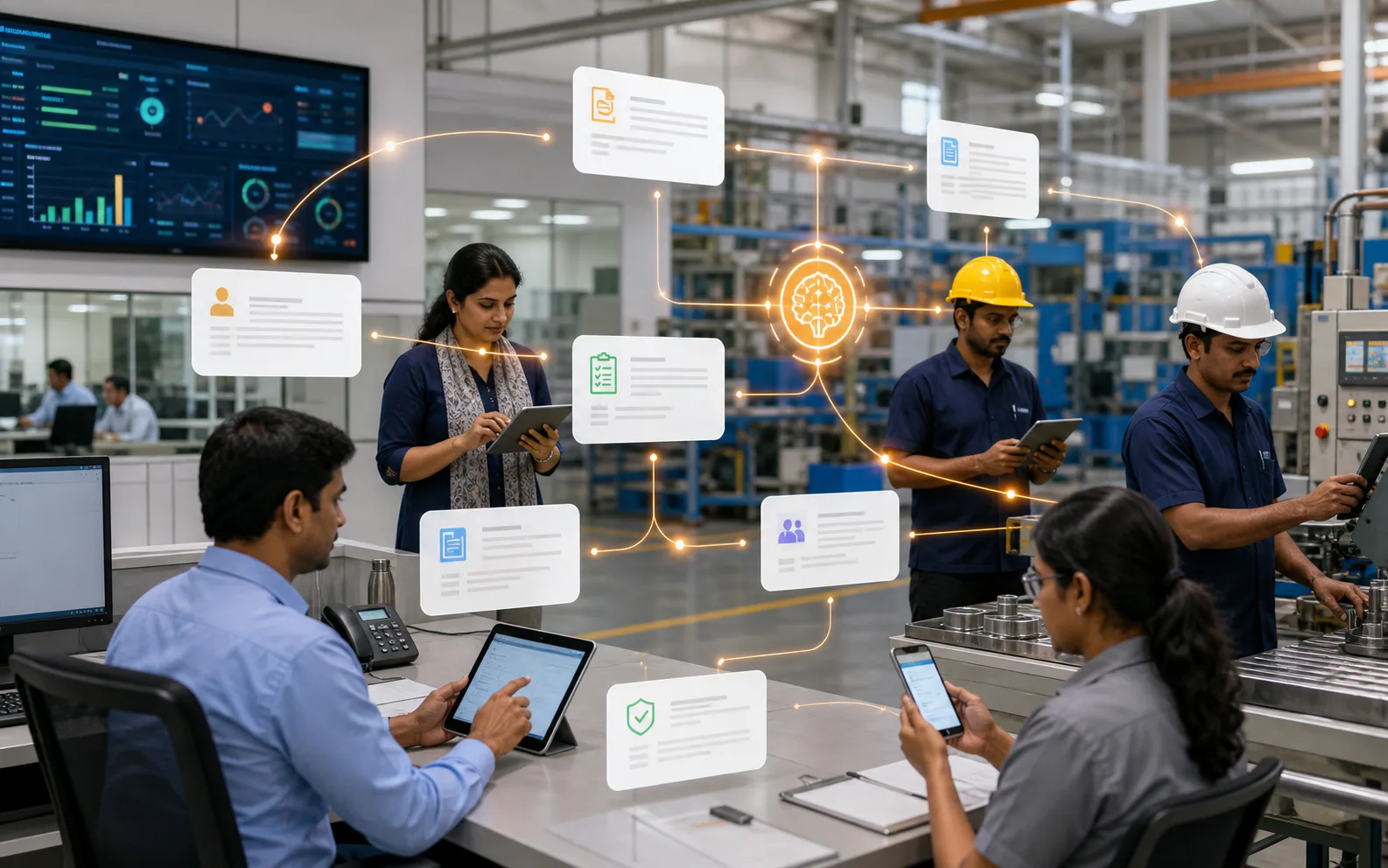
Optiwise, Odoo, Acumatica and Business Central for Manufacturing
Compare manufacturing workflows in Optiwise, Odoo, Acumatica and Dynamics 365 Business Central. See what your factory can run in Optiwise.
11 Jun 2026Read more →