
Basic MRP vs Full Manufacturing ERP: Choose the Right Scope
Basic MRP vs Full Manufacturing ERP. Use a worked manufacturing test, exception checks and direct Optiwise workflow evidence before rollout.
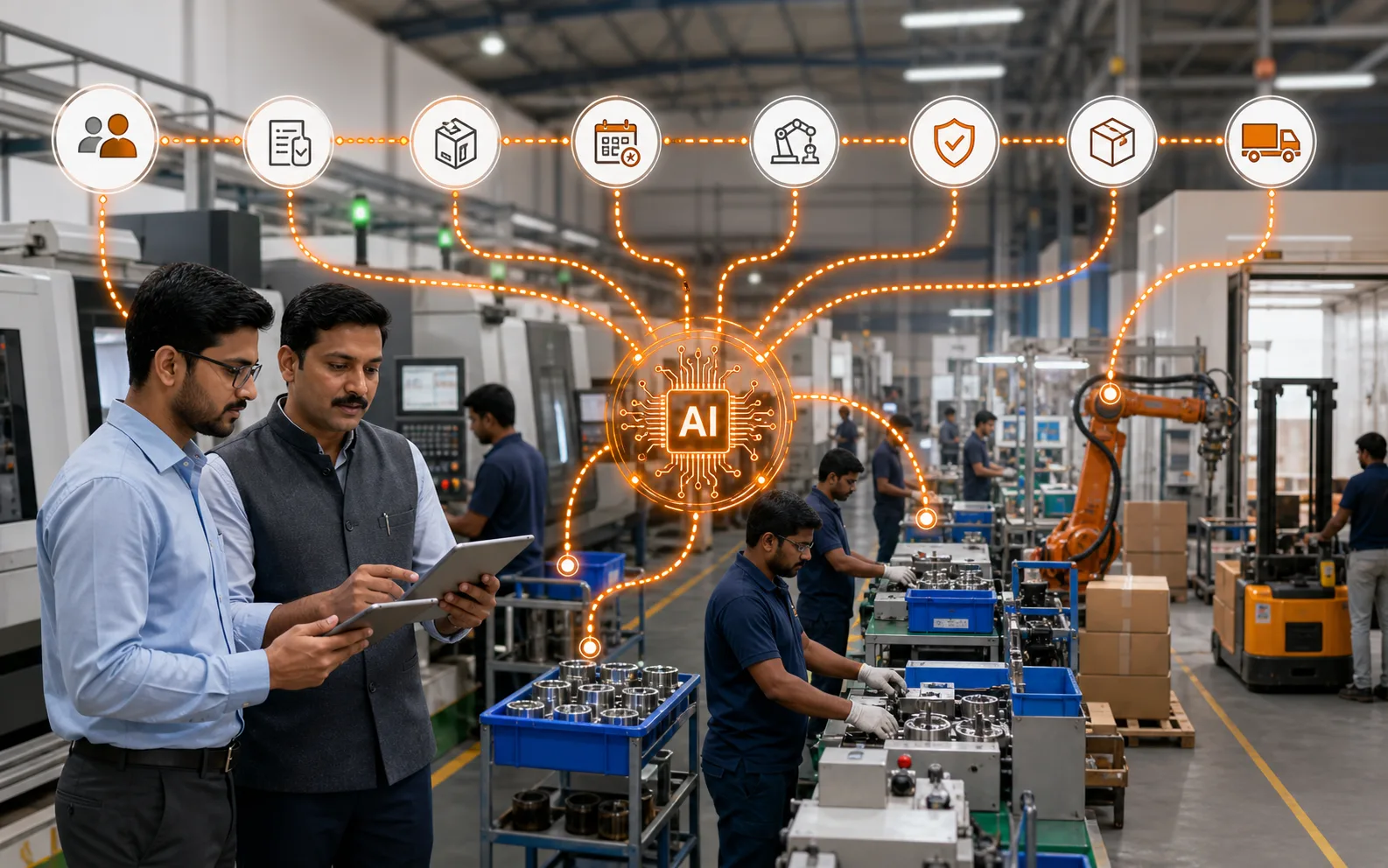
Basic MRP vs Full Manufacturing ERP: Choose the Right Scope should help you decide whether material planning alone is enough. Start with one order, one item and one exception. A screen tour cannot prove that records stay connected when the work changes.
A basic MRP run can identify a shortage of 60 bearings. A full ERP should also show the purchase indent, supplier response, receipt and quality status, issue to the work order, completed output and order impact.
Start with the decision the system must support
Trace one confirmed order from demand through shortage, work order, inspection, dispatch and cost.
Optiwise connects Smart Suggest material actions with production, purchasing, inventory, quality, subcontracting and order timelines. That is the practical dividing line to test when you compare MRP with ERP.
Use ERPNext material-request documentation as an external reference for the relevant data or process model. It does not prove an Optiwise feature or a business result; the product statements above come from our current feature record.
| # | Input to prepare | Evidence to retain |
|---|---|---|
| 1 | Demand source and due date | Owner and last update |
| 2 | BOM quantity and lead time | Definition and source |
| 3 | Available and reserved stock | Acceptance rule |
| 4 | Open purchase and production orders | Exception owner |
Run one controlled workflow before expanding scope
- 1. Demand source and due date. Confirm who maintains it and which record is authoritative.
- 2. BOM quantity and lead time. Use the current value in the chosen test order.
- 3. Available and reserved stock. Record the pass condition before the demo begins.
- 4. Open purchase and production orders. Assign the person who resolves a mismatch.
Keep the first test small enough to reconcile by hand. When the system result differs from the source documents, stop and identify whether the problem is master data, timing, transaction ownership or configuration. Adding more dashboards will not correct an unreliable event.
Test exceptions alongside the normal flow
- Late supplier delivery
- Rejected receipt
- Demand change after release
For each exception, record the expected status, permitted action, approver and audit trail. A useful manufacturing system should make the exception visible without allowing an unapproved shortcut to rewrite history.
Verify the connected Optiwise workflow
Review workflow details, product capability, supporting guide, implementation context, connected process, book a demo. In the demo, ask us to execute the scenario with your roles and sample records. Confirm the source transaction, resulting status, notification or action, correction method and report before accepting the workflow.
Questions to ask before rollout
What should we test first?
Choose one current order with a known complication. Prepare the four inputs above, run the transaction sequence and reconcile the result with the source documents.
How do we know the page describes a real capability?
Ask for the workflow to be shown with your role permissions and sample data. Keep feature validation separate from a promised business outcome; adoption, master data and operating discipline still determine the result.
MRP and ERP are related, but they are not the same thing.
This confusion is common in manufacturing because both systems deal with planning, materials, production, and inventory. A manufacturer looking for software may hear MRP from one vendor, ERP from another, and manufacturing ERP from a third. Everyone sounds similar until the business starts asking practical questions.
Can the system calculate material requirements? Can it create purchase needs? Can it track work orders? Can it connect sales with production? Can it show job cost? Can it manage quality? Can it update inventory after production? Can finance see the impact? Can owners see dashboards?
That is where the difference becomes clear.
MRP is mainly about material and production planning. ERP is about connecting the entire business operation.
For a manufacturer, MRP may be enough at an early stage if the biggest problem is knowing what material to buy and when. But as the business grows, full ERP becomes more valuable because production is not isolated. It depends on sales, purchase, inventory, quality, costing, dispatch, finance, and management decisions.
Quick Answer
Basic MRP helps manufacturers plan materials and production requirements. It typically answers what to make, what material is needed, how much is needed, and when it is needed.
Full ERP includes MRP capabilities but connects them with broader business functions such as sales, purchase, inventory, production, work orders, quality control, costing, finance, CRM, dispatch, reporting, dashboards, IoT, and automation.
In simple terms:
- MRP helps plan materials.
- ERP helps run the manufacturing business.
A manufacturer should choose based on complexity, growth stage, visibility needs, and how connected operations need to be.
What Is MRP?
MRP stands for Material Requirements Planning.
The core purpose of MRP is to help manufacturers plan material based on demand, inventory, BOMs, and production schedules.
A basic MRP system usually helps answer:
- What products need to be made?
- What materials are required?
- How much material is needed?
- What stock is already available?
- What shortages exist?
- When should purchase or production happen?
MRP is useful because material planning is a major manufacturing challenge.
If material is short, production stops. If too much material is purchased, cash gets blocked. If the wrong material is bought, quality and delivery suffer.
MRP helps reduce these problems by planning requirements more systematically.
What Is ERP?
ERP stands for Enterprise Resource Planning.
ERP connects multiple business functions into one system.
For manufacturers, ERP may include:
- Sales and CRM
- Quotations
- Customer orders
- Inventory
- Purchase
- Supplier management
- BOMs
- MRP
- Production planning
- Work orders
- Shop-floor tracking
- Quality control
- Maintenance
- Dispatch
- Finance
- Costing
- Reports and dashboards
- Integrations
- IoT and AI capabilities in modern systems
ERP gives the business a connected operating view.
Instead of planning materials in one system, tracking production in another, accounting in another, and quality in spreadsheets, ERP brings the flow together.
MRP Focuses on Material Planning
MRP is strongest when the key problem is material readiness.
It uses inputs such as:
- Demand
- BOM
- Current stock
- Open purchase orders
- Lead times
- Production plan
Then it calculates requirements.
For example, if you need to produce 1,000 units and each unit needs two components, MRP calculates the component requirement, checks stock, subtracts available quantity, considers purchase orders, and suggests what to buy or produce.
This is valuable, especially for repeat manufacturing.
But MRP may not fully answer questions outside material planning.
It may not show detailed job cost, quality rejection, customer pipeline, machine downtime, financial impact, or approval workflows unless it is part of a broader ERP system.
ERP Connects Planning With Execution
ERP includes planning but goes further into execution.
A full ERP connects the order-to-delivery flow:
- Sales order received
- Inventory checked
- MRP calculates material
- Purchase requirement created
- Purchase order raised
- Material received
- Work order released
- Material issued to production
- Production updated
- Quality inspected
- Finished goods received
- Dispatch completed
- Invoice generated
- Cost and margin reported
This connected flow is the main difference.
MRP may tell you what material is needed. ERP helps manage what happens before and after that requirement.
MRP vs ERP in Inventory Management
MRP helps plan material requirements.
ERP manages broader inventory activity.
ERP inventory may include:
- Raw material
- WIP
- Finished goods
- Stock by location
- Batch and lot tracking
- Material issue
- Stock transfer
- Rejection and quarantine
- Inventory valuation
- Low stock alerts
- Slow-moving stock
- Physical stock reconciliation
If your only problem is planning material, MRP may help. If your problem is full inventory control, ERP is stronger.
MRP vs ERP in Production
MRP can support production planning by showing material needs and planned orders.
ERP supports production execution.
ERP can manage:
- Work orders
- Operation routing
- Machine scheduling
- Production status
- Labour and machine time
- Rework and rejection
- Quality checks
- WIP tracking
- Finished goods receipt
- Production costing
This matters because a production plan is not the same as production control.
MRP can help decide what should happen. ERP helps track what actually happened.
MRP vs ERP in Purchase
MRP suggests what to purchase based on material requirements.
ERP manages the full purchase cycle:
- Purchase requisition
- Vendor selection
- Purchase order
- Approval
- Expected delivery
- Goods receipt
- Supplier invoice
- Vendor performance
- Quality rejection
- Purchase price variance
This gives better visibility into supplier reliability and cost.
MRP vs ERP in Quality
Basic MRP usually does not manage quality deeply.
ERP can connect quality with purchase, production, inventory, and dispatch.
ERP quality features may include:
- Incoming inspection
- In-process inspection
- Final inspection
- Rejection tracking
- Rework
- Quality hold
- Supplier quality
- Customer complaints
- Corrective actions
- Traceability
For manufacturers with compliance, customer audits, or high rejection cost, ERP-level quality control is important.
MRP vs ERP in Costing
MRP may help estimate material needs, but it usually does not provide complete job or product costing.
ERP can connect:
- Material cost
- Labour cost
- Machine cost
- Subcontracting cost
- Rework cost
- Overheads
- Purchase variance
- Scrap
- Actual margin
This is critical for manufacturers who need to know which jobs, customers, and products are profitable.
When Basic MRP May Be Enough
MRP may be enough if:
- Your production process is simple.
- Your biggest issue is material planning.
- You have stable BOMs.
- You do not need deep shop-floor tracking.
- Quality tracking is simple.
- Finance is handled separately without major integration needs.
- You are not ready for full ERP implementation.
MRP can be a useful first step.
But it may become limiting as operations grow.
When Full ERP Is the Better Choice
ERP is usually better when:
- Sales, production, purchase, inventory, and finance need to connect.
- Work orders are difficult to track.
- Inventory is inaccurate.
- Production delays are common.
- Quality records matter.
- Job costing is unclear.
- Owners need dashboards.
- Multiple departments use separate spreadsheets.
- The business is growing.
- Customer delivery commitments are becoming harder to manage.
At this stage, MRP alone may not be enough.
Where AICAN Optiwise Fits
AICAN Optiwise is a manufacturing ERP built to connect the full operating flow, not only material planning.
Optiwise includes manufacturing capabilities across CRM, quotations, production, inventory, purchase, work orders, layered BOM, cost estimation, quality control, shop-floor tracking, IoT, reports, and AI agents.
This means manufacturers can move beyond basic MRP into connected execution:
- Material planning linked with purchase
- BOM linked with cost estimation
- Work orders linked with production tracking
- Inventory linked with QR movement
- Quality linked with production and dispatch
- IoT linked with shop-floor visibility
- AI agents linked with alerts and summaries
- Reports linked with owner decisions
Explore AICAN Optiwise and About AICAN.
Practical Example
A manufacturer uses MRP to calculate raw material requirements. It helps purchase know what to buy. But production still uses paper work orders. Quality rejection is tracked separately. Job cost is calculated late. Sales does not know whether delivery is at risk.
MRP solved one problem: material planning.
ERP solves the wider problem: connected operations.
The right choice depends on what the business needs now and what it is trying to become.
FAQ
What is the main difference between MRP and ERP?
MRP focuses mainly on material requirements and production planning. ERP includes MRP but connects broader business functions such as sales, purchase, inventory, production, quality, finance, costing, and reporting.
Is MRP part of ERP?
Yes, many manufacturing ERP systems include MRP functionality as one part of the broader system.
Can I use MRP without ERP?
Yes, some manufacturers use standalone MRP tools. This may work for material planning, but it may not provide full operational visibility.
When should I move from MRP to ERP?
Move to ERP when you need connected visibility across sales, purchase, inventory, production, quality, costing, finance, and management reporting.
Is ERP more expensive than MRP?
Usually ERP has broader scope and may cost more, but it also solves more business problems. Compare value, not only software price.
How does AICAN Optiwise help beyond MRP?
AICAN Optiwise connects MRP-like planning with production, inventory, purchase, work orders, quality, costing, shop-floor tracking, IoT, AI agents, and reports.
Founder’s Note
MRP is useful because material planning matters. But manufacturers do not run on material planning alone.
A factory runs on commitments, people, machines, stock, purchase, quality, cost, delivery, and decisions.
At AICAN, we think manufacturers need systems that connect the whole operating picture. Planning is important. Execution is where the truth appears.
Final Thought
MRP helps you plan what material you need. ERP helps you run the manufacturing business around that plan.
If your challenge is only material calculation, MRP may help. If your challenge is visibility, control, costing, quality, and growth, full ERP is the stronger path.

Related Posts
A Manufacturing Alternative to SAP: Optiwise
Run your factory in Optiwise, a manufacturing alternative to SAP Business One with connected operations, AI agents and no-code workflows.
14 Jun 2026Read more →How Do I Know If My Manufacturing Business Really Needs an ERP?
A practical guide for manufacturers to identify when spreadsheets, manual follow-ups, and disconnected systems are no longer enough — and when ERP becomes an operational necessity.
14 Jun 2026Read more →Production Management System Optimized | Optiwise
Learn best practices for optimizing a production management system across planning, scheduling, material readiness, quality, and reporting.
12 Jun 2026Read more →
What Is the Best ERP for Pharmaceutical Manufacturing?
Learn how to choose the best ERP for pharmaceutical manufacturing, with guidance on batch control, quality workflows, traceability, inventory, documentation, and GMP discipline.
10 Jun 2026Read more →