
What's the Easiest ERP to Learn for My Shop Floor Team?
A practical guide for manufacturers choosing an ERP their shop floor team can actually adopt, with clear signs of usability, training needs, and factory-fit workflows.
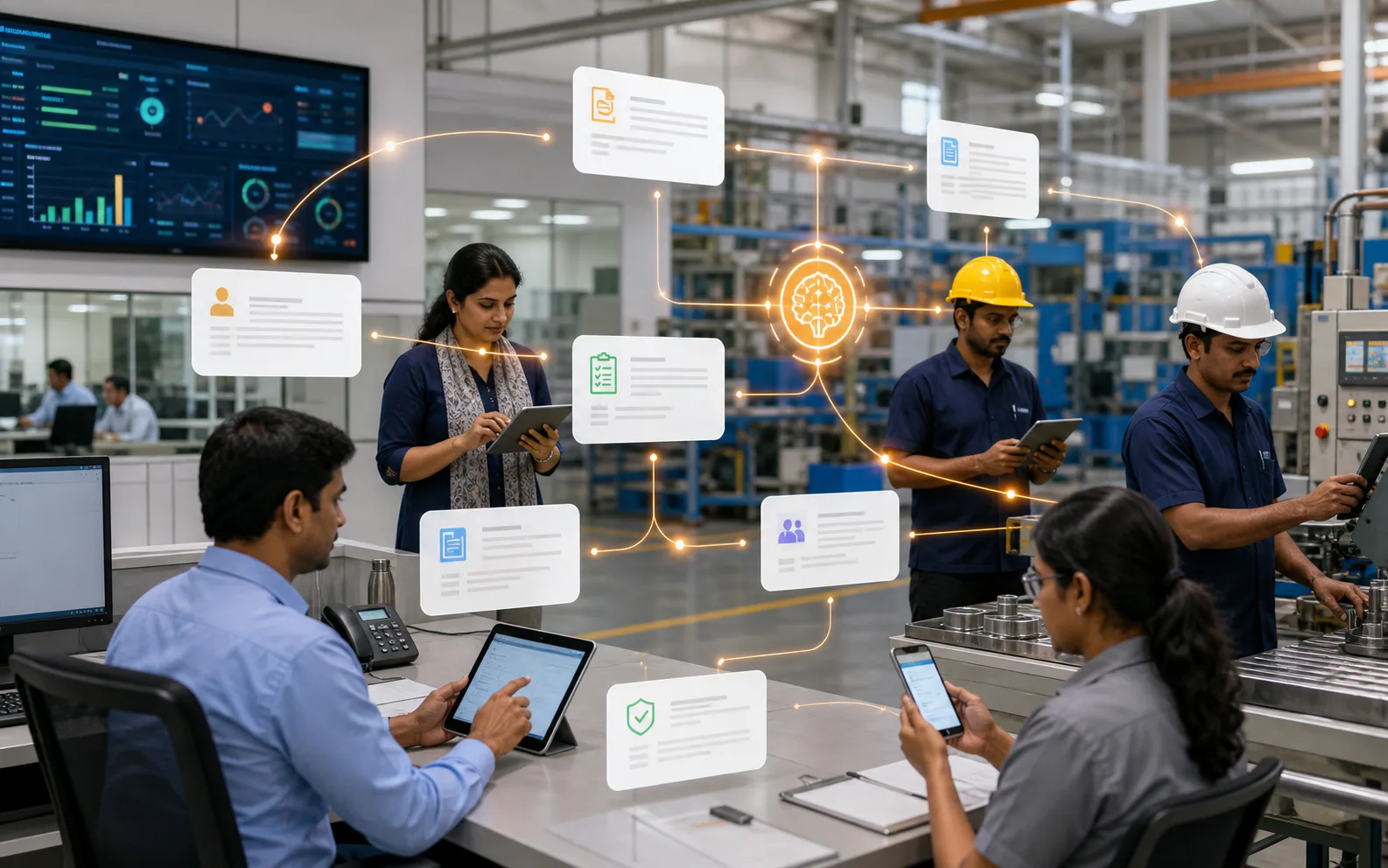
What's the Easiest ERP to Learn for My Shop Floor Team?
Introduction
One of the most practical ERP questions a factory owner can ask is not about features.
It is this:
Will my shop floor team actually use it?
That question matters because ERP value depends on daily adoption. If operators, storekeepers, supervisors, purchase users, and production planners avoid the system, the ERP becomes another reporting layer instead of the operating system of the factory.
The easiest ERP is not always the one with the fewest buttons.
It is the one that matches how factory work actually happens.
A shop floor user should not need to understand software architecture. They need to know what job is assigned, what material is required, what quantity was produced, what was rejected, what issue needs attention, and what must be updated before the next shift.
If the system supports that flow clearly, adoption becomes easier.
What Makes ERP Easy for Shop Floor Teams
A shop floor-friendly ERP has a few practical qualities.
First, the screens are role-based. A production operator should not see finance menus. A storekeeper should not search through sales dashboards. A supervisor should see pending work, job status, material availability, and exceptions.
Second, transactions are simple. Stock issue, production update, QC check, machine downtime, job completion, and rejection entry should be fast enough to do during real work.
Third, the system should support mobile or tablet access where needed. Many factory users are not sitting at desks. They are moving between machines, stores, QC areas, and dispatch zones.
Fourth, the ERP should reduce follow-ups, not increase them. If users feel the software only adds data entry, adoption will be weak. If they see fewer calls, fewer repeated questions, and clearer work priorities, they are more likely to use it.
Why Manufacturing-Specific ERP Matters
Generic ERP can be difficult for shop floor teams because it often speaks the language of administration, not production.
Manufacturing teams think in job cards, work orders, BOMs, material issue, WIP, QC status, machine loading, rejection, rework, and dispatch commitment.
An ERP built for manufacturing starts closer to this reality.
AICAN Optiwise is designed around these operational workflows: production planning, work orders, layered BOM, inventory visibility, purchase planning, QC, shopfloor IoT, mobile workflows, and AI agents. That matters because the system can guide the user through the work instead of forcing the user to translate factory operations into generic software fields.
For example, Rohit, the AI Production Strategist, can help production teams understand delays, work order priorities, and shift efficiency. Rishabh, the AI Inventory Guardian, supports stock visibility and reorder suggestions. Virat, the AI Task Commander, helps keep follow-ups from disappearing between shifts.
The easier ERP is the one that reduces mental load.
A Real Manufacturing Scenario
A small fabrication unit introduced ERP after years of using whiteboards and Excel sheets. The first rollout failed because the shop floor team was asked to enter too many details on desktop screens placed away from the production area.
Supervisors updated the system at the end of the day from memory. Operators still relied on printed job sheets. Stores continued issuing material informally when production was urgent.
The system existed, but operations did not run through it.
The second rollout changed the approach. The business limited the first phase to job status, material issue, production quantity, and rejection entry. Supervisors used role-based screens. Store transactions were simplified. Daily reports showed pending jobs and material shortages clearly.
Adoption improved because the ERP became useful during the shift, not after the shift.
That is the core lesson.
Shop floor ERP must fit the rhythm of factory work.
Frequently Asked Questions
What is the easiest ERP for a shop floor team to learn?
The easiest ERP is one with role-based screens, simple production transactions, mobile access, and workflows built around real manufacturing activities like work orders, BOMs, material issue, QC, and dispatch.
How much training does a shop floor team need for ERP?
Most teams need practical transaction-based training, not classroom theory. Train users on real jobs, real stock issues, real production updates, and real exceptions.
Why do shop floor teams resist ERP?
Resistance usually happens when ERP feels like extra data entry, slows down work, or does not return useful information to the user.
Can AI make ERP easier to use?
Yes. AI agents can summarize pending work, flag delays, remind users, and help managers ask natural-language questions instead of searching through reports.
Conclusion
The easiest ERP is not the simplest-looking product.
It is the ERP that makes factory work clearer.
If the system helps users see what to do, update work quickly, reduce follow-ups, and trust the information, adoption becomes possible.
For manufacturers, usability should be evaluated on the shop floor, not only in a conference room demo.
A Final Thought
Shop floor teams do not reject technology because they dislike improvement.
They reject tools that do not respect how work actually happens.
If ERP helps them avoid confusion, reduce repeated calls, and finish the shift with clearer priorities, they will use it.
If it only gives them more screens to fill, they will work around it.
The right ERP should feel like operational support, not administrative pressure.
Manufacturers evaluating shop floor ERP can explore AICAN Optiwise at aican.co.in.
— Vedant Awasthi

Related Posts

Will AI Create More Jobs Than It Destroys?
Explore whether AI will create more jobs than it destroys, with a practical view of manufacturing, automation, new roles, reskilling, and business transformation.
13 Jun 2026Read more →Manufacturing AI vs. Hiring More Workers
Compare manufacturing AI with hiring more workers and learn when automation, better systems, training, or additional people are the right answer.
7 Jun 2026Read more →
Will AI Replace My Production Planning Job?
Understand how AI affects production planning jobs, what tasks may change, and how planners can become more valuable with AI-supported scheduling and visibility.
6 Jun 2026Read more →Do I Need Special Skills to Use AI in Manufacturing?
Learn what skills manufacturing teams need to use AI, including process knowledge, data discipline, prompt clarity, review judgment, ERP understanding, and change readiness.
6 Jun 2026Read more →