
Which ERP Integrates with CNC and VMC Machines?
Learn how ERP can integrate with CNC and VMC machines, what data can be captured, what factories should prepare, and how machine connectivity improves production visibility.
Which ERP Integrates with CNC and VMC Machines?
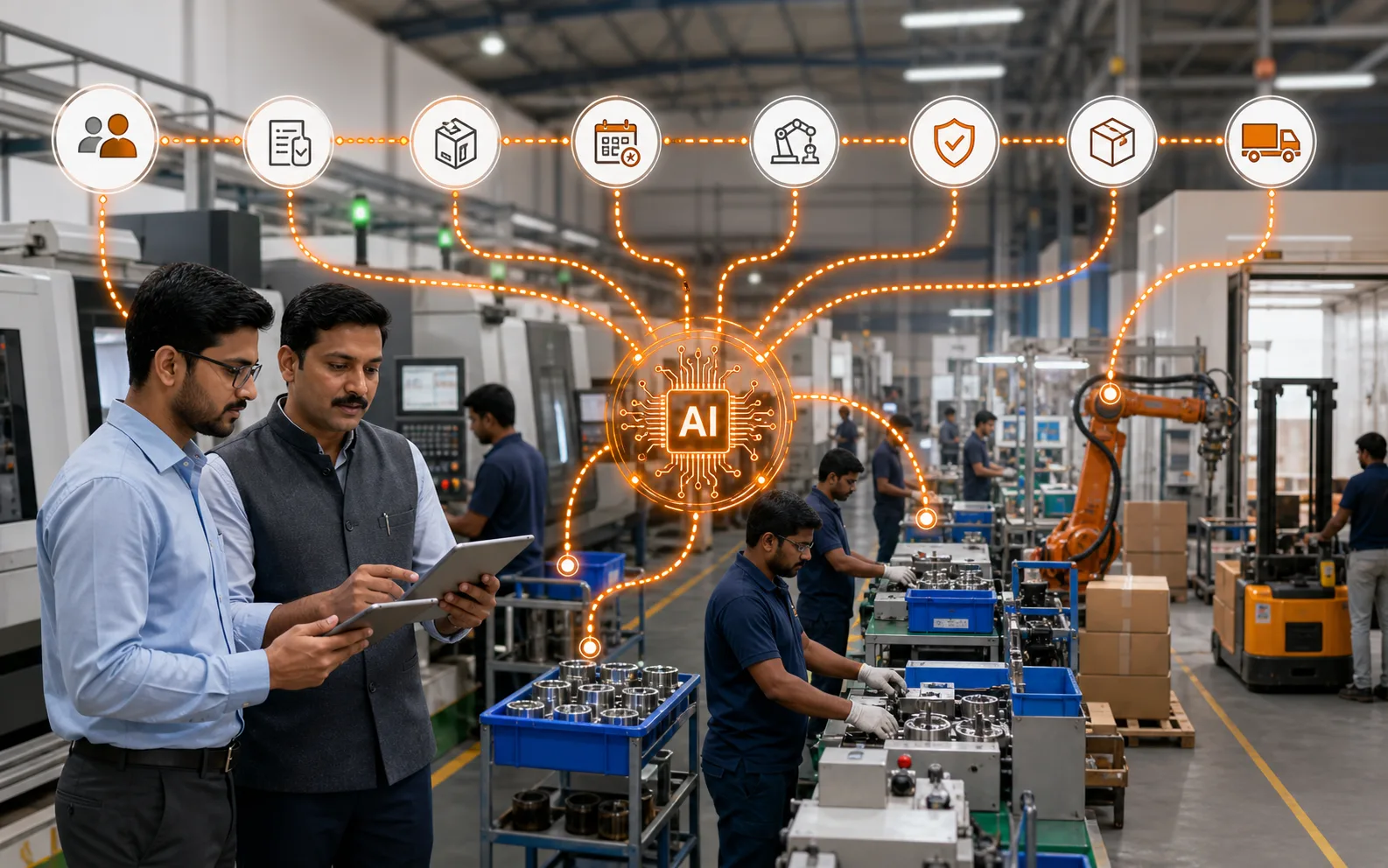
The right ERP for CNC and VMC machine integration is not just an ERP that has a checkbox called “machine integration.” It is an ERP that can connect machine data with production orders, operators, material issue, quality checks, downtime reasons, and management reporting.
That distinction matters.
A CNC or VMC machine can generate useful signals: running, idle, alarm, cycle complete, program status, production count, and sometimes process parameters. But if those signals remain in a machine dashboard without production context, the factory still has to ask the same questions manually. Which job was running? Which part was produced? How many good pieces were accepted? Why was the machine idle? Which dispatch is affected?
Machine integration becomes valuable when machine data joins the factory workflow.
For automobile and auto component manufacturers, AICAN Optiwise is relevant because it is designed around connected manufacturing visibility. The goal is not to collect machine data for decoration. The goal is to help production, planning, quality, and management act from clearer information.
What CNC and VMC Integration Actually Means
CNC and VMC integration usually means connecting machine-level data to a software system. This may happen through direct machine communication, PLCs, controllers, edge devices, sensors, operator terminals, barcode scans, or manual confirmation combined with machine signals.
The exact method depends on the age of the machine, controller type, network availability, data ports, protocols, and factory infrastructure.
Integration can be simple or advanced.
A simple setup may capture:
- Machine running or idle status.
- Job start and stop.
- Production quantity.
- Operator entry.
- Downtime reason.
- Work order reference.
A more advanced setup may capture:
- Cycle time.
- Program number.
- Alarm codes.
- Spindle load.
- Feed rate.
- Tool usage.
- Process parameters.
- Energy data.
- Automatic production counts.
The best approach depends on what the factory wants to improve first. A plant does not need to capture every possible signal on day one. It should begin with the data that supports real decisions.
Why ERP Context Is Important
Machine data by itself answers machine questions. ERP context answers business questions.
For example, a machine monitoring screen may show that a VMC was idle for 90 minutes. That is useful, but incomplete. The production manager needs to know whether the idle time was caused by material shortage, tool setting, operator unavailability, program issue, maintenance problem, inspection hold, or no job released.
ERP context connects the machine event to:
- Production order.
- Part number.
- Customer order.
- BOM and routing.
- Operator.
- Shift.
- Material issue.
- Quality inspection.
- Rework or rejection.
- Dispatch commitment.
This is why ERP integration matters. The same downtime event becomes more useful when it is tied to the actual job and business impact.
What Data Should Flow from CNC/VMC to ERP?
Not every factory needs the same integration depth. A practical starting point is to capture enough data to improve planning, utilization, and accountability.
Useful CNC/VMC data includes:
- Machine status: running, idle, stopped, alarm, maintenance.
- Job status: planned, started, paused, completed.
- Production count: pieces produced during a shift or work order.
- Cycle time: actual time compared with expected time.
- Downtime: duration and reason.
- Operator: person assigned to the job.
- Program or operation reference: where technically feasible.
- Quality status: accepted, rejected, rework, inspection pending.
- Tool or setup events: where relevant.
This data helps the factory move from estimates to evidence.
What Data Should Flow from ERP to Machines or Operators?
Integration is not only machine-to-ERP. The ERP can also provide context to the shopfloor.
For example, the ERP can show:
- Which production order should run next.
- Which part and operation are scheduled.
- What quantity is required.
- Which drawing revision or process instruction applies.
- Which material has been issued.
- Which quality checks are required.
- What the expected cycle time is.
- Which priority jobs are at risk.
This reduces confusion at the machine level. Operators and supervisors can work from the latest production plan instead of relying on printed lists or verbal instructions.
Integration Methods Factories Should Understand
CNC and VMC integration can happen in several ways.
Some machines support direct data communication through controller interfaces or industrial protocols. Some require an intermediate PLC, gateway, or edge device. Older machines may need external sensors or operator input for basic status tracking. Some factories begin with barcode-based production reporting before moving to deeper machine connectivity.
Common approaches include:
- Direct controller integration where supported.
- PLC or industrial gateway connection.
- IoT edge devices for status and signal capture.
- Sensor-based monitoring for older machines.
- Operator terminals for job start, stop, quantity, and downtime reasons.
- Barcode or QR scanning for work order identification.
- Hybrid setups combining automatic machine signals with manual reason entry.
The best method is the one that produces reliable data without disrupting production.
Common Mistakes in CNC/VMC ERP Integration
Many factories make the mistake of chasing advanced machine data before fixing basic production discipline.
Common mistakes include:
- Capturing machine status without linking it to work orders.
- Recording production count but not quality status.
- Tracking downtime duration but not downtime reason.
- Building dashboards that operators do not use.
- Ignoring older machines because they cannot support deep integration.
- Treating integration as an IT project instead of a production improvement project.
- Starting with too many machines and no clear success metric.
The fix is to begin with a focused pilot. Choose a machine group, define the data needed, connect it to production orders, and review whether decisions improve.
How Machine Integration Improves Production Planning
When machine data is connected to ERP, planners can see whether the production plan is actually progressing.
They can identify:
- Jobs running behind schedule.
- Machines with repeated idle time.
- Operations with longer actual cycle times.
- Orders stuck due to machine downtime.
- Capacity assumptions that are no longer accurate.
- Dispatch risk caused by slow production.
This improves planning because the planner is not relying only on end-of-shift reporting. The system can reveal delays earlier.
How Integration Improves Machine Utilization
Machine utilization is often estimated poorly. A machine may look busy, but actual cutting time may be low because of setup delays, waiting for material, tool issues, quality holds, or operator availability.
Integrated data helps separate:
- Planned production time.
- Actual running time.
- Idle time.
- Setup time.
- Breakdown time.
- No-material time.
- Inspection waiting time.
- No-plan time.
Once these reasons are visible, managers can improve the real cause instead of blaming the machine or operator blindly.
How Integration Supports Quality
CNC and VMC processes often affect dimensional accuracy and part quality. When quality results are connected to machine, job, tool, and shift data, patterns become easier to see.
For example, repeated rejection after a specific operation may point to tooling, fixture wear, program issues, material variation, or operator training. If quality data is separate from production and machine data, those patterns take longer to detect.
A connected ERP can help link inspection results with production orders and machine activity. This creates a stronger base for root cause analysis.
What to Prepare Before ERP-Machine Integration
Before integrating CNC and VMC machines, factories should prepare:
- A list of machines and controller types.
- Network readiness on the shopfloor.
- Production order and routing discipline.
- Work order identification method.
- Downtime reason categories.
- Operator reporting workflow.
- Quality status definitions.
- Baseline utilization and output metrics.
- A pilot scope with clear success criteria.
If the factory does not define downtime reasons, for example, it may capture idle time but still not know why it happened.
Where AICAN Optiwise Fits
AICAN Optiwise helps manufacturers connect machine visibility with wider factory workflows. For CNC and VMC-heavy plants, the practical value is connecting machine status and production progress with planning, material, quality, and dispatch context.
AICAN is focused on making manufacturing data usable for real decisions. You can learn more about the company at About AICAN.
Founder’s Note
Machine integration should not become a vanity dashboard. A factory does not become smarter just because a screen shows green, yellow, and red machine states.
The real value begins when machine signals help people act: adjust the plan, fix a bottleneck, understand downtime, protect dispatch, and improve quality. That is the kind of integration we believe manufacturers should aim for.
FAQs
Can ERP integrate with CNC and VMC machines?
Yes, ERP can integrate with CNC and VMC machines when the right connectivity method is used. The method depends on machine controller capability, network setup, available signals, and the level of data required.
What data can be captured from CNC and VMC machines?
Factories can capture machine status, running time, idle time, cycle count, production quantity, alarm status, downtime, operator input, and sometimes program or process parameters depending on the machine and controller.
Is machine integration useful without ERP?
Machine monitoring alone is useful, but ERP integration adds production context. It connects machine data to work orders, material, quality, planning, and dispatch impact.
Can older CNC machines be integrated?
Often, yes, but the method may be different. Older machines may need sensors, operator terminals, gateways, or hybrid reporting rather than direct controller integration.
How does AICAN Optiwise support CNC/VMC integration?
AICAN Optiwise supports connected manufacturing visibility by helping machine-related production data fit into broader planning, quality, inventory, and reporting workflows.

Related Posts

Kanban System | Optiwise
Learn how a Kanban system works in manufacturing, where it helps, where it fails, and how Optiwise connects Kanban signals with inventory, purchase, and production planning.
12 Jun 2026Read more →Erp In Operations Management | Optiwise
Learn how ERP improves operations management by connecting planning, inventory, purchase, production, quality, dispatch, finance, and reporting.
12 Jun 2026Read more →ERP for FMCG Companies in India
A practical guide to ERP for FMCG companies in India, covering distributor orders, batch tracking, expiry, inventory, production, schemes, costing, and reporting.
11 Jun 2026Read more →
Optiwise, Odoo, Acumatica and Business Central for Manufacturing
Compare manufacturing workflows in Optiwise, Odoo, Acumatica and Dynamics 365 Business Central. See what your factory can run in Optiwise.
11 Jun 2026Read more →