
What Support Do ERP Vendors Provide to Small Businesses?
Learn what ERP vendor support should include for small manufacturers: implementation, training, migration, go-live help, bug fixes, updates, support channels, and change requests.
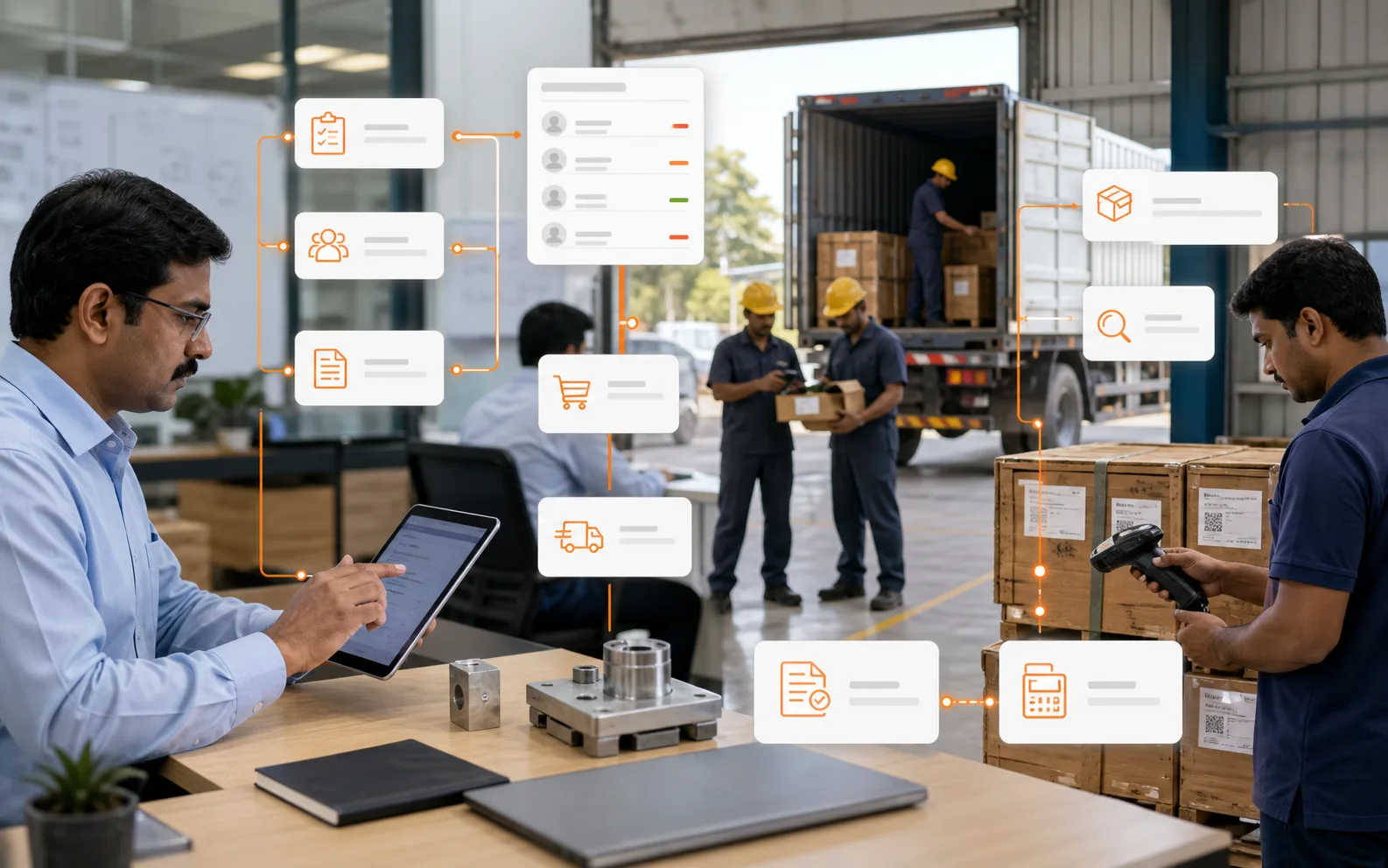
What Support Do ERP Vendors Provide to Small Businesses?
ERP vendor support can make or break implementation. A good ERP with weak support can fail because users do not know how to configure, adopt, or fix the system. A practical ERP with strong support can become part of daily business much faster.
Small manufacturers should evaluate support as seriously as features.
Types of ERP Support
1. Pre-Implementation Consultation
Good vendors first understand your business workflow: enquiry, quotation, sales order, purchase, inventory, production, quality, dispatch, and finance coordination.
This helps avoid generic configuration.
2. Implementation Support
Implementation support includes system setup, master data guidance, user roles, workflow configuration, document formats, reports, and testing.
3. Data Migration Help
Vendors may help migrate customer masters, supplier masters, item masters, opening stock, open orders, and other records. But your team must still clean and validate the data.
4. Training
Training should be role-based. Sales, purchase, stores, production, quality, dispatch, finance, and management need different training.
5. Go-Live Support
The first few weeks after go-live need close support. Users will have doubts and edge cases. The vendor should help resolve them quickly.
6. Ongoing Helpdesk
After go-live, support may happen through tickets, calls, email, chat, or account managers. Ask how issues are prioritized and tracked.
7. Bug Fixes and Updates
Support should include bug resolution and product updates, depending on contract terms.
8. Change Requests
New reports, workflow changes, integrations, or custom features may be treated as change requests. Clarify cost and timelines.
Questions to Ask Before Signing
Ask vendors:
- Who will implement our project?
- How much training is included?
- What is the go-live support period?
- What support channels are available?
- What are response times?
- Are updates included?
- What is charged separately?
- Is manufacturing domain support available?
- Can support happen in our preferred language?
Why Manufacturing Support Must Be Domain-Aware
A generic software support person may understand screens but not manufacturing reality. For example, production delay, material issue, QC rejection, and dispatch mismatch need operational understanding.
Support quality improves when the vendor understands factory workflows.
Where AICAN Optiwise Fits
AICAN Optiwise is built for MSME manufacturing workflows, so support can focus on real operating questions across sales, purchase, inventory, production, quality, dispatch, and finance visibility. The aim is not only solving tickets but helping the team use the system properly.
FAQ
Is ERP support included in pricing?
It depends on the vendor and contract. Always confirm what is included and what is chargeable.
What support is most important during ERP implementation?
Process setup, data migration guidance, role-based training, and go-live support are critical.
How long should go-live support last?
At least the first few weeks need close support. Complex implementations may need longer.
Should vendor support understand manufacturing?
Yes. Manufacturing ERP support is stronger when the vendor understands operational workflows, not only software screens.
Final Thought
ERP support is not an after-sales courtesy. It is part of implementation success.
Choose a vendor who can guide your team through real business usage, not only answer technical questions.

Related Posts

Kanban System | Optiwise
Learn how a Kanban system works in manufacturing, where it helps, where it fails, and how Optiwise connects Kanban signals with inventory, purchase, and production planning.
12 Jun 2026Read more →Erp In Operations Management | Optiwise
Learn how ERP improves operations management by connecting planning, inventory, purchase, production, quality, dispatch, finance, and reporting.
12 Jun 2026Read more →ERP for FMCG Companies in India
A practical guide to ERP for FMCG companies in India, covering distributor orders, batch tracking, expiry, inventory, production, schemes, costing, and reporting.
11 Jun 2026Read more →
Optiwise, Odoo, Acumatica and Business Central for Manufacturing
Compare manufacturing workflows in Optiwise, Odoo, Acumatica and Dynamics 365 Business Central. See what your factory can run in Optiwise.
11 Jun 2026Read more →