
ERP vs Accounting Software: Follow One Manufacturing Order
ERP vs Accounting Software: Follow One Manufacturing Order. Use a worked factory test, explicit inputs and exception checks before rollout.

ERP vs Accounting Software: Follow One Manufacturing Order helps you decide whether accounting software covers the factory records you need. Use one real order, one normal path and one exception in the evaluation.
The invoice is only the commercial end. The factory also needs BOM demand, stock reservations, work execution, rejects and accepted output tied to the order.
Make the operational decision explicit
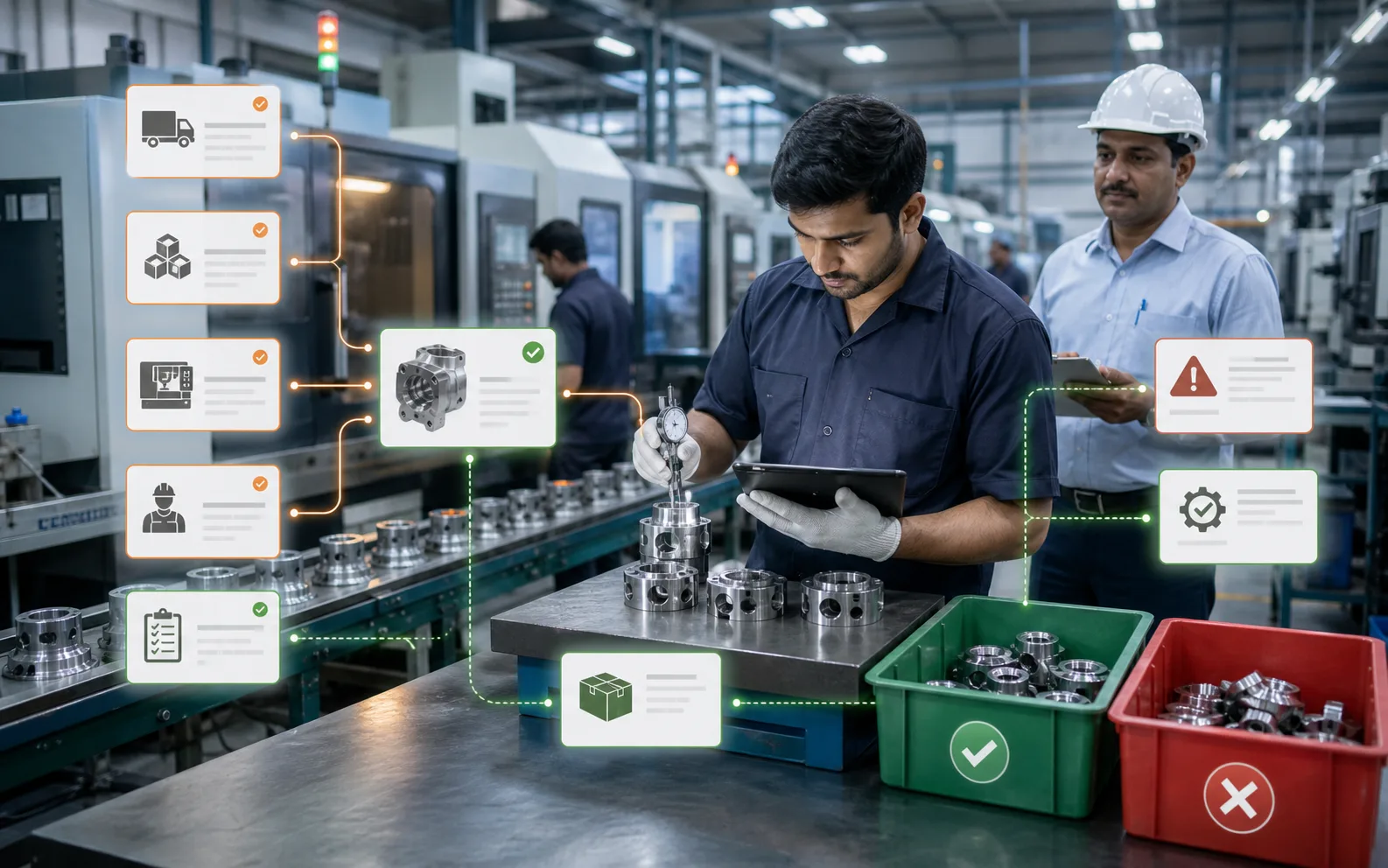
Trace one order through material, production, outside work, quality and finished receipt, then identify which records remain separate.
Optiwise connects sales, purchasing, inventory, production, quality, subcontracting and dispatch records in role-specific workflows.
ERPNext manufacturing documentation is the external process or control reference for this guide: https://docs.frappe.io/erpnext/user/manual/en/manufacturing. It does not prove an Optiwise feature or outcome; our product statements come from the current product record.
| # | Input | Evidence |
|---|---|---|
| 1 | Order and commercial record | Owner and definition |
| 2 | BOM and material status | Authoritative source |
| 3 | Production and quality | Acceptance rule |
| 4 | Finished stock and cost handoff | Exception owner |
Run the workflow with accountable roles
- 1. Order and commercial record. Name the person who owns the record and decision.
- 2. BOM and material status. Use a current value from the representative order.
- 3. Production and quality. Write the pass condition before the demo or rollout.
- 4. Finished stock and cost handoff. Assign correction and escalation responsibility.
Reconcile the test by hand. When the system result differs from the source record, classify the gap as master data, timing, transaction ownership, permissions or configuration before changing the workflow.
Test exceptions before rollout
- Late transaction crosses period
- Subcontract cost arrives later
- Physical quantity is unresolved
For each exception, record the expected status, permitted action, approver, correction path and audit evidence. A fast normal path does not compensate for an uncontrolled exception.
Connect the page to the next buyer task
review the product workflow, check the supporting module, prepare implementation inputs, read the related guide, open the detailed workflow guide, book a connected demo. Ask us to run the scenario with your roles and representative records, including the exception and correction path.
Questions to settle in the demo
What should we prepare?
Prepare one representative order, the four inputs above and a complication your team encounters today. Remove confidential values if needed while keeping the record relationships intact.
What is a passing result?
Accept the workflow when the normal path and exceptions leave a complete, role-appropriate record that another person can reconcile. Keep capability validation separate from any promised business result.
Generated Featured Image: /aican-optiwise-assets/cms-uploads/blog/erp-vs-accounting-software-small-manufacturers.png
Keyword: MSME ERP
Meta Title: ERP vs Accounting Software for Small Manufacturers | AICAN Optiwise
Meta Description: Learn when accounting software is enough, when a manufacturing business needs ERP, and how ERP connects inventory, production, purchases, sales, quality, and finance.
URL Slug: erp-vs-accounting-software-small-manufacturers
Featured Image Brief: A small Indian factory office where an owner compares a simple accounting screen with a connected ERP dashboard showing inventory, production, orders, and finance.
Image Alt Text: ERP versus accounting software comparison for a small manufacturing business.
For many small manufacturers, accounting software is the first serious business system they buy. It helps with invoices, GST, payments, ledgers, receivables, and basic financial discipline. That is useful. In fact, a good accounting system is often the reason a growing factory stops depending completely on handwritten bills and scattered Excel files.
But accounting software answers one main question: what happened financially?
An ERP answers a wider manufacturing question: what is happening across the business, why is it happening, and what should we do next?
That difference becomes important when your factory is no longer just managing bills. You are managing raw material, purchase follow-ups, job work, production stages, stock variance, customer enquiries, dispatch commitments, quality issues, and cash flow at the same time.
The Simple Difference
Accounting software is usually finance-first. It records transactions after they happen. Sales invoice created. Purchase bill entered. Payment received. GST report prepared. Outstanding balance checked.
ERP is operations-first and finance-connected. It captures the work before, during, and after the financial transaction.
For example, an accounting system may show that you purchased fabric worth Rs. 4 lakh. An ERP can show who requested it, which supplier confirmed it, whether the PO was approved, what quantity arrived, how much passed quality check, which production order consumed it, what balance is left, and whether the customer order can still be dispatched on time.
That is why manufacturers usually outgrow accounting-only systems before they realize it.
When Accounting Software Is Enough
You may not need ERP immediately if your business is very small, your production process is simple, and the owner or manager can still personally remember most operational details.
Accounting software may be enough when:
- You make a limited number of products.
- Stock movement is low and easy to verify manually.
- Production is not stage-wise or batch-wise.
- Orders are few enough to track by phone and Excel.
- You do not have frequent material shortages or dispatch delays.
- You only need invoices, GST, payments, and basic reports.
There is no shame in this stage. Buying ERP too early, before the team has real operational complexity, can create unnecessary work.
When ERP Becomes Necessary
ERP becomes important when the factory starts losing money, time, or trust because information is not connected.
Typical signs include:
- Sales confirms delivery without knowing real stock.
- Purchase orders are placed late because inventory is not updated.
- Production stops because one small item is missing.
- The owner keeps asking different people for the same status update.
- Finished goods are ready but dispatch is delayed due to paperwork.
- Quality rejections are discussed but not recorded properly.
- Excel sheets exist, but nobody fully trusts them.
- Accounts knows the bill value, but operations knows the real problem.
This is the point where accounting software may still be working, but the business system is not.
A Real Factory Example
Imagine a garment manufacturer handling 80 to 100 style orders every month. Accounting software can generate invoices and purchase entries. But it will not naturally track fabric booking, trims availability, cutting status, stitching line progress, finishing, QC, packing, dispatch, and customer-wise delivery promises.
So the team builds Excel trackers. One for orders. One for fabric. One for production. One for dispatch. Accounts has another system. WhatsApp has the latest discussion. The owner asks for a report, and three people spend two hours compiling it.
The issue is not that people are careless. The issue is that the business has outgrown disconnected tools.
ERP brings these flows into one system so the team can see the same truth.
Why Manufacturers Need More Than Finance Reports
A finance report tells you profit and loss after the work is done. But manufacturers need control before the loss happens.
You need to know:
- Which orders are at risk today?
- Which raw materials are below reorder level?
- Which supplier is delaying critical purchases?
- Which production stage is creating bottlenecks?
- Which customer orders are consuming too much working capital?
- Which product lines have high rejection or rework?
These answers need operational data, not just accounting entries.
ERP and Accounting Should Work Together
A good ERP should not replace accounting discipline. It should strengthen it.
The ideal setup is that operational events create clean financial consequences. Purchase receipt connects to supplier billing. Sales dispatch connects to invoicing. Inventory consumption connects to costing. Customer orders connect to collections. This reduces duplicate entry and gives finance a stronger source of truth.
For Indian MSMEs, this matters because GST, e-way bills, inventory valuation, and cash-flow planning all become easier when operations and finance are not separated.
How Optiwise Supports the Workflow
AICAN Optiwise is built for MSME manufacturers that need more than basic accounting but do not want a heavy, complicated ERP implementation. It connects sales, purchase, inventory, production, quality, dispatch, finance workflows, and AI-assisted follow-ups in one system.
For example, a business owner can ask what orders are delayed, which material is short, or which enquiry needs attention, instead of waiting for manual reports. That is useful when the business is growing but the management team is still lean.
FAQ
Is ERP better than accounting software?
ERP is not simply better. It solves a different problem. Accounting software manages financial records. ERP manages the operating flow of the manufacturing business and connects it with finance.
Can I use both ERP and accounting software?
Yes. Many businesses use ERP for operations and integrate or align it with accounting. The goal is to reduce duplicate work and keep financial data accurate.
At what size should a manufacturer consider ERP?
There is no fixed employee count. Consider ERP when order tracking, inventory control, production planning, quality records, and dispatch commitments become difficult to manage manually.
Is ERP only for large companies?
No. Modern cloud ERP systems can be suitable for MSMEs if they are practical, modular, and implemented around real workflows.
Final Thought
If your only problem is invoicing and GST, accounting software may be enough. But if your real problem is missed commitments, material confusion, production delays, and decisions based on half-information, you are already dealing with ERP-level problems.
The decision is not about software size. It is about whether your business needs one connected operating system instead of many disconnected records.

Related Posts
Types Of GST Returns For Manufacturers | Optiwise
A practical guide to GST returns for manufacturers, including GSTR-1, GSTR-3B, GSTR-9, GSTR-9C, composition returns, TDS/TCS returns, and reconciliation discipline.
17 May 2026Read more →
Gst Invoice | Optiwise
Understand GST invoices, required details, common mistakes, e-invoice readiness, and how ERP helps manufacturers create accurate billing and tax records.
14 May 2026Read more →Gstr 10 | Optiwise
Learn what GSTR-10 final return is, who needs to file it, when it is filed, what records matter, and how ERP helps businesses close GST records cleanly.
20 Apr 2026Read more →
How to Transition Your Manual Accounting to ERP-Based Accounting
Learn how MSME manufacturers can move from manual or standalone accounting to ERP-based accounting with clean masters, opening balances, inventory links, approvals, and finance controls.
13 Apr 2026Read more →