
Finished Goods | Optiwise
Understand finished goods, how they differ from raw materials and WIP, examples, accounting relevance, and how ERP improves finished goods control.

Finished Goods: The Point Where Production Becomes Customer Commitment
Finished goods are products that have completed production and are ready to be sold, dispatched, or delivered. They are the output of manufacturing work, but they are not the end of the business cycle. They still need quality clearance, storage, dispatch planning, invoicing, and customer delivery.
For manufacturers, finished goods are important because they connect production effort with revenue. If finished goods are poorly tracked, the business may produce correctly and still fail at delivery.
AICAN Optiwise helps manufacturers connect finished goods with production, inventory, sales orders, dispatch, and finance.
What Are Finished Goods?
Finished goods are completed products that are ready for sale or use by the customer.
Examples:
- A packed machine ready for dispatch
- A finished auto component ready for customer shipment
- A tested electrical panel ready for delivery
- A sealed chemical product ready for sale
- A fabricated item completed and approved by quality
Finished goods are different from raw materials and work in progress.
Finished Goods vs Raw Materials
Raw materials are inputs used to make products. Finished goods are completed outputs.
Example:
Steel sheet is raw material.
A fabricated enclosure made from that steel is a finished good.
Raw materials still need processing. Finished goods have already passed through the production process.
Finished Goods vs Work in Progress
Work in progress means production is underway but not complete.
Example:
A partially assembled control panel is WIP.
A tested, labelled, packed control panel is finished goods.
This distinction matters because WIP may not be ready for sale, while finished goods usually are.
Why Finished Goods Matter
Finished goods matter for several reasons:
- They represent value created by production.
- They affect customer delivery.
- They occupy warehouse space.
- They influence working capital.
- They appear in financial reporting.
- They indicate whether production matches demand.
- They help sales teams commit dispatch dates.
Too much finished goods may mean production is ahead of demand or dispatch is blocked. Too little may mean the business cannot fulfil orders quickly.
Finished Goods in Manufacturing Flow
A typical manufacturing flow looks like this:
- Raw material is purchased.
- Material is issued to production.
- Production creates WIP.
- WIP is completed.
- Quality inspection is done.
- Finished goods are received into stock.
- Finished goods are reserved or dispatched.
- Invoice and delivery records are created.
A connected ERP system helps each step update the next.
Quality Status of Finished Goods
Finished goods should not be treated as ready for customer delivery unless quality and documentation are complete.
Possible statuses include:
- Produced
- Under inspection
- Approved
- Packed
- On hold
- Rejected
- Rework required
- Ready for dispatch
These statuses help avoid accidental shipment of goods that are not truly ready.
Finished Goods and Sales Orders
Finished goods should connect with customer orders. If finished stock is available, sales and dispatch should know whether it is free stock or already reserved for another customer.
ERP can help show:
- Available finished goods
- Reserved finished goods
- Order-wise stock
- Pending dispatch
- Partial dispatch
- Customer-wise availability
This improves customer communication.
Finished Goods and Accounting
Finished goods also matter for accounting because they represent inventory value. Their valuation depends on costing method, production cost, and applicable accounting policy.
Businesses should work with qualified accounting professionals to ensure finished goods valuation is handled correctly.
Operationally, accurate production completion and stock records make accounting easier.
Finished Goods Reports
Useful reports include:
- Finished goods stock summary
- Finished goods ageing
- Finished goods valuation
- Pending dispatch
- Order-wise finished goods
- Batch-wise finished goods
- Slow-moving finished goods
- Stock reserved for orders
These reports help management see whether completed production is becoming revenue.
How Optiwise Helps
Optiwise by AICAN helps manufacturers track finished goods as part of the complete operating flow. Production completion, quality status, warehouse stock, sales order reservation, dispatch, and finance visibility can be connected.
That connection helps teams avoid a common problem: goods are ready somewhere, but no one has a clear operational view.
Founder’s Note
At AICAN, we believe finished goods should never be invisible. Once a business has spent money, material, time, and labour to make a product, it deserves a clear path to dispatch and revenue.
AICAN built Optiwise to make that path visible, so finished goods do not get trapped between production, stores, sales, and accounts.
FAQs
What are finished goods?
Finished goods are completed products ready for sale, dispatch, or customer delivery.
How are finished goods different from raw materials?
Raw materials are inputs used in production. Finished goods are completed outputs.
How are finished goods different from WIP?
WIP is still under production. Finished goods have completed production and are ready for the next commercial step.
Why should finished goods be tracked carefully?
They affect delivery, revenue, inventory value, warehouse space, and customer commitments.
How does Optiwise help track finished goods?
Optiwise by AICAN connects production, quality, finished stock, sales orders, dispatch, and finance visibility.

Related Posts

Kanban System | Optiwise
Learn how a Kanban system works in manufacturing, where it helps, where it fails, and how Optiwise connects Kanban signals with inventory, purchase, and production planning.
12 Jun 2026Read more →Erp In Operations Management | Optiwise
Learn how ERP improves operations management by connecting planning, inventory, purchase, production, quality, dispatch, finance, and reporting.
12 Jun 2026Read more →ERP for FMCG Companies in India
A practical guide to ERP for FMCG companies in India, covering distributor orders, batch tracking, expiry, inventory, production, schemes, costing, and reporting.
11 Jun 2026Read more →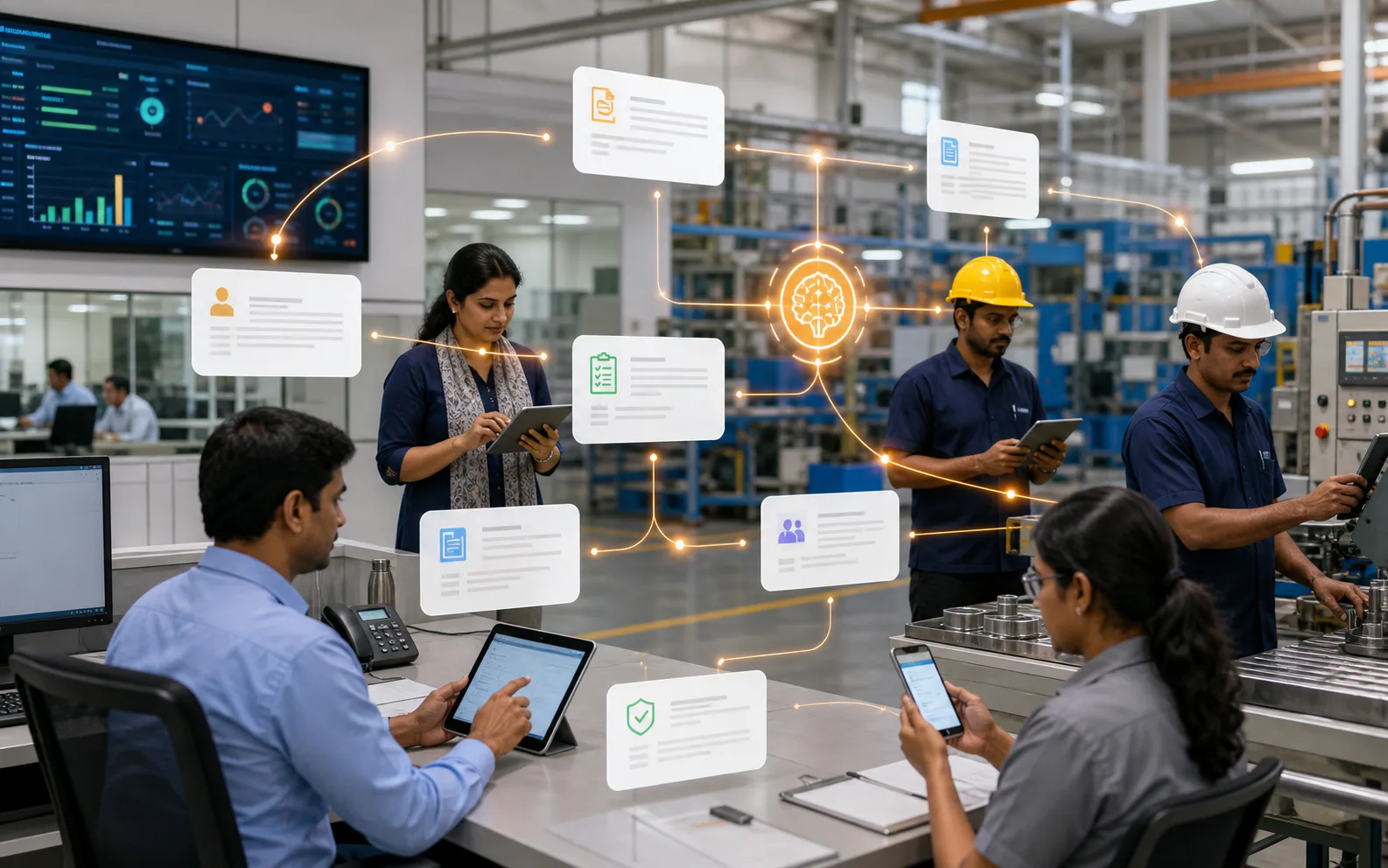
Optiwise, Odoo, Acumatica and Business Central for Manufacturing
Compare manufacturing workflows in Optiwise, Odoo, Acumatica and Dynamics 365 Business Central. See what your factory can run in Optiwise.
11 Jun 2026Read more →