
How Do Auto Manufacturers Track Production in Real Time?
Learn how auto manufacturers track production in real time using ERP, shopfloor reporting, machine data, barcode scans, quality status, WIP visibility, and dashboards.
How Do Auto Manufacturers Track Production in Real Time?
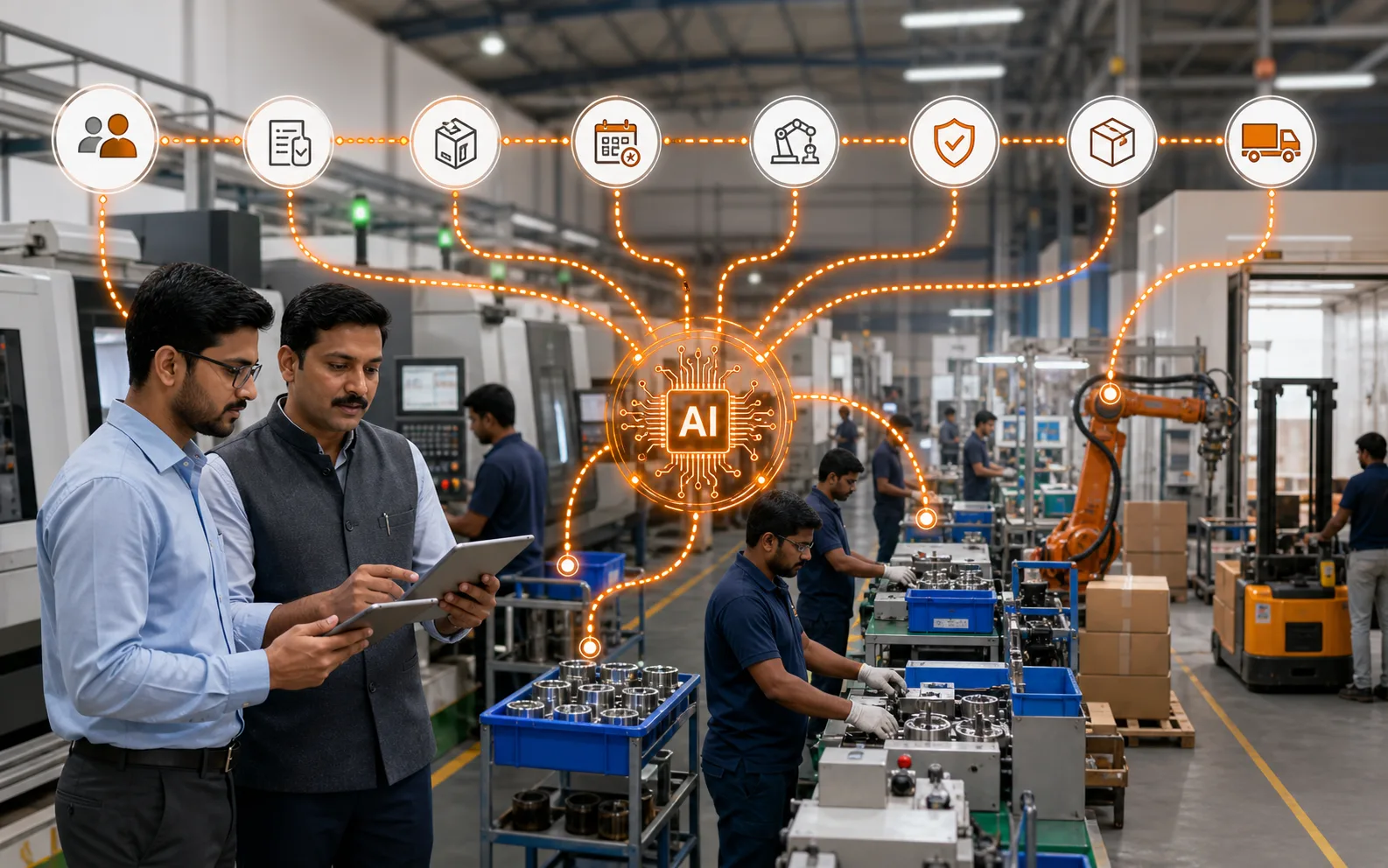
Auto manufacturers track production in real time by connecting production orders, shopfloor reporting, machine status, material movement, quality checks, WIP, and dispatch readiness into one system. The goal is not only to know how many parts were made. The goal is to know what is happening right now and what needs attention.
In many factories, production tracking is still delayed. Operators write quantities on paper. Supervisors update Excel at the end of the shift. Quality reports arrive later. Stores updates material movement separately. By the time management sees the report, the problem may already have affected dispatch.
Real-time production tracking reduces this delay between shopfloor reality and management visibility.
AICAN Optiwise supports this by connecting manufacturing workflows so production, inventory, quality, purchase, and dispatch are not treated as separate islands.
What Real-Time Tracking Actually Means
Real-time does not always mean every signal updates every second. In manufacturing, it means the system is current enough for teams to act before problems become expensive.
For some factories, this may mean live machine data. For others, it may mean operator updates at each operation, barcode scans at movement points, or immediate quality status updates.
A practical real-time tracking system should show:
- Which production orders are running.
- Which operations are complete.
- Which jobs are delayed.
- How much quantity is produced.
- How much is rejected or under rework.
- Which machines are idle or down.
- Which material is short.
- Which WIP is waiting between stages.
- Which finished goods are ready for dispatch.
The key is actionability. If the data does not help someone act, it is only display.
Production Orders Create the Tracking Base
Real-time tracking starts with production orders. A production order defines what part must be produced, how much quantity is required, which BOM and routing apply, and which process steps are involved.
Without production orders, tracking becomes loose. Teams may know that a machine is running, but not which customer order or dispatch the output belongs to.
A production order connects shopfloor activity to business demand.
It should include:
- Part number.
- Required quantity.
- Customer or internal demand reference.
- BOM.
- Routing.
- Planned start and end date.
- Material issue status.
- Quality requirements.
Once this base is clear, the factory can track progress at each stage.
Shopfloor Reporting Captures Progress
Shopfloor reporting is the process of updating the system as work happens. This can be done through operator terminals, supervisor screens, barcode scans, tablets, mobile devices, or machine integration.
Operators or supervisors may report:
- Job start.
- Job pause.
- Job completion.
- Quantity produced.
- Quantity rejected.
- Downtime reason.
- Rework quantity.
- Material consumption.
- Operation completion.
The best reporting workflow is simple enough for daily use. If the screen is too complex or the transaction takes too long, users will delay entries. Delayed entries destroy real-time visibility.
Machine Data Adds Another Layer
For automated or semi-automated lines, CNC machines, VMC machines, presses, moulding machines, and assembly equipment, machine signals can improve tracking.
Machine data may include:
- Running status.
- Idle status.
- Alarm status.
- Cycle count.
- Cycle time.
- Downtime duration.
- Program or operation reference where available.
- Energy or process parameters in advanced setups.
Machine data becomes more powerful when connected to ERP context. A machine status dashboard is useful, but it becomes much more useful when it is tied to production order, part, shift, operator, quality result, and dispatch risk.
Barcode and QR Scanning Improve Movement Accuracy
Barcode or QR scanning can help track material and WIP movement. It reduces manual typing and creates a faster way to connect physical movement with system updates.
Scanning can be used for:
- Material receipt.
- Bin movement.
- Production issue.
- WIP transfer.
- Operation completion.
- Packing.
- Dispatch.
- Quality hold and release.
For auto component factories with many parts and operations, scanning can reduce mistakes and improve traceability.
WIP Visibility Is Critical
Work-in-progress is where production status often becomes unclear. A job may be between operations, waiting for inspection, waiting for material, waiting for rework, or stuck at a bottleneck.
Real-time tracking should show WIP by:
- Production order.
- Part number.
- Operation.
- Quantity.
- Status.
- Location.
- Aging.
- Quality hold.
This helps supervisors see where flow is slowing down.
Without WIP visibility, a factory may discover delays only when dispatch asks why finished goods are not ready.
Quality Status Must Be Connected
Production quantity alone is not enough. A factory must know how much output is good, rejected, under inspection, under rework, or on hold.
Real-time tracking should include quality status at important checkpoints:
- Incoming inspection.
- In-process inspection.
- Final inspection.
- Customer-specific inspection.
- Rework release.
- Dispatch clearance.
If quality updates are delayed, production reports may show output that is not actually available for dispatch. This creates false confidence.
Dashboards Should Show Risk, Not Just Counts
A good production dashboard should not only show how many parts were produced. It should show where attention is needed.
Useful dashboard views include:
- Plan vs actual production.
- Work orders running behind.
- Machine downtime by reason.
- WIP stuck between operations.
- Rejection trends.
- Material shortage impact.
- Dispatch risk.
- Operator or shift-wise output.
- Bottleneck operations.
The best dashboards help teams decide what to do next.
Common Mistakes in Real-Time Tracking
Factories often struggle because they focus on dashboards before fixing data flow.
Common mistakes include:
- Tracking machine status without work order context.
- Reporting quantity but not rejection.
- Updating production at shift end and calling it real-time.
- Creating too many mandatory fields for operators.
- Ignoring WIP movement.
- Keeping quality status outside the production system.
- Building reports that management likes but supervisors do not use.
The fix is to design tracking around daily decisions. What does the operator need? What does the supervisor need? What does planning need? What does dispatch need?
How AICAN Optiwise Supports Real-Time Tracking
AICAN Optiwise helps auto manufacturers connect production tracking with the wider operating flow. Production progress becomes more useful when it is tied to inventory, purchase, quality, WIP, and dispatch.
AICAN focuses on practical visibility for manufacturers. You can learn more about the company at About AICAN.
Founder’s Note
Real-time tracking is not about watching a screen all day. It is about shortening the distance between a problem and the person who can fix it.
If a line is behind, if material is short, if quality is holding stock, or if dispatch is at risk, the factory should know early enough to act. That is the real purpose of visibility.
FAQs
How do auto manufacturers track production in real time?
They use production orders, shopfloor reporting, barcode scans, machine data, WIP updates, quality status, and ERP dashboards to track progress as work happens.
Is machine integration required for real-time tracking?
Not always. Machine integration helps, but factories can also begin with barcode scanning, operator terminals, and supervisor reporting if the workflow is disciplined.
What should a real-time production dashboard show?
It should show plan vs actual, running jobs, delays, WIP status, downtime, rejection, material shortages, and dispatch risk.
Why is quality status important in production tracking?
Because produced quantity is not always usable quantity. Quality status shows what is accepted, rejected, under inspection, or under rework.
How does AICAN Optiwise help?
AICAN Optiwise connects production tracking with inventory, quality, planning, and dispatch so teams can act from clearer operating data.

Related Posts
A Manufacturing Alternative to SAP: Optiwise
Run your factory in Optiwise, a manufacturing alternative to SAP Business One with connected operations, AI agents and no-code workflows.
14 Jun 2026Read more →How Do I Know If My Manufacturing Business Really Needs an ERP?
A practical guide for manufacturers to identify when spreadsheets, manual follow-ups, and disconnected systems are no longer enough — and when ERP becomes an operational necessity.
14 Jun 2026Read more →Production Management System Optimized | Optiwise
Learn best practices for optimizing a production management system across planning, scheduling, material readiness, quality, and reporting.
12 Jun 2026Read more →
What Is the Best ERP for Pharmaceutical Manufacturing?
Learn how to choose the best ERP for pharmaceutical manufacturing, with guidance on batch control, quality workflows, traceability, inventory, documentation, and GMP discipline.
10 Jun 2026Read more →