
Multi-Location Manufacturing ERP: Ownership, Transfer and Reconciliation
Multi-Location Manufacturing ERP. Use a worked manufacturing test, explicit inputs and exception checks before rollout.
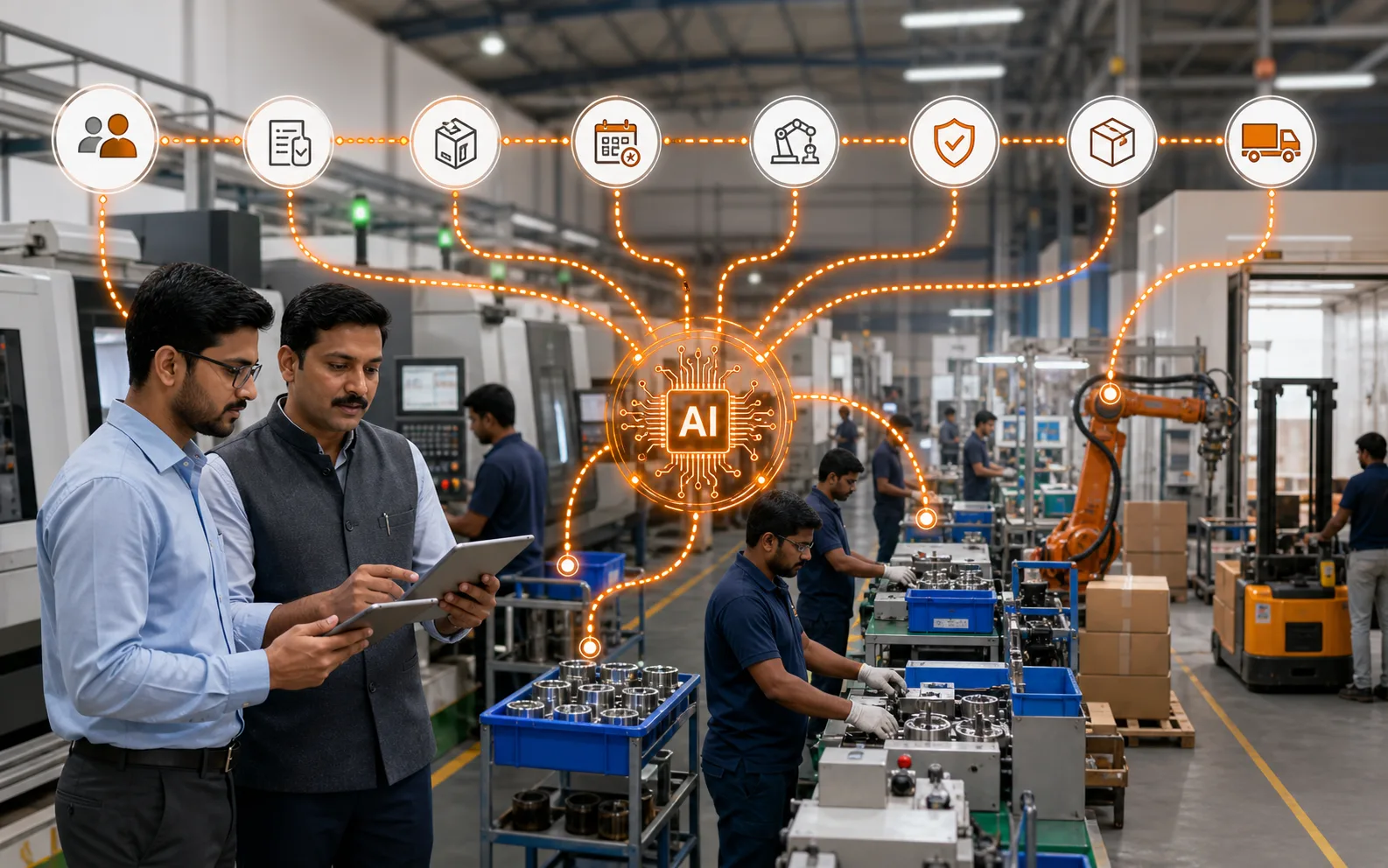
Multi-Location Manufacturing ERP: Ownership, Transfer and Reconciliation helps you coordinate plants and warehouses without double counting stock or work. Test one real order and one exception before expanding scope.
Plant A reserves and transfers a component to Plant B. The system records dispatch, in-transit status, receipt and any variance; neither plant can treat the same quantity as usable at the same time.
Start with the decision the system must support
Assign ownership to each order, store, transfer and production receipt before consolidating dashboards.
Optiwise supports multiple companies and facilities, multiple stores, stock transfers, order-linked production and multi-plant views with role-specific workspaces.
Use ISA-95 enterprise and control-system model as an external reference for the relevant process or control model. It does not prove an Optiwise feature or business result; our product statements come from the current feature record.
| # | Input to prepare | Evidence to retain |
|---|---|---|
| 1 | Plant, store and order ownership | Owner and last update |
| 2 | Transfer states and documents | Definition and source |
| 3 | Shared masters and local rules | Acceptance rule |
| 4 | Consolidation and reconciliation owner | Exception owner |
Run one controlled workflow
- 1. Plant, store and order ownership. Name the owner and authoritative record.
- 2. Transfer states and documents. Use the current value from the test order.
- 3. Shared masters and local rules. Write the pass condition before the demo.
- 4. Consolidation and reconciliation owner. Assign the person who resolves a mismatch.
Keep the first test small enough to reconcile by hand. When the result differs from the source documents, identify whether the problem is master data, timing, transaction ownership or configuration.
Test exceptions with the normal flow
- Shipment is partially received
- Item code differs by plant
- Inter-plant correction is late
For every exception, record the expected status, permitted action, approver and audit trail. The workflow should expose a problem without allowing an unapproved shortcut to rewrite history.
Verify the connected Optiwise workflow
Review workflow details, product capability, supporting guide, implementation context, connected process, book a demo. In the demo, ask us to run the scenario with your roles and sample records. Confirm the source transaction, resulting status, action, correction method and report.
Questions to ask before rollout
What should we test first?
Choose one current order with a known complication. Prepare the four inputs above, run the sequence and reconcile the result with the source documents.
What result should we accept?
Accept the workflow only when the normal path and named exceptions leave a complete, role-appropriate record. Keep feature validation separate from a promised outcome.
Running one manufacturing location is already complex.
Running multiple locations adds another layer of difficulty.
Now inventory may sit in different warehouses. Production may happen in more than one plant. One unit may produce components while another completes assembly. Purchase may be centralized, but goods may be received locally. Quality may follow common standards, but inspections may happen at each site. Dispatch may happen from the nearest warehouse. Owners may want one consolidated view, while each location needs its own daily control.
Without ERP, multi-location operations often become a maze of spreadsheets, phone calls, stock transfers, duplicate entries, and delayed reports.
ERP helps by giving the business a structured way to manage multiple plants, warehouses, departments, and business units from one connected system.
The goal is not just to see all locations. The goal is to coordinate them.
Quick Answer
ERP handles multi-location manufacturing by allowing companies to define multiple plants, warehouses, storage locations, work centers, departments, users, approval rules, inventory transfer flows, production orders, purchase flows, quality checks, dispatch points, and consolidated reports.
A good manufacturing ERP helps answer:
- What stock is available at each location?
- Which plant is producing which order?
- Can material be transferred from one location to another?
- Which location has free capacity?
- Are purchase orders centralized or local?
- Which warehouse should dispatch from?
- Which location has quality issues?
- What is the total inventory value across all sites?
- How is each plant performing?
ERP gives local control and central visibility.
Why Multi-Location Manufacturing Is Hard Without ERP
When a manufacturer grows beyond one location, informal systems begin to fail.
At one site, people may still manage with memory and daily conversations. Across multiple sites, that becomes impossible.
Common problems include:
- Stock is available in one warehouse but unknown to another.
- Plants buy the same material separately at different prices.
- Production capacity is overloaded at one site while another has availability.
- Material transfers are not recorded properly.
- Finished goods are dispatched from the wrong location.
- Quality standards vary between plants.
- Reports arrive late from each unit.
- Owners do not get one consolidated picture.
- Finance struggles with location-wise cost and valuation.
ERP reduces these issues by creating common processes and shared data.
ERP Defines Locations Clearly
The first step is location structure.
ERP can define:
- Companies or legal entities
- Plants
- Warehouses
- Stores
- Production departments
- Work centers
- Machines
- Quality areas
- Dispatch locations
- Scrap or rejection locations
This structure matters because transactions must happen at the correct place.
If material is received at Plant A but needed at Plant B, the system should show that clearly. If finished goods are stored in Warehouse 2, dispatch planning should know. If rejected stock is held separately, inventory reports should reflect it.
Without clear location structure, multi-location reporting becomes unreliable.
ERP Tracks Inventory by Location
Inventory visibility becomes more important as locations increase.
ERP can show stock by:
- Plant
- Warehouse
- Bin or storage location
- Batch or lot
- Quality status
- Reserved quantity
- Available quantity
- WIP
- Finished goods
- Rejected or hold stock
This helps planners use existing stock before buying more.
For example, Plant B may be short of a component, but Plant A may have excess stock. ERP can reveal this and support stock transfer.
This reduces overbuying and emergency purchase.
ERP Manages Stock Transfers
Multi-location manufacturing needs controlled stock transfer.
Material may move between warehouses, plants, job work units, subcontractors, or dispatch centers.
ERP can track:
- Transfer request
- Approval
- Material issue from source
- In-transit status
- Receipt at destination
- Quantity mismatch
- Damage or rejection
- Transfer cost if needed
This prevents material from disappearing between locations.
It also improves inventory accuracy because stock does not vanish from one warehouse without appearing in another.
ERP Supports Plant-Wise Production Planning
Each manufacturing location may have different capacity, machines, skills, and product lines.
ERP can help plan production location-wise.
It can show:
- Which plant can make which product
- Current production load
- Available machine capacity
- Material availability by plant
- Work orders by location
- WIP by location
- Completion status
- Delayed jobs
This helps management decide where to produce an order.
In some companies, one location produces semi-finished goods and another completes final assembly. ERP can connect both stages.
ERP Supports Centralized and Local Purchase
Multi-location companies may purchase centrally or locally.
ERP can support both models.
In centralized purchase, requirements from multiple locations can be consolidated. This helps negotiate better rates, reduce duplicate orders, and control vendor selection.
In local purchase, each plant can raise requirements based on its own operational needs.
ERP can manage:
- Location-wise purchase requirements
- Centralized purchase approvals
- Vendor selection
- Delivery location
- Goods receipt by plant
- Supplier performance by location
- Purchase price comparison
This gives purchase teams control without losing local visibility.
ERP Supports Quality Across Locations
Quality standards must remain consistent across plants.
ERP can define common inspection plans while allowing location-specific records.
It can show:
- Incoming inspection by location
- In-process inspection
- Final inspection
- Rejection by plant
- Supplier quality by receiving location
- Quality hold stock
- Rework by location
- Customer complaints linked to plant
This helps identify whether quality issues are location-specific or system-wide.
For example, if rejection is higher at Plant 2 for the same product, management can investigate training, machine condition, material handling, or process discipline.
ERP Gives Consolidated Reporting
Owners and leadership need consolidated visibility.
ERP can provide reports across all locations:
- Total inventory
- Plant-wise inventory
- Open purchase orders
- Production output by plant
- Work order status
- Dispatch status
- Quality rejection by location
- Cost by plant
- Sales order fulfillment
- Machine utilization
- Stock transfers
- Inter-location dependencies
This helps management compare performance and make decisions.
Without ERP, consolidated reports often arrive late because each location prepares data separately.
ERP Supports Role-Based Access by Location
Multi-location ERP needs proper permissions.
A user at Plant A may need access only to Plant A transactions. A central manager may need all locations. Finance may need consolidated data. Purchase may need vendor and requirement visibility across plants.
ERP can define role-based and location-based access.
This protects data while giving the right people the right visibility.
ERP Helps Standardize Processes Across Sites
When each location develops its own process, scaling becomes difficult.
ERP helps standardize key processes:
- Item coding
- Stock movement
- Purchase approvals
- Work order flow
- Quality inspection
- Production reporting
- Dispatch process
- Costing logic
- Reporting formats
Standardization does not mean every plant loses flexibility. It means the business uses common rules where consistency matters.
How Optiwise Supports the Workflow
AICAN Optiwise supports manufacturers that need connected visibility across production, inventory, purchase, quality, shop-floor tracking, IoT, reports, and AI agents.
For multi-location manufacturing, Optiwise can help teams manage:
- Location-wise inventory
- Production planning and work orders
- Purchase requirements and vendor visibility
- Stock transfers
- Quality tracking
- Shop-floor and machine visibility
- Consolidated dashboards
- AI alerts and operational summaries
- Owner-level reporting across locations
This helps growing MSME manufacturers move from location-specific spreadsheets to one connected operating view.
Explore AICAN Optiwise and About AICAN.
Practical Example
A manufacturer has two plants and one warehouse. Plant A makes components, Plant B assembles finished products, and the warehouse dispatches orders.
Without ERP, teams coordinate through calls and spreadsheets. Plant B often waits for components that Plant A says are ready. Warehouse stock reports are delayed. Purchase orders are duplicated.
With ERP, Plant A production status is visible. Component transfer is recorded. Plant B sees incoming material. Warehouse sees finished goods availability. Purchase consolidates material needs. Owners see all locations in one dashboard.
The business becomes easier to coordinate.
FAQ
Can ERP manage multiple plants?
Yes. Manufacturing ERP can define multiple plants, warehouses, work centers, users, inventory locations, production flows, and reports.
Can ERP show stock by location?
Yes. ERP can show stock by warehouse, plant, bin, batch, quality status, reserved quantity, and available quantity.
Can ERP transfer stock between locations?
Yes. ERP can manage transfer requests, issue, in-transit status, receipt, and quantity differences between locations.
Can ERP compare plant performance?
Yes. ERP can report production, quality, cost, inventory, purchase, and dispatch performance by location.
Is cloud ERP better for multi-location manufacturing?
Cloud ERP is often practical because it supports access across locations without heavy local infrastructure. But the right deployment depends on connectivity, security, and business needs.
How does AICAN Optiwise support multi-location operations?
AICAN Optiwise connects production, inventory, purchase, quality, shop-floor tracking, IoT, reports, and AI agents to give manufacturers location-wise and consolidated visibility.
Founder’s Note
Growth creates distance. When a factory expands to more locations, the owner can no longer depend on walking the floor to know everything.
That is where systems matter.
A multi-location manufacturer needs local teams to operate independently, but leadership still needs one truth. At AICAN, we build Optiwise with that balance in mind: local execution, central clarity.
Final Thought
ERP handles multi-location manufacturing by connecting plants, warehouses, production, inventory, purchase, quality, and reporting into one structured system.
For growing manufacturers, this visibility is not optional. It is what allows expansion without losing control.

Related Posts
A Manufacturing Alternative to SAP: Optiwise
Run your factory in Optiwise, a manufacturing alternative to SAP Business One with connected operations, AI agents and no-code workflows.
14 Jun 2026Read more →How Do I Know If My Manufacturing Business Really Needs an ERP?
A practical guide for manufacturers to identify when spreadsheets, manual follow-ups, and disconnected systems are no longer enough — and when ERP becomes an operational necessity.
14 Jun 2026Read more →Production Management System Optimized | Optiwise
Learn best practices for optimizing a production management system across planning, scheduling, material readiness, quality, and reporting.
12 Jun 2026Read more →
What Is the Best ERP for Pharmaceutical Manufacturing?
Learn how to choose the best ERP for pharmaceutical manufacturing, with guidance on batch control, quality workflows, traceability, inventory, documentation, and GMP discipline.
10 Jun 2026Read more →