
How to Choose an ERP System: Complete Buyer's Guide
A practical ERP buyer's guide for MSME manufacturers covering process fit, modules, cost, vendor support, implementation, training, scalability, and ROI.
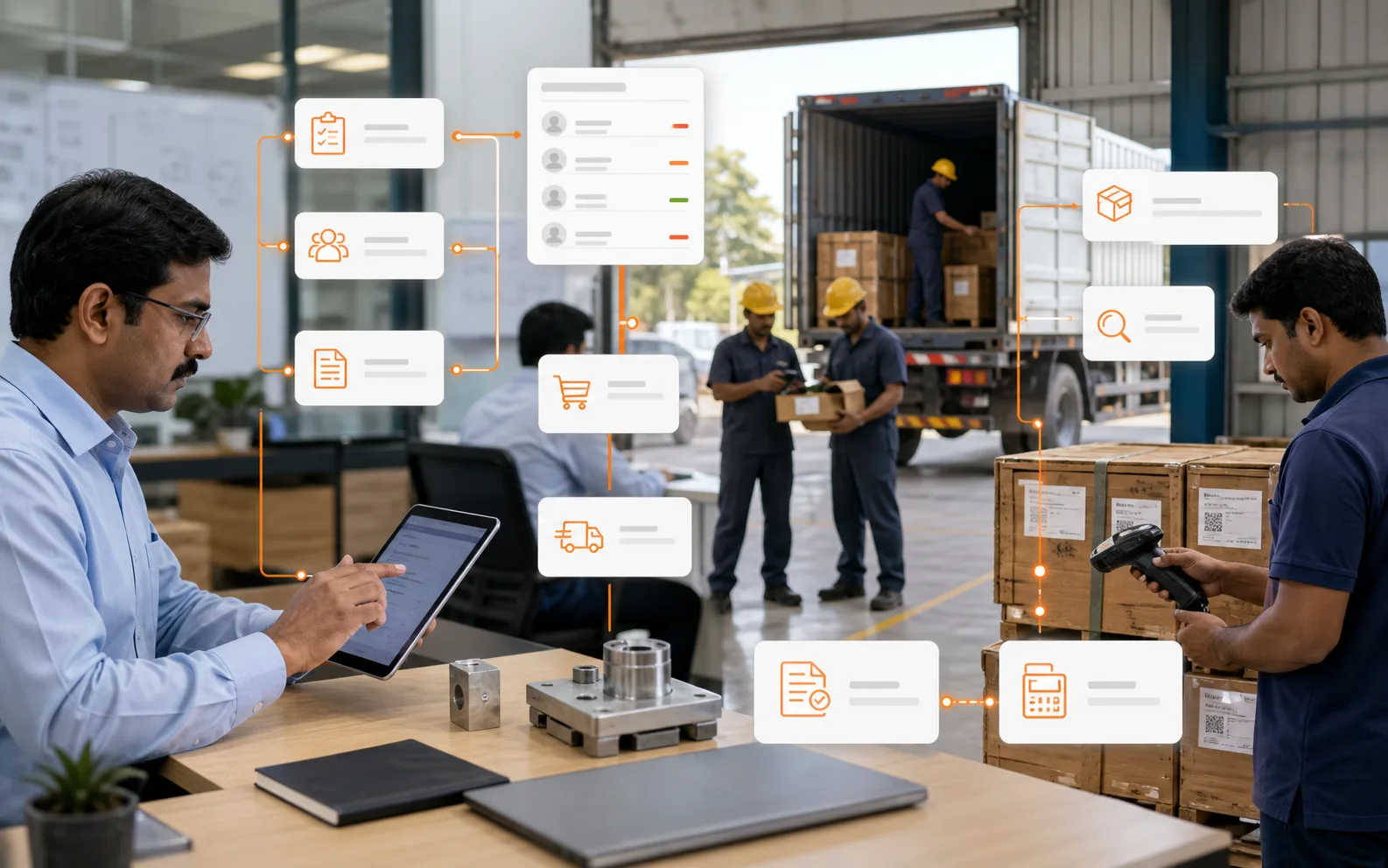
How to Choose an ERP System: Complete Buyer's Guide
Choosing ERP is not like buying a normal software subscription. ERP affects how your business receives orders, buys material, tracks stock, plans production, checks quality, dispatches goods, and reviews performance.
A wrong ERP decision can slow the team down. A good ERP decision can create visibility and discipline for years.
This buyer's guide is written for MSME manufacturers who want a practical way to evaluate ERP without getting lost in demos and jargon.
Step 1: Define the Business Problem
Before looking at vendors, write down why you need ERP.
Common reasons include:
- Inventory is unreliable.
- Orders are hard to track.
- Production status is unclear.
- Purchase follow-up is weak.
- Quality issues repeat.
- Reports take too long.
- Teams depend too much on Excel and WhatsApp.
- The owner has no real-time visibility.
If you cannot define the problem, every demo will look impressive and confusing.
Step 2: Map Your Core Workflow
Create a simple flow of how work moves in your business.
For many manufacturers, the flow is:
Enquiry → Quotation → Sales Order → Material Planning → Purchase → Inventory Receipt → Production → QC → Packing → Dispatch → Invoice → Payment Follow-up
Your ERP should support this flow naturally. If the system forces your team into an unnatural process, adoption will suffer.
Step 3: Separate Must-Have From Nice-to-Have
Do not buy ERP based on a long feature list. Decide what is essential for phase one.
Must-have features for many MSME manufacturers include:
- Sales enquiry and order tracking
- Purchase management
- Inventory control
- Production planning and updates
- Quality checks
- Dispatch visibility
- User roles and approvals
- Basic dashboards
- Finance coordination
Nice-to-have features may include advanced analytics, deep integrations, custom mobile apps, machine data, or complex automation. These can come later.
Step 4: Check Manufacturing Fit
A generic business ERP may not understand manufacturing depth. Ask how the system handles:
- BOMs
- Work orders
- Material issue
- Production stages
- WIP
- Rework
- Scrap
- QC records
- Job work
- Batch or lot tracking
- Dispatch against orders
If these are weak, the system may become only an accounting and inventory tool, not a manufacturing ERP.
Step 5: Evaluate Vendor Support
ERP success depends heavily on implementation support. During evaluation, ask:
- Who will implement the system?
- How will they study our process?
- How many training sessions are included?
- What happens after go-live?
- How quickly do support issues get resolved?
- Are updates included?
- Can the vendor speak manufacturing language?
A strong vendor reduces risk.
Step 6: Understand Total Cost
Compare total cost, not just subscription price.
Include:
- Software cost
- Implementation cost
- Data migration
- Customization
- Training
- Integrations
- Support
- Additional users
- Future modules
Ask for a written cost breakdown.
Step 7: Demand a Realistic Demo
Do not accept a generic demo. Give the vendor your actual process and ask them to show how it would work.
For example:
- Capture a real enquiry.
- Convert it to quotation.
- Convert to sales order.
- Check stock.
- Raise purchase.
- Issue material.
- Update production.
- Complete QC.
- Dispatch and invoice.
This reveals whether the ERP fits daily work.
Step 8: Plan Implementation Before Signing
Before finalizing, ask for an implementation plan with scope, timeline, roles, data requirements, training, and success metrics.
If the vendor cannot explain implementation clearly, be careful.
Where AICAN Optiwise Fits
AICAN Optiwise is built for MSME manufacturers that need connected workflows across sales, purchase, inventory, production, quality, dispatch, and finance. Its AI-native layer helps surface follow-ups, delays, shortages, and management insights without requiring the owner to manually pull reports all day.
For buyers, the important point is fit: Optiwise is designed around manufacturing operations rather than generic business administration.
FAQ
What is the most important factor when choosing ERP?
Process fit is the most important factor. The ERP must support how your manufacturing business actually runs.
Should I choose the ERP with the most features?
No. Choose the ERP with the right features, strong support, and practical implementation fit. Too many unused features can slow adoption.
How many vendors should I compare?
Shortlist three to five vendors, then evaluate deeply using your real workflow and cost requirements.
What should I ask during an ERP demo?
Ask the vendor to demonstrate your actual enquiry-to-dispatch process, not a generic dashboard tour.
Final Thought
The best ERP choice is not made in the most polished demo. It is made when you understand your own business clearly enough to test whether the system can support it.
Choose the ERP that your team can adopt, your managers can trust, and your business can grow with.

Related Posts

Kanban System | Optiwise
Learn how a Kanban system works in manufacturing, where it helps, where it fails, and how Optiwise connects Kanban signals with inventory, purchase, and production planning.
12 Jun 2026Read more →Erp In Operations Management | Optiwise
Learn how ERP improves operations management by connecting planning, inventory, purchase, production, quality, dispatch, finance, and reporting.
12 Jun 2026Read more →ERP for FMCG Companies in India
A practical guide to ERP for FMCG companies in India, covering distributor orders, batch tracking, expiry, inventory, production, schemes, costing, and reporting.
11 Jun 2026Read more →
Optiwise, Odoo, Acumatica and Business Central for Manufacturing
Compare manufacturing workflows in Optiwise, Odoo, Acumatica and Dynamics 365 Business Central. See what your factory can run in Optiwise.
11 Jun 2026Read more →