
Is NetSuite Good for Small Manufacturing Businesses?
Learn whether NetSuite is good for small manufacturing businesses, what it offers, where it fits, where it may be heavy, and how to compare it with manufacturing ERP alternatives.
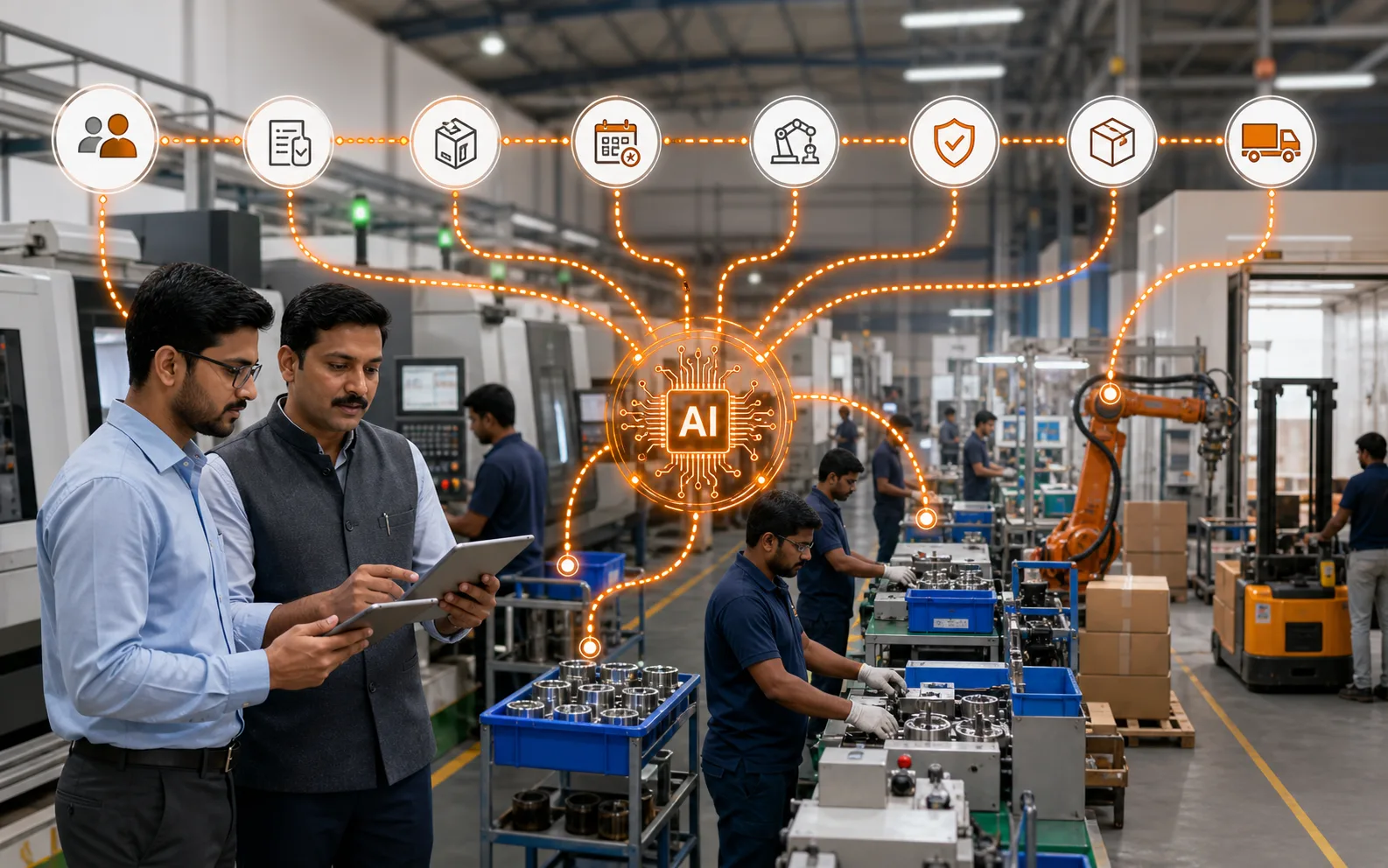
Is NetSuite Good for Small Manufacturing Businesses?
NetSuite can be a good ERP for some small manufacturing businesses, but it is not automatically the right fit for every small manufacturer.
That is the honest answer.
NetSuite is a well-known cloud ERP platform with broad business management capabilities across finance, inventory, procurement, CRM, commerce, reporting, and manufacturing-related functions. Oracle NetSuite positions its manufacturing ERP as a system that integrates procurement, production, inventory, shipping, and finance into one platform, giving manufacturers a complete business view.
That can be valuable for a growing manufacturer.
But small manufacturing businesses are not all the same. A 25-person machine shop, a food manufacturer, a packaging unit, an industrial equipment maker, a custom fabrication shop, and a high-growth multi-location manufacturing company may all need very different ERP depth.
So the better question is not, "Is NetSuite good?"
The better question is: is NetSuite good for your manufacturing process, your team, your budget, your implementation capacity, and your growth plan?
Quick Answer
NetSuite can be good for small manufacturing businesses that need a cloud-based ERP with strong financials, inventory, procurement, production visibility, reporting, and scalability. It can be especially relevant for fast-growing companies that want a unified business platform.
However, NetSuite may feel heavy or expensive for smaller manufacturers that mainly need practical shop-floor control, simple work order management, inventory discipline, production scheduling, quality tracking, and fast adoption. These businesses should compare NetSuite with manufacturing-focused ERP alternatives before deciding.
A small manufacturer should evaluate NetSuite on:
- Manufacturing process fit
- Implementation cost and timeline
- Required modules
- Customization needs
- Shop-floor usability
- Job costing depth
- Production scheduling needs
- Inventory and purchase control
- Quality management
- Local support
- Total cost of ownership
- Ability of the team to adopt it
What NetSuite Offers Manufacturers
NetSuite is a cloud ERP suite, not a narrow production tool.
That is both its strength and its challenge.
For manufacturers, NetSuite can support broad business functions such as:
- Financial management
- Procurement
- Inventory management
- Production management
- Order management
- Shipping
- Reporting and dashboards
- CRM and commerce capabilities
- Multi-entity or multi-location visibility depending on setup
- Manufacturing modules and extensions
NetSuite’s manufacturing pages position the platform around integrated visibility across production, supply chain, and financials. That is important because manufacturing problems rarely sit in one department. Inventory affects production. Production affects delivery. Purchase affects scheduling. Costing affects finance. Customer orders affect capacity.
For a small manufacturer trying to move away from disconnected tools, that unified approach can be attractive.
Where NetSuite Can Be Strong for Small Manufacturers
NetSuite may be a strong fit when a small manufacturer is growing quickly and needs more than basic production tracking.
Strong Financial Backbone
NetSuite is widely known for financial management. If a manufacturer needs better accounting visibility, multi-entity structure, revenue tracking, financial reporting, and operational finance, this can be a major advantage.
For businesses where finance and operations need to be tightly connected, NetSuite can help reduce silos.
Cloud Access
NetSuite is cloud-based, which can help owners and managers access information remotely. This is useful for companies with multiple locations, traveling owners, distributed teams, or external accountants.
Unified Platform
Small manufacturers often use separate systems for accounting, inventory, sales, and production. NetSuite can bring many of these functions into one platform, reducing duplication and improving reporting.
Scalability
NetSuite is designed for growing businesses. If a small manufacturer expects to expand into more locations, more product lines, more channels, or more complex reporting, scalability may be attractive.
Reporting and Visibility
ERP value often comes from visibility. NetSuite’s broader ERP structure can help leaders see operational and financial data together.
Where NetSuite May Be Too Heavy
NetSuite may not be ideal if the manufacturer’s biggest need is simple, fast, practical shop-floor execution.
Some small manufacturers do not need a large business suite first. They need to fix daily production problems:
- Work orders are unclear.
- Inventory is inaccurate.
- Material shortages are discovered late.
- Production status is updated manually.
- Machine load is not visible.
- Job costing is rough.
- Quality rejection is not tracked.
- Supervisors do not want complex screens.
If this is your situation, NetSuite may still work, but implementation must be carefully scoped. Otherwise the company may pay for breadth while struggling with adoption on the factory floor.
Small manufacturers should be especially careful if:
- They have limited internal process maturity.
- They need heavy manufacturing customization.
- Shop-floor users are not comfortable with complex ERP screens.
- Their budget is tight.
- They need fast rollout.
- They mainly want production, inventory, purchase, and quality control.
- They do not have strong implementation support.
The issue is not that NetSuite cannot support manufacturing. The issue is whether it is the most practical first ERP for your business.
NetSuite for Make-to-Stock vs Custom Manufacturing
Manufacturing style matters.
If your company makes repeat products, manages inventory, sells through multiple channels, and needs strong financial integration, NetSuite may be easier to fit.
If your company runs job shop, custom fabrication, engineer-to-order, or one-off production, you must examine the details more carefully.
Ask how NetSuite will handle:
- Job-specific BOMs
- Custom routings
- Drawing revisions
- Work order changes
- Machine scheduling
- Rework and rejection
- Subcontracting
- Job-wise costing
- Shop-floor updates
- Customer-specific quality requirements
These are practical questions. A generic ERP demo may not reveal them.
What Small Manufacturers Should Ask Before Choosing NetSuite
Before choosing NetSuite, ask these questions:
- Which manufacturing modules do we actually need?
- What will be included in the initial implementation?
- How will work orders be managed?
- How will BOMs and routings be handled?
- Can supervisors update production easily?
- How will material issue and consumption work?
- How will quality checks be recorded?
- Can we track actual job cost?
- What reports will owners see daily?
- How much customization is needed?
- How long will implementation take?
- Who will support us after go-live?
- What is the full cost over three years?
- Can we start small and expand later?
The answers matter more than the product name.
Compare NetSuite With Manufacturing-Focused ERP
Small manufacturers should compare NetSuite with ERP systems built specifically around manufacturing operations.
A manufacturing-focused ERP may offer simpler workflows for:
- Production planning
- Work order tracking
- BOM and costing
- Inventory movement
- Purchase planning
- Shop-floor updates
- Quality control
- Machine visibility
- IoT integration
- AI alerts and operational summaries
This does not mean manufacturing-focused ERP is always better. It means the comparison should be based on operating fit.
If your biggest pain is finance consolidation, multi-entity reporting, and broad business integration, NetSuite may be strong.
If your biggest pain is factory visibility, work order discipline, production delays, inventory errors, and shop-floor adoption, a manufacturing-first system may be more practical.
Cost and Implementation Considerations
NetSuite pricing and implementation cost depend on modules, users, scope, customization, data migration, integrations, and partner support.
Small manufacturers should avoid comparing only subscription price. The full cost includes:
- Software subscription
- Required modules
- Implementation partner cost
- Configuration
- Customization
- Data migration
- Training
- Support
- Integration
- Internal team effort
- Future changes
Implementation effort is especially important.
A powerful ERP that the team cannot adopt becomes expensive even if the software is technically capable.
When NetSuite May Be a Good Fit
NetSuite may be a good fit if:
- The business is growing fast.
- Financial and operational visibility are both important.
- The company wants cloud ERP.
- Multiple departments need one system.
- The team can support a structured implementation.
- The budget allows proper configuration and training.
- Manufacturing processes are not extremely unusual or can be mapped well.
- Leadership wants a scalable platform for future growth.
When to Consider Alternatives
Consider alternatives if:
- You need a simpler first ERP.
- Shop-floor adoption is the biggest risk.
- Manufacturing workflows are highly custom.
- Budget is tight.
- You need faster deployment.
- You want IoT and AI tightly connected to factory operations.
- You need a vendor focused on Indian MSME manufacturing realities.
This is where a focused ERP can sometimes beat a broader platform.
Where AICAN Optiwise Fits
AICAN Optiwise is built specifically for manufacturers that need connected factory operations, not just a broad business suite.
Optiwise brings together CRM, custom quotations, production, inventory, purchase, work orders, layered BOM, cost estimation, quality control, shop-floor tracking, IoT, reports, and AI agents.
For small manufacturers comparing NetSuite, Optiwise is worth evaluating if the main goals are:
- Practical production visibility
- Faster shop-floor adoption
- Work order control
- Inventory and purchase discipline
- Job-wise costing
- Quality tracking
- Machine and IoT visibility
- AI-powered alerts and summaries
- Manufacturing workflows designed for MSMEs
The goal is not to say every manufacturer should choose the same ERP. The goal is to choose based on fit.
Explore AICAN Optiwise and learn more about AICAN.
Practical Example
A small manufacturer with 35 employees wants ERP because stock is inaccurate, work orders are manual, purchase delays affect production, and the owner cannot see job status.
NetSuite may offer a broad cloud ERP platform, but the company must check whether the implementation will solve the factory problems quickly enough. If most of the budget goes into finance configuration and broad suite setup while production still runs manually, the ERP may not deliver the expected value.
Another manufacturer with 150 employees, multi-location operations, finance complexity, growing sales channels, and a stronger internal team may find NetSuite more suitable.
Same product category. Different fit.
FAQ
Is NetSuite good for small manufacturing businesses?
NetSuite can be good for small manufacturers that need cloud ERP, strong financials, inventory, procurement, production visibility, and scalability. It may be too heavy for companies that need a simpler manufacturing-first system.
Is NetSuite only for large companies?
No. NetSuite serves small and mid-sized businesses as well as larger companies. But small manufacturers should evaluate implementation scope and cost carefully.
Does NetSuite support manufacturing?
Yes. NetSuite offers manufacturing ERP capabilities across procurement, production, inventory, shipping, finance, planning, and reporting, depending on modules and configuration.
Is NetSuite expensive for small manufacturers?
Cost depends on users, modules, implementation, customization, support, and integrations. Small manufacturers should evaluate total cost of ownership, not just subscription fees.
What should I compare NetSuite against?
Compare it against manufacturing-focused ERP systems that support work orders, BOMs, production planning, inventory, purchase, quality, job costing, shop-floor tracking, IoT, and AI.
How does AICAN Optiwise compare as an option?
AICAN Optiwise is designed around manufacturing workflows for Indian MSMEs, including production, inventory, purchase, work orders, BOM, costing, quality, shop-floor tracking, IoT, AI agents, and reports.
Founder’s Note
A famous ERP name can give confidence, but it should not replace judgment.
Small manufacturers need systems that their teams can actually use. If the ERP is powerful but too heavy, adoption suffers. If the ERP is simple but cannot grow, the business outgrows it quickly.
The right answer is fit.
At AICAN, we believe manufacturers should evaluate ERP from the factory floor upward. Start with real problems: production delays, inventory errors, costing gaps, quality issues, and missing visibility. Then choose the system that solves those problems with the least unnecessary friction.
Final Thought
NetSuite can be a good ERP for small manufacturing businesses, especially those that need a broad cloud platform and strong financial visibility.
But it is not automatically the best answer for every small manufacturer.
If your biggest challenges are shop-floor control, production visibility, inventory accuracy, and practical adoption, compare NetSuite with manufacturing-focused alternatives before deciding.
ERP is not about choosing the biggest name. It is about choosing the system your factory will trust and use.

Related Posts
A Manufacturing Alternative to SAP: Optiwise
Run your factory in Optiwise, a manufacturing alternative to SAP Business One with connected operations, AI agents and no-code workflows.
14 Jun 2026Read more →How Do I Know If My Manufacturing Business Really Needs an ERP?
A practical guide for manufacturers to identify when spreadsheets, manual follow-ups, and disconnected systems are no longer enough — and when ERP becomes an operational necessity.
14 Jun 2026Read more →Production Management System Optimized | Optiwise
Learn best practices for optimizing a production management system across planning, scheduling, material readiness, quality, and reporting.
12 Jun 2026Read more →
What Is the Best ERP for Pharmaceutical Manufacturing?
Learn how to choose the best ERP for pharmaceutical manufacturing, with guidance on batch control, quality workflows, traceability, inventory, documentation, and GMP discipline.
10 Jun 2026Read more →