
Machine Downtime Tracking Strategies
Learn practical machine downtime tracking strategies for manufacturers, including downtime reasons, thresholds, ownership, alerts, OEE context, and production impact.
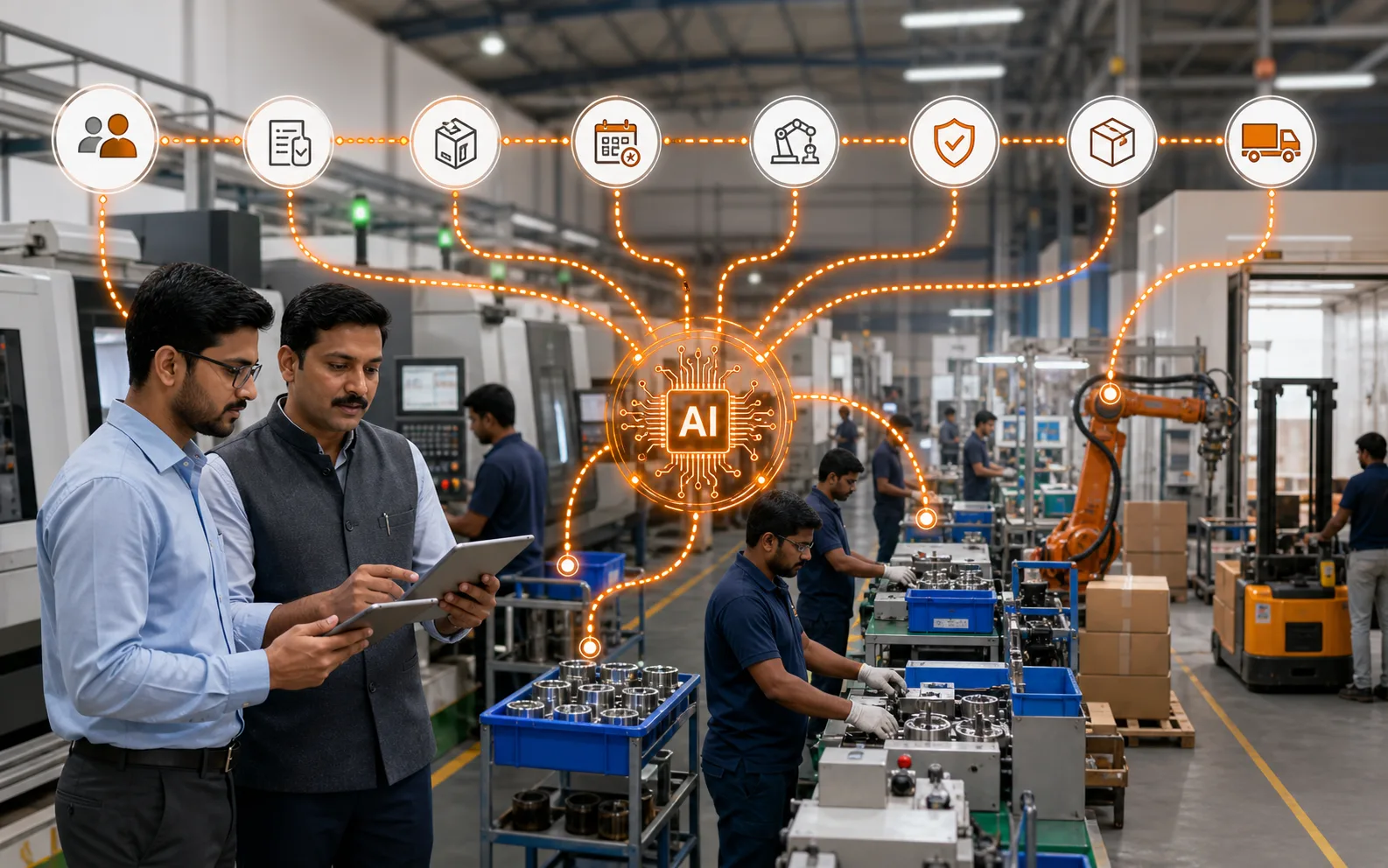
Machine Downtime Tracking Strategies
Machine downtime is easy to complain about and surprisingly hard to measure properly.
Everyone knows when a critical machine stops. The supervisor knows the line is waiting. The operator knows the job is delayed. Maintenance knows there is a ticket. Management knows dispatch may be affected. But at the end of the week, many factories still cannot answer the most important questions clearly.
How much downtime happened? Which machines caused the most lost time? Which reasons repeated? How much production was lost? Was it breakdown, setup, waiting for material, tool issue, power fluctuation, operator unavailability, quality hold, or planned maintenance? Which stops were preventable?
Without clear downtime tracking, factories rely on memory and rough estimates. That leads to wrong priorities. Teams may focus on the loudest breakdown instead of the costliest pattern.
For manufacturers working on Factory Floor Visibility, machine downtime tracking is not just a maintenance activity. It is a production control discipline. It helps the factory understand capacity, delivery risk, maintenance priorities, and hidden losses.
This guide explains practical machine downtime tracking strategies and how AICAN Optiwise can help manufacturers connect downtime data with production decisions.
Define What Counts as Downtime
The first step is to define downtime clearly.
Different factories use the word differently. Some count only breakdowns. Some include setup delays. Some include waiting for material. Some count any period where the machine is not producing. Without a shared definition, downtime reports become inconsistent.
A practical approach is to separate downtime into categories:
- Breakdown: Machine stopped due to mechanical, electrical, hydraulic, pneumatic, software, or control issue.
- Setup or changeover: Machine unavailable while preparing for the next job.
- Material waiting: Machine ready, but material or component not available.
- Tooling or fixture issue: Machine cannot run because tool, die, fixture, mould, or program is not ready.
- Quality hold: Machine or job paused due to inspection, approval, or defect concern.
- Operator or manpower issue: Machine available, but required operator or skill not available.
- Planned maintenance: Machine intentionally stopped for scheduled maintenance.
- No plan or no load: Machine idle because no job is assigned.
Not every category should be treated the same. A breakdown needs maintenance action. Material waiting needs stores or purchase action. No load may point to planning or demand. Setup delay may require process improvement.
Good downtime tracking starts by naming the right problem.
Track Duration, Not Just Occurrence
Counting downtime events is not enough.
A machine that stops ten times for two minutes has a different problem from a machine that stops once for four hours. Both matter, but they require different responses.
Track these basics for every downtime event:
- Machine or asset name.
- Start time.
- End time.
- Total duration.
- Job or work order affected.
- Downtime reason.
- Person or team responsible for next action.
- Production quantity lost, if estimated.
Duration makes the problem measurable. It helps teams see whether they are losing time due to frequent minor stops, long breakdowns, slow changeovers, or waiting between jobs.
Capture Reason Codes Carefully
Reason codes are useful only when they reflect reality.
If the reason list is too short, everything becomes "other." If it is too long, operators avoid using it properly. The best reason-code structure is practical and understandable.
Start with broad categories, then add sub-reasons where needed.
For example:
- Breakdown: electrical, mechanical, hydraulic, pneumatic, control panel, sensor.
- Setup: tool change, program change, fixture setting, trial adjustment.
- Material: raw material short, component short, wrong material, material not issued.
- Quality: first-piece pending, inspection hold, defect investigation, rework decision.
- Utility: power issue, air pressure, coolant, water, gas.
Reason codes should be reviewed regularly. If one code is used too often, break it into clearer sub-reasons. If a code is never used, remove it.
The purpose is not perfect classification. The purpose is better decisions.
Connect Downtime to the Job Running
Downtime becomes much more useful when linked to the job or work order.
If a machine stops, the factory should know which customer order, batch, operation, or product was affected. This connects maintenance data with production impact.
For example, a 45-minute stop during an internal buffer job may be manageable. A 45-minute stop during an urgent customer order may create dispatch risk. The downtime duration is the same, but the business impact is different.
Job-linked downtime helps answer:
- Which orders were delayed because of downtime?
- Which products face repeated machine issues?
- Which operations are most vulnerable?
- Which machines affect customer commitments the most?
This is where downtime tracking moves beyond maintenance reporting into Factory Floor Visibility.
Separate Planned and Unplanned Downtime
Planned maintenance is not the same as unexpected breakdown.
Factories should separate planned downtime from unplanned downtime so performance is not misunderstood. Planned maintenance may reduce available hours, but it is usually necessary to prevent larger problems. Unplanned downtime creates more disruption because it breaks the schedule without warning.
Track both, but review them differently.
For planned downtime, ask:
- Was maintenance completed as scheduled?
- Did it overrun?
- Was production planning aware?
- Did the downtime prevent future breakdowns?
For unplanned downtime, ask:
- What failed?
- How long did detection, response, repair, and restart take?
- Was the issue repeated?
- Could preventive maintenance, spares, training, or operating discipline reduce it?
This separation makes downtime analysis fairer and more useful.
Track Response Time and Repair Time
A downtime event has stages.
The machine stops. Someone notices. Maintenance is informed. The team reaches the machine. Diagnosis begins. Repair happens. Trial starts. Production resumes.
If the factory tracks only total downtime, it may miss where time is being lost.
Useful measures include:
- Time from stop to reporting.
- Time from reporting to maintenance response.
- Time from response to diagnosis.
- Time from diagnosis to repair.
- Time from repair to production restart.
These details help improve process. If reporting is slow, the issue is visibility. If response is slow, the issue may be manpower or prioritization. If repair is slow, the issue may be spares, skill, documentation, or machine condition.
Use Threshold-Based Alerts
Not every stop needs escalation.
A machine may stop briefly during normal adjustment. But when downtime crosses a defined threshold, the right team should know.
Thresholds can be based on:
- Duration of stop.
- Machine criticality.
- Job priority.
- Dispatch risk.
- Repeated stoppage count.
- Safety or quality risk.
For example:
- Alert supervisor after 10 minutes of unplanned stop.
- Alert maintenance after 15 minutes if no reason is entered.
- Alert plant head after 45 minutes on a critical machine.
- Alert planning if downtime affects a dispatch order due within 24 hours.
This prevents small issues from becoming invisible and large issues from staying trapped at one level.
Measure Repeated Minor Stops
Long breakdowns get attention. Repeated minor stops often escape review.
A machine that stops for 3 minutes, 20 times a shift, may lose an hour of production without creating a dramatic breakdown story. These micro-stops can be caused by sensor issues, feeding problems, tool wear, operator adjustments, material variation, or process instability.
Tracking repeated minor stops helps identify chronic loss.
Useful views include:
- Number of stops per machine.
- Average stop duration.
- Top repeat reason codes.
- Time of day or shift pattern.
- Product or job associated with repeated stops.
This is especially useful in high-volume operations where small interruptions add up quickly.
Use Downtime Data for Maintenance Priorities
Maintenance teams often work under pressure. Without data, priority is driven by urgency, seniority, or whoever calls the loudest.
Downtime tracking helps maintenance leaders prioritize based on impact.
Review:
- Machines with highest downtime hours.
- Machines with most frequent stops.
- Machines causing dispatch risk.
- Breakdown reasons that repeat.
- Spares that repeatedly delay repair.
- Preventive maintenance tasks overdue.
This helps maintenance move from reactive repair to targeted reliability improvement.
Connect Downtime With OEE Carefully
Downtime is a major part of OEE, but factories should use OEE carefully.
OEE can be useful when data quality is good and definitions are clear. But if availability, performance, and quality numbers are poorly captured, OEE becomes a number people argue about.
Before focusing heavily on OEE, make sure the basics are reliable:
- Accurate machine availability.
- Clear planned production time.
- Reliable downtime records.
- Realistic cycle time standards.
- Correct production and rejection quantities.
For many factories, the first win is not a perfect OEE dashboard. The first win is honest downtime tracking that helps reduce avoidable stops.
Review Downtime Daily and Weekly
Downtime tracking should become part of review rhythm.
Daily review should focus on immediate action:
- What stopped yesterday or today?
- Which jobs were affected?
- Which machines need attention before the next shift?
- Which open issues remain unresolved?
Weekly review should focus on patterns:
- Top 5 machines by downtime.
- Top repeated reasons.
- Longest unresolved breakdowns.
- Preventive maintenance gaps.
- Spare availability issues.
- Downtime linked to dispatch delays.
This review should include production and maintenance together. Downtime is not only a maintenance problem. It affects production planning, delivery, quality, and cost.
Avoid Blame-Based Downtime Tracking
If downtime tracking becomes a blame tool, people will hide data.
Operators may delay reporting. Supervisors may choose vague reasons. Maintenance teams may avoid closing tickets accurately. The data becomes political instead of useful.
The tone matters. The purpose of downtime tracking is to improve reliability and flow. It should help teams see problems early, allocate resources better, and prevent repeat issues.
A healthy downtime system asks, "What failed in the process?" before it asks, "Who is at fault?"
Where AICAN Optiwise Fits
AICAN Optiwise helps manufacturers connect machine downtime tracking with live production visibility.
This connection matters because downtime is not isolated. A stopped machine can delay jobs, create WIP pileups, affect quality timing, increase overtime, and put dispatch commitments at risk. When downtime data is connected to production and order status, teams can make better decisions faster.
Optiwise can help manufacturers work toward:
- Clear machine status visibility.
- Downtime reason capture.
- Job-linked downtime tracking.
- Better maintenance and production coordination.
- Exception alerts for long or repeated stops.
- Management dashboards that show downtime impact, not just downtime count.
AICAN focuses on practical factory systems that improve visibility where the work actually happens. You can learn more at About AICAN.
FAQ
What is machine downtime tracking?
Machine downtime tracking is the process of recording when machines stop, why they stop, how long they remain unavailable, which job is affected, and what action is needed to restart production.
What downtime reasons should manufacturers track?
Common downtime reasons include breakdown, setup, material waiting, tooling issue, quality hold, operator unavailability, planned maintenance, utility issue, and no job assigned. The reason list should match the factory’s actual operations.
Why should downtime be linked to work orders?
Linking downtime to work orders shows production impact. It helps teams understand which customer orders, products, operations, or dispatch commitments were affected by machine stoppages.
How often should downtime be reviewed?
Downtime should be reviewed daily for immediate action and weekly for patterns. Daily review helps close open issues, while weekly review helps identify repeat machines, repeat reasons, maintenance gaps, and capacity risks.
Is OEE necessary for downtime tracking?
OEE can be useful, but it is not the first requirement. Manufacturers should first capture accurate downtime, production quantity, rejection, planned time, and cycle time. Without reliable data, OEE becomes misleading.
How does downtime tracking improve Factory Floor Visibility?
Downtime tracking improves Factory Floor Visibility by showing which machines are available, which are stopped, why production is delayed, and how downtime affects jobs and customer commitments.
Founder’s Note
Downtime tracking is not about proving that machines fail. Everyone already knows that.
The real value is learning which failures hurt the factory most, which ones repeat, and which ones can be prevented. A stopped machine is not only a maintenance event. It is a production event, a planning event, sometimes a customer event.
At AICAN, we believe manufacturers need downtime visibility that connects to the real flow of work. When production and maintenance look at the same facts, the conversation becomes more useful and less emotional.
Final Thought
Machine downtime will never disappear completely. But hidden downtime, repeated downtime, and poorly understood downtime can be reduced.
The right tracking strategy helps manufacturers see where time is lost, why it is lost, and what action will prevent the same loss from returning. That is a practical foundation for stronger Factory Floor Visibility and better production reliability.

Related Posts

Kanban System | Optiwise
Learn how a Kanban system works in manufacturing, where it helps, where it fails, and how Optiwise connects Kanban signals with inventory, purchase, and production planning.
12 Jun 2026Read more →Erp In Operations Management | Optiwise
Learn how ERP improves operations management by connecting planning, inventory, purchase, production, quality, dispatch, finance, and reporting.
12 Jun 2026Read more →ERP for FMCG Companies in India
A practical guide to ERP for FMCG companies in India, covering distributor orders, batch tracking, expiry, inventory, production, schemes, costing, and reporting.
11 Jun 2026Read more →
Optiwise, Odoo, Acumatica and Business Central for Manufacturing
Compare manufacturing workflows in Optiwise, Odoo, Acumatica and Dynamics 365 Business Central. See what your factory can run in Optiwise.
11 Jun 2026Read more →