
How Can I Monitor Fabrication Equipment Remotely?
Learn how fabrication companies can remotely monitor equipment, machine status, downtime, job progress, maintenance alerts, and production risks using IoT-connected ERP dashboards.
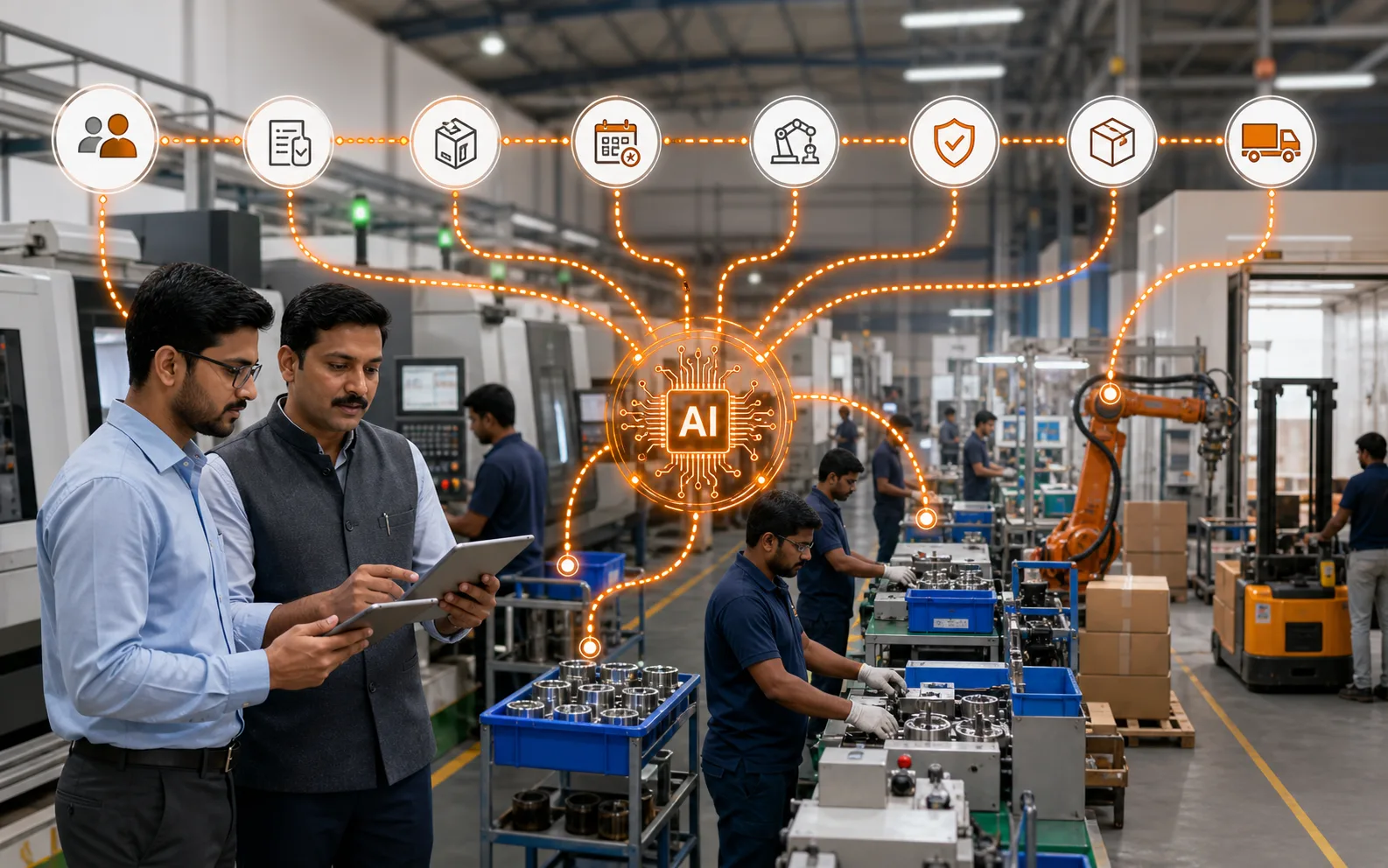
How Can I Monitor Fabrication Equipment Remotely?
You can monitor fabrication equipment remotely by collecting equipment status from machines, IoT devices, sensors, PLCs, operator updates, and maintenance records, then showing that data on a secure dashboard connected to production and ERP workflows.
Remote monitoring is useful when the owner is not always on the floor, the plant head manages multiple areas, maintenance support is shared across units, or production decisions need faster visibility. But remote monitoring should not become a passive camera-like view of the shop. The real value is knowing what changed, why it changed, and what action is required.
For a fabrication company, the useful questions are practical: which equipment is running, which is idle, which job is affected, why did the machine stop, whether maintenance has responded, whether production is slipping, and whether dispatch is at risk.
AICAN Optiwise helps connect equipment monitoring with production planning, job cards, quality, maintenance, and dispatch so remote visibility becomes operationally useful.
What Equipment Can Be Monitored Remotely?
Fabrication shops may monitor different types of equipment depending on the process:
- Cutting machines
- CNC or VMC machines
- Bending machines
- Welding machines or welding bays
- Compressors
- Cranes and handling equipment
- Shot blasting machines
- Painting or coating lines
- Power or utility systems
- Inspection equipment where relevant
Not every asset needs the same monitoring depth. A bottleneck cutting machine may need live status and downtime alerts. A compressor may need runtime and maintenance alerts. Welding bays may need job progress and reason updates more than machine signals.
Start With The Operational Reason
Before adding sensors or dashboards, define why remote monitoring is needed.
Common reasons include:
- Owners need visibility across plants
- Production heads need faster exception alerts
- Maintenance needs breakdown notifications
- Supervisors need machine status without repeated calls
- Dispatch teams need early warning on delayed jobs
- Management wants utilization and downtime reports
The reason decides what data to capture. If the goal is downtime reduction, capture downtime reasons. If the goal is delivery control, connect equipment status to job progress. If the goal is maintenance planning, capture breakdown and repeat fault history.
How Remote Equipment Monitoring Works
Remote monitoring usually has four layers.
First, data is captured from equipment. This may come from machine controllers, PLCs, sensors, current monitoring, IoT gateways, or operator input.
Second, data is processed locally or at the edge. This helps convert raw signals into useful states such as running, idle, stopped, breakdown, setup, or maintenance.
Third, data is sent securely to a cloud or server platform.
Fourth, dashboards and alerts show the right information to the right people.
The strongest systems then connect this data to ERP so managers can see not only equipment status but also job impact.
What A Remote Dashboard Should Show
A remote fabrication equipment dashboard should be simple enough to act on.
Useful views include:
- Equipment status by area
- Running, idle, stopped, breakdown, or maintenance state
- Current job or production order where applicable
- Downtime duration
- Downtime reason
- Operator or shift
- Maintenance ticket status
- Production delay impact
- Critical alerts
- Historical downtime trends
The dashboard should not overload users with raw data. It should highlight exceptions.
Alerts Matter More Than Watching
Remote monitoring should not require someone to stare at a screen all day. Alerts should notify the right person when something crosses a practical threshold.
Examples include:
- Machine stopped for more than 15 minutes
- Breakdown not acknowledged
- Critical job delayed
- Compressor runtime abnormal
- Maintenance due
- Equipment idle during planned production
- Production stage not updated
Alerts must be tuned carefully. Too many alerts create fatigue. Too few alerts create missed action.
Security And Access Control
Remote equipment monitoring should be secure. The company should define who can see what, who can change settings, and how data is accessed.
Important controls include:
- Role-based access
- Secure device communication
- User authentication
- Network segmentation where needed
- Audit trail for critical actions
- Controlled mobile access
Security should be part of the design, not an afterthought.
Connect Remote Monitoring With ERP
Equipment status becomes much more useful when it is connected to jobs and production plans.
For example, a remote alert saying “Cutting Machine 2 stopped” is useful. But “Cutting Machine 2 stopped while running Job 782, dispatch due tomorrow, downtime reason: tool issue” is far more useful.
ERP context turns machine visibility into decision support. AICAN Optiwise helps create that connection between equipment, jobs, material, quality, maintenance, and dispatch.
Implementation Roadmap
A practical rollout can be phased:
- Choose critical equipment first.
- Define status categories and downtime reasons.
- Install IoT or integration where needed.
- Validate machine signals with supervisors.
- Connect equipment status to jobs.
- Configure alerts by role.
- Review reports weekly.
- Expand to more assets after trust is built.
This phased approach keeps the project grounded in factory value.
Common Mistakes
The first mistake is monitoring too many assets without a clear use case. The second is ignoring downtime reasons. The third is giving everyone the same dashboard. The fourth is failing to train supervisors on updates. The fifth is keeping remote monitoring separate from ERP.
A good remote monitoring system should reduce calls, reduce guesswork, and improve response time. If it only adds another dashboard, it is not doing enough.
Founder’s Note
At AICAN, we believe remote monitoring should help management act earlier, not micromanage from far away. A factory still runs through people, judgement, and process discipline. Remote visibility simply gives those people better timing and better context.
AICAN Optiwise is built to connect remote equipment visibility with the real manufacturing flow. More about our work is available on About AICAN.
FAQs
What is remote equipment monitoring?
It is the process of viewing equipment status, downtime, alerts, maintenance signals, and production impact from outside the immediate shop-floor area.
Can old fabrication equipment be monitored remotely?
In many cases, yes. Older equipment may need external sensors, electrical signal monitoring, or operator-assisted updates.
Is remote monitoring the same as CCTV?
No. CCTV shows visuals. Remote monitoring shows operational data such as running status, downtime reason, job impact, and alerts.
Why should remote monitoring connect with ERP?
ERP connection links equipment status to jobs, production plans, quality, maintenance, dispatch, and costing, making the data more actionable.
Can remote monitoring reduce downtime?
It can help by detecting stoppages faster and showing repeat downtime causes. Actual reduction comes from maintenance and process action.
How can AICAN Optiwise help?
AICAN Optiwise helps manufacturers connect remote equipment monitoring with production, maintenance, quality, dispatch, and ERP dashboards.

Related Posts

Kanban System | Optiwise
Learn how a Kanban system works in manufacturing, where it helps, where it fails, and how Optiwise connects Kanban signals with inventory, purchase, and production planning.
12 Jun 2026Read more →Erp In Operations Management | Optiwise
Learn how ERP improves operations management by connecting planning, inventory, purchase, production, quality, dispatch, finance, and reporting.
12 Jun 2026Read more →ERP for FMCG Companies in India
A practical guide to ERP for FMCG companies in India, covering distributor orders, batch tracking, expiry, inventory, production, schemes, costing, and reporting.
11 Jun 2026Read more →
Optiwise, Odoo, Acumatica and Business Central for Manufacturing
Compare manufacturing workflows in Optiwise, Odoo, Acumatica and Dynamics 365 Business Central. See what your factory can run in Optiwise.
11 Jun 2026Read more →