
Can I Monitor My Factory Sensors Remotely?
Learn how manufacturers can monitor factory sensors remotely, what infrastructure is needed, and how to keep remote visibility practical and secure.
Can I Monitor My Factory Sensors Remotely?
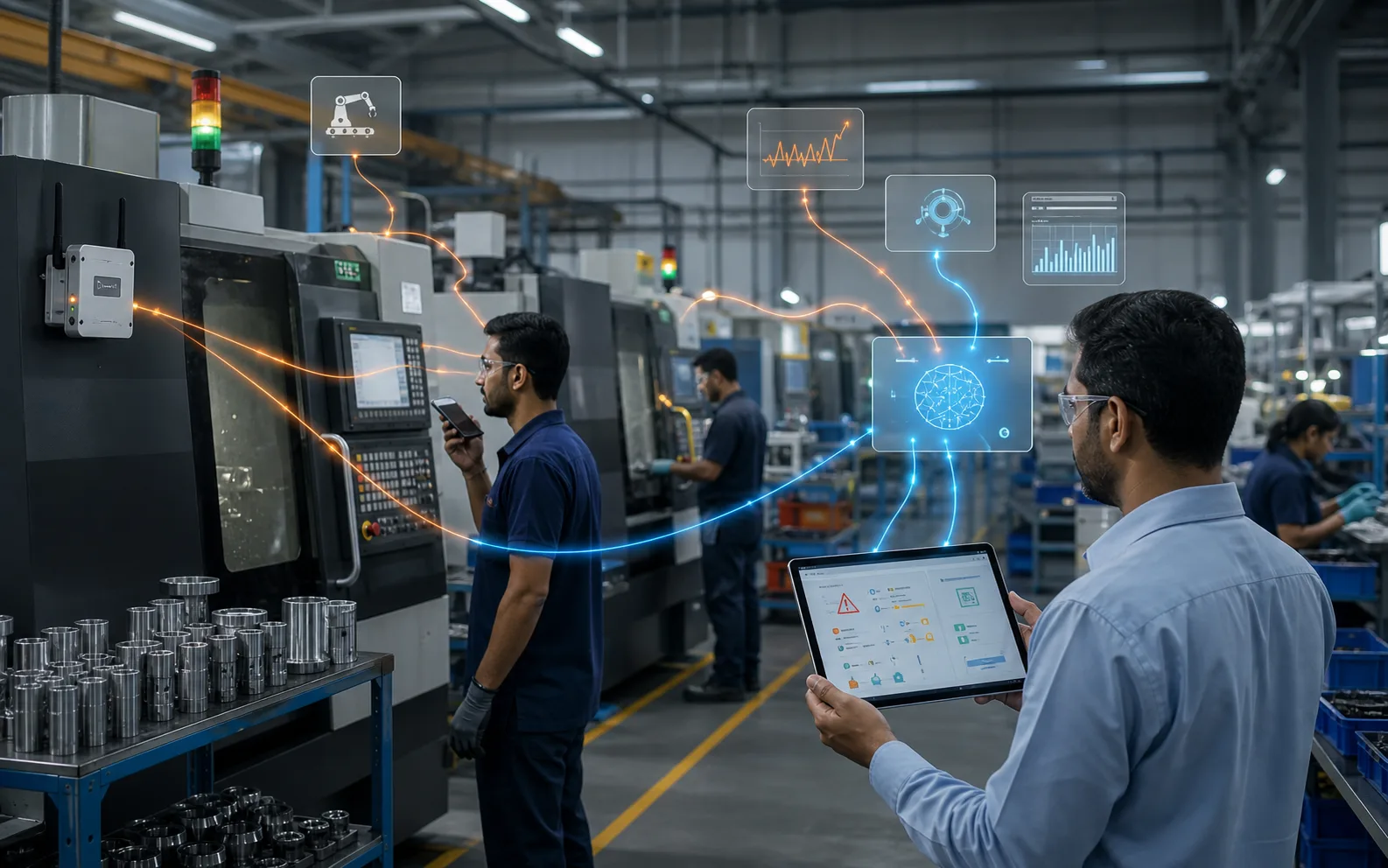
Yes, factory sensors can be monitored remotely if the sensor data has a reliable and secure path from the shop floor to the people who need it.
That path may include sensors, PLCs, IoT gateways, industrial networks, cloud platforms, user permissions, dashboards, and alerts. The exact setup depends on the factory’s machines, connectivity, security needs, and operating habits.
Remote monitoring is not only about seeing numbers from outside the plant. It is about making sure the right people can understand machine conditions, production status, downtime, utility usage, and alerts without waiting for a phone call or a manual report.
For manufacturers evaluating AICAN Optiwise, remote sensor monitoring can help owners, managers, maintenance teams, and supervisors stay connected to operations even when they are not standing beside the machine.
What remote sensor monitoring means
Remote monitoring means sensor data from the factory is available through a dashboard, mobile view, report, or alert outside the immediate machine location.
A sensor may measure cycle count, machine status, current draw, vibration, temperature, pressure, level, flow, or environmental conditions. The data is collected locally, sent through a gateway or connected system, then displayed in a platform accessible to authorised users.
This can be useful for factory owners, plant heads, production managers, maintenance leaders, and multi-site teams.
The factory still needs local reliability
Remote monitoring should not depend on fragile connectivity alone.
The factory floor should continue to operate even if the internet connection drops. In many setups, data can be collected locally and synced later. Critical machine control should remain properly designed at the machine or control level, not casually shifted to a remote dashboard.
Remote visibility is powerful, but it should not make the plant dependent on a weak network.
What infrastructure is usually needed?
A typical setup may include:
- sensors or machine data sources
- PLCs, controllers, or data acquisition devices
- IoT gateways or industrial PCs
- wired or wireless network connectivity
- secure internet or cloud connection
- dashboard software
- user access controls
- alert rules and escalation paths
- data storage for history and reporting
The exact architecture should match the factory. A small plant may need a simple gateway and dashboard. A larger manufacturer may need site-wise segmentation, role-based access, stronger cybersecurity controls, and integration with ERP or maintenance systems.
Remote alerts are often more useful than remote dashboards
A dashboard is helpful when someone checks it. Alerts are helpful when attention is needed.
Remote monitoring should include meaningful alerts for stoppages, abnormal sensor readings, production delays, temperature excursions, pressure issues, or maintenance warnings. But alerts must be designed carefully. If every small change triggers a notification, people stop paying attention.
Good alerts are specific, actionable, and routed to the right person.
Security matters from the beginning
Remote access creates responsibility.
Manufacturers should avoid casual setups where sensor systems are exposed without proper access control. Strong passwords, role-based access, network segmentation, secure gateways, update practices, and clear user permissions matter.
Remote monitoring should be convenient for authorised users and difficult for unauthorised users.
For more mature cyber hygiene, manufacturers can refer to official guidance such as CISA’s Cross-Sector Cybersecurity Performance Goals, which provide practical cybersecurity goals for organisations.
Remote monitoring helps multi-site management
If a company runs more than one plant, remote sensor monitoring can create a common operating view.
Leaders can compare machine availability, downtime patterns, production progress, utility usage, and maintenance alerts across sites. This is useful only if data definitions are consistent. “Downtime,” “running,” “idle,” and “production count” should mean the same thing across locations.
Without standard definitions, remote dashboards can create confusion at scale.
Remote monitoring should still respect the shop floor
Remote visibility should not become remote micromanagement.
People on the floor still understand local context: material delays, operator constraints, tooling problems, machine behaviour, and practical workarounds. A remote dashboard can show what happened, but conversations with the team explain why.
The best use of remote monitoring is support, not suspicion.
Start with a focused use case
Do not begin by trying to monitor everything.
Start with one useful question: Which machines are running? Which line is behind plan? Which compressor pressure drops at night? Which critical machine needs maintenance attention? Which site has recurring downtime?
A focused use case helps the team design the right sensors, data flow, dashboard, and alerts. Once the first use case works, remote monitoring can expand.
Where AICAN Optiwise fits
AICAN Optiwise helps manufacturers connect factory signals into dashboards, reports, and alerts that can support remote visibility. The value is strongest when remote access is tied to practical decisions, not passive monitoring.
AICAN builds for manufacturers that want connected operations across production, maintenance, inventory, and management. Learn more at About AICAN.
Founder’s Note
Remote monitoring is not about watching the factory from far away. It is about staying close to the truth of operations even when you are not physically present. The goal is faster support, clearer decisions, and fewer surprises.
FAQs
Can I monitor sensors from my phone?
Yes, if the system supports mobile access and the factory data is connected securely to the platform.
Do I need cloud for remote monitoring?
Often yes, but some setups use private networks, VPNs, or hybrid systems. The architecture depends on security and business needs.
Will machines stop if the internet goes down?
They should not, if the system is designed properly. Remote monitoring should not replace local machine control.
What sensors are useful for remote monitoring?
Machine status, production count, current, vibration, temperature, pressure, flow, level, and environmental sensors are common starting points.
How does AICAN Optiwise support remote monitoring?
It can bring machine and sensor data into dashboards, reports, and alerts so authorised users can understand factory status from anywhere.

Related Posts

Kanban System | Optiwise
Learn how a Kanban system works in manufacturing, where it helps, where it fails, and how Optiwise connects Kanban signals with inventory, purchase, and production planning.
12 Jun 2026Read more →Erp In Operations Management | Optiwise
Learn how ERP improves operations management by connecting planning, inventory, purchase, production, quality, dispatch, finance, and reporting.
12 Jun 2026Read more →ERP for FMCG Companies in India
A practical guide to ERP for FMCG companies in India, covering distributor orders, batch tracking, expiry, inventory, production, schemes, costing, and reporting.
11 Jun 2026Read more →
Optiwise, Odoo, Acumatica and Business Central for Manufacturing
Compare manufacturing workflows in Optiwise, Odoo, Acumatica and Dynamics 365 Business Central. See what your factory can run in Optiwise.
11 Jun 2026Read more →