
How Do I Monitor Welding Operations?
Learn how to monitor welding operations with job cards, welder assignment, fit-up readiness, stage progress, inspection holds, rework reasons, consumables, and ERP dashboards.
How Do I Monitor Welding Operations?
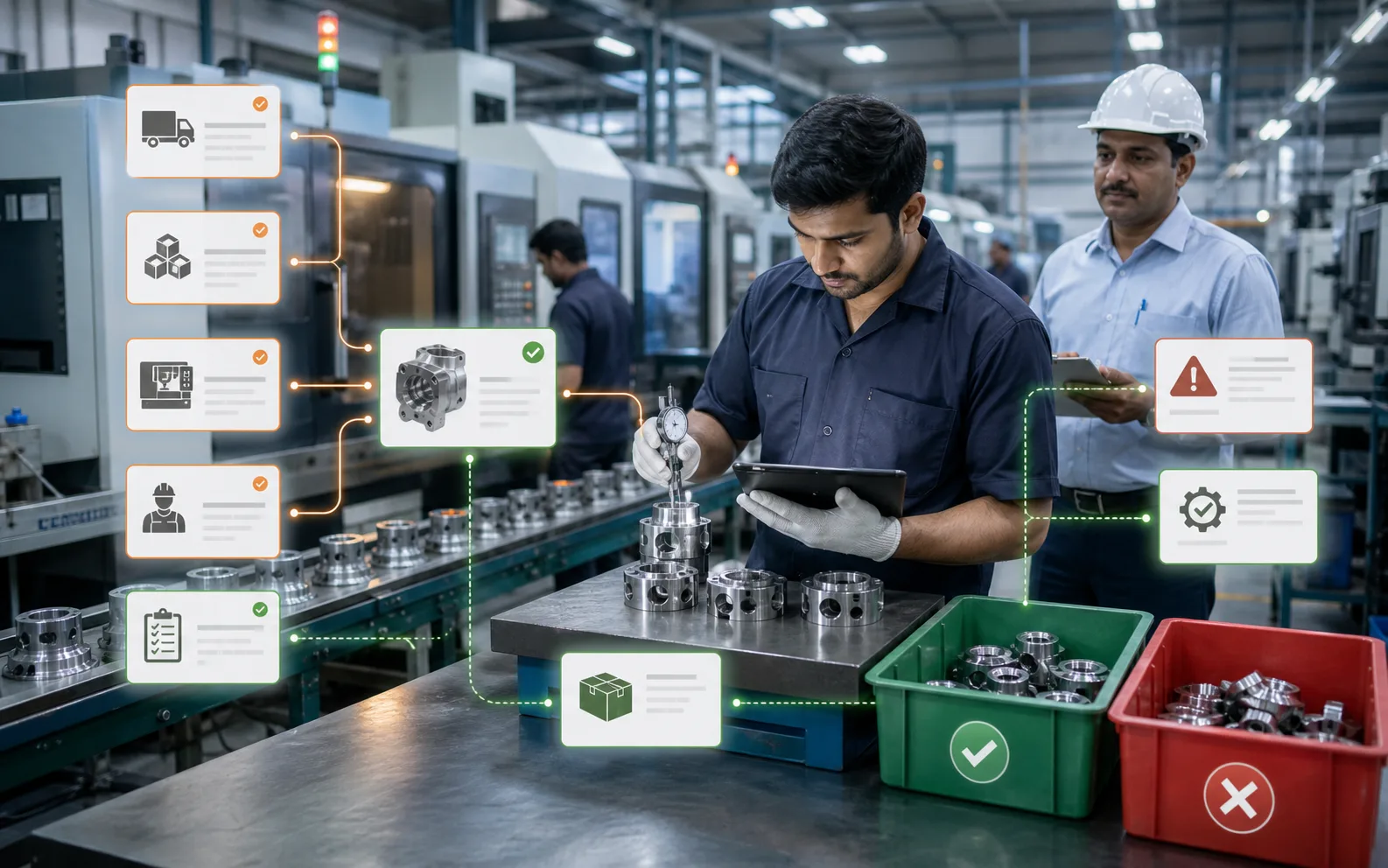
You monitor welding operations by tracking which jobs are ready for welding, which welders or bays are assigned, what stage each job is in, what inspection holds apply, what rework is pending, and whether welding output is moving according to plan.
In many fabrication shops, welding is the stage everyone watches, but not always the stage everyone understands. A job may be waiting for fit-up. A welder may be waiting for consumables. An assembly may be welded but pending inspection. Another may be rejected because distortion crossed tolerance. If all of that is tracked verbally, management gets a delayed and incomplete picture.
Welding monitoring should not be treated like worker surveillance. It should be treated as production control. The goal is to help welders work on ready jobs, reduce avoidable waiting, catch quality issues early, and give supervisors better visibility.
A connected ERP system like AICAN Optiwise helps bring welding progress, quality, material, job cards, and dispatch into one operating view.
Start With Welding Readiness
Before monitoring welding output, monitor welding readiness. Many welding delays begin before welding starts.
A job should be released to welding only when:
- Drawing revision is approved
- Material is cut and available
- Fit-up is complete or clearly planned
- Fixtures and jigs are ready
- Welding consumables are available
- Welder qualification or process requirement is understood
- Inspection hold points are known
- Priority and delivery date are clear
If readiness is weak, welding productivity will look poor even if welders are not the cause.
Use Job Cards For Welding Control
The welding job card should show what needs to be welded, where it sits in the production route, and what quality requirements apply.
A practical welding job card may include:
- Job number
- Part or assembly name
- Drawing revision
- Material details
- Fit-up status
- Welding process or instruction
- Quantity or joint details where needed
- Assigned welder or team
- Target completion date
- Inspection requirement
- Rework status if applicable
This gives welders and supervisors a shared reference instead of fragmented instructions.
Track Welding Stage Progress
A broad status like “under welding” is often too vague. The system should allow meaningful progress tracking based on the shop’s process.
For example:
- Ready for welding
- Welding started
- Root weld complete
- Full weld complete
- Grinding pending
- Inspection pending
- Rework required
- Rework complete
- Accepted
- Moved to next stage
Not every shop needs this level of detail, but the status should be specific enough to support decisions.
Capture Welder And Bay Assignment
Welder assignment helps with workload planning, accountability, and quality analysis. It should be used carefully and fairly.
If one welder repeatedly gets difficult jobs, output comparisons must consider job complexity. If one bay has more waiting time, the issue may be crane availability or fixture shortage. Data should be interpreted with context.
ERP can help show assignment and progress without turning the shop floor into a blame exercise.
Monitor Consumables And Supporting Material
Welding delays often happen because supporting material is missing: electrodes, wire, gas, fixtures, clamps, PPE, grinding wheels, or inspection tools.
A welding monitoring system should connect with inventory enough to show whether critical consumables are available. Otherwise, the dashboard may show the job is ready, but the welder is still waiting.
Track Inspection Holds
Quality inspection is closely tied to welding progress. A job may be welded but not released because visual inspection, dimensional inspection, NDT, pressure test, or customer inspection is pending.
ERP should make inspection holds visible. This prevents welding completion from being mistaken for job completion.
For quality-sensitive fabrication, inspection status may be one of the most important welding metrics.
Record Rework Clearly
Welding rework should be recorded with reason, stage, responsible process, and material or labour impact where practical.
Common rework reasons include:
- Weld defect
- Distortion
- Incorrect fit-up
- Wrong sequence
- Drawing mismatch
- Dimensional issue
- Incomplete weld
- Inspection rejection
Recording rework helps identify repeat causes. The goal is process improvement, not blame.
Use Welding Dashboards For Daily Control
A welding dashboard should show:
- Jobs ready for welding
- Jobs under welding
- Jobs delayed
- Welder or bay workload
- Inspection pending
- Rework pending
- Consumable shortage
- Jobs at dispatch risk
- Shift-wise output
The dashboard should help supervisors decide where to assign people and what problem to solve first.
Connect Welding With The Full Fabrication Flow
Welding does not exist alone. It depends on cutting and fit-up before it. It affects grinding, inspection, painting, assembly, and dispatch after it.
If welding monitoring is isolated, the team may improve one stage while the overall job still delays. ERP integration matters because it connects welding progress to the full order flow.
AICAN Optiwise helps manufacturers track welding as part of job progress, not as a separate spreadsheet.
Founder’s Note
At AICAN, we see welding monitoring as a way to protect skilled time. A good welder should not lose time because material is missing, fit-up is unclear, or inspection status is hidden. Software should make the work around welding better prepared.
That is how AICAN Optiwise approaches fabrication control: practical visibility that helps people do better work. You can read more about us on About AICAN.
FAQs
What is welding operation monitoring?
It is the process of tracking welding readiness, job assignment, welding progress, inspection status, rework, consumables, and delays.
Should welding be monitored by welder output only?
No. Welder output depends on job complexity, fit-up readiness, material availability, fixtures, inspection, and process requirements.
Can ERP track welding rework?
Yes. ERP can track rework reason, job, stage, inspection result, labour impact, and material impact where required.
Why is inspection status important in welding?
Because welded work may not be accepted until inspection is complete. Inspection holds can delay downstream stages and dispatch.
Can welding monitoring improve delivery?
Yes. It helps supervisors see which welding jobs are ready, delayed, pending inspection, or blocking dispatch.
How can AICAN Optiwise help?
AICAN Optiwise helps connect welding operations with job cards, production stages, quality, material, dispatch, and costing.

Related Posts

Kanban System | Optiwise
Learn how a Kanban system works in manufacturing, where it helps, where it fails, and how Optiwise connects Kanban signals with inventory, purchase, and production planning.
12 Jun 2026Read more →Erp In Operations Management | Optiwise
Learn how ERP improves operations management by connecting planning, inventory, purchase, production, quality, dispatch, finance, and reporting.
12 Jun 2026Read more →ERP for FMCG Companies in India
A practical guide to ERP for FMCG companies in India, covering distributor orders, batch tracking, expiry, inventory, production, schemes, costing, and reporting.
11 Jun 2026Read more →
Optiwise, Odoo, Acumatica and Business Central for Manufacturing
Compare manufacturing workflows in Optiwise, Odoo, Acumatica and Dynamics 365 Business Central. See what your factory can run in Optiwise.
11 Jun 2026Read more →