
Online Erp Software | Optiwise
Learn what online ERP software is, how it helps manufacturers connect departments, and what to check before choosing a cloud-based ERP system.

Online ERP Software for Manufacturing Businesses
An online ERP system gives a manufacturing business one connected place to manage daily operations. Instead of separate files for purchase, inventory, production, sales, and reporting, teams work from shared data.
For growing manufacturers, this matters because delays often happen between departments. Sales does not know stock status. Purchase does not know upcoming production demand. Stores updates inventory late. Management gets reports after the problem has already happened.
Online ERP software helps reduce this disconnect by making operational data available through the cloud.
What Is Online ERP Software?
Online ERP software is an enterprise resource planning system accessed through the internet. It usually runs on cloud infrastructure and allows users to work from browsers, mobile devices, or connected apps.
For manufacturers, ERP modules may include inventory, purchase, sales, production, BOM, quality, finance integration, reporting, approvals, and dashboards.
The word online is important because users are not limited to one office computer or local server. Teams can update and view information from different locations, subject to permissions.
Why Manufacturers Use Online ERP
Manufacturers use online ERP to improve visibility, reduce manual work, connect departments, standardize workflows, and support decision-making.
A purchase manager can see material requirements. A production planner can check stock readiness. Stores can update GRNs and issues. Sales can check order status. Management can view dashboards.
The value is not only convenience. The value is coordination.
Benefits of Online ERP Software
The first benefit is real-time visibility. Teams can see updated information faster than with manual reports.
The second benefit is easier collaboration. Multiple departments can work on connected workflows without maintaining separate versions of truth.
The third benefit is lower IT burden compared with many on-premise systems. Updates, backups, and access can be easier to manage, depending on the vendor.
The fourth benefit is scalability. As the business adds users, locations, or workflows, cloud-based ERP can often expand more smoothly.
Risks and Questions to Check
Online ERP also needs careful evaluation. Manufacturers should check data security, uptime, user permissions, backup policies, export options, implementation support, internet dependency, integration needs, and long-term cost.
Cybersecurity matters. Role-based access, strong passwords, user discipline, audit trails, and vendor security practices should be reviewed. This article is not cybersecurity or legal advice; businesses should consult qualified professionals for risk assessment.
Manufacturing-Specific Requirements
Generic ERP may not be enough for manufacturing. A manufacturing business should check whether the system handles BOM, routing, work orders, material issue, production consumption, rejection, batch tracking, QC, machine data, and inventory valuation support.
The ERP should reflect factory reality, not only office workflow.
Implementation Approach
Start with process mapping. Identify how purchase, inventory, production, sales, and dispatch currently work. Clean item masters, vendors, customers, BOMs, and opening stock.
Then implement in phases. Inventory and purchase often make a strong starting point because they affect many other workflows. Production planning can follow once stock discipline improves.
Training is critical. ERP adoption fails when users treat the system as extra work instead of the main workflow.
How Optiwise Helps
AICAN Optiwise is built as a connected manufacturing operating system bringing together ERP, IoT, reporting, and AI capabilities. For manufacturers looking at online ERP, this matters because cloud access alone is not enough. The system must understand production, inventory, and operational signals.
With Optiwise by AICAN, manufacturers can connect purchase, inventory, sales, production, and management dashboards while building toward AI-supported decision-making. Learn more about AICAN and its AI-native manufacturing focus.
Selection Checklist
Before choosing online ERP, ask:
- Does it support manufacturing workflows?
- Can users adopt it without heavy friction?
- Are permissions and audit trails clear?
- Can data be exported if needed?
- Does it support reporting for management?
- Does it connect inventory with production and purchase?
- What implementation support is included?
- How will the system scale over three years?
Founder’s Note
AICAN’s founder-led view is that online ERP should not be treated as just cloud software. It should become the operating backbone of the factory.
The goal is not to digitize old confusion. The goal is to give every department a cleaner way to work from the same facts.
FAQs
What is online ERP software?
Online ERP software is a cloud-accessible system that connects business processes such as inventory, purchase, production, sales, and reporting.
Is online ERP suitable for manufacturing?
Yes, if it supports manufacturing-specific workflows such as BOM, work orders, material issue, production tracking, and inventory control.
Is online ERP secure?
Security depends on the vendor, configuration, user practices, access controls, and data policies. Businesses should assess security carefully.
How long does ERP implementation take?
It depends on scope, data quality, process complexity, and team readiness. A phased rollout is often safer.
Why choose Optiwise by AICAN?
Optiwise is designed for connected manufacturing operations with ERP, IoT, reporting, and AI-supported workflows.
Final Thought
Online ERP software helps manufacturers move from scattered updates to shared operating visibility. The right system becomes less like software and more like the daily rhythm of the business.

Related Posts

Kanban System | Optiwise
Learn how a Kanban system works in manufacturing, where it helps, where it fails, and how Optiwise connects Kanban signals with inventory, purchase, and production planning.
12 Jun 2026Read more →Erp In Operations Management | Optiwise
Learn how ERP improves operations management by connecting planning, inventory, purchase, production, quality, dispatch, finance, and reporting.
12 Jun 2026Read more →ERP for FMCG Companies in India
A practical guide to ERP for FMCG companies in India, covering distributor orders, batch tracking, expiry, inventory, production, schemes, costing, and reporting.
11 Jun 2026Read more →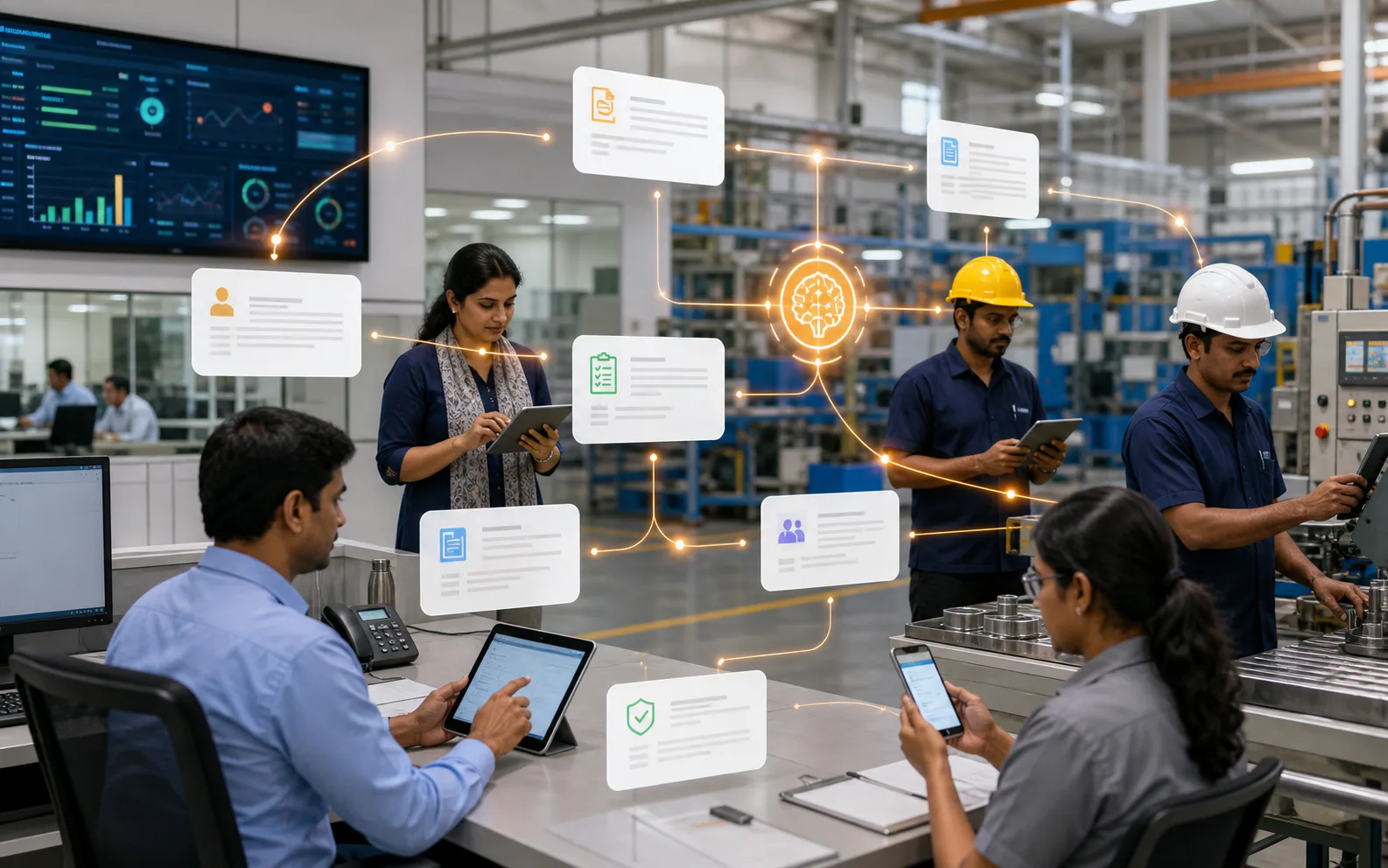
Optiwise, Odoo, Acumatica and Business Central for Manufacturing
Compare manufacturing workflows in Optiwise, Odoo, Acumatica and Dynamics 365 Business Central. See what your factory can run in Optiwise.
11 Jun 2026Read more →