
Real Manufacturing Companies Share Their ERP Stories
Learn practical lessons from real manufacturing ERP stories, including visibility, BOM accuracy, scalability, shop-floor control, and why ERP success depends on process fit.
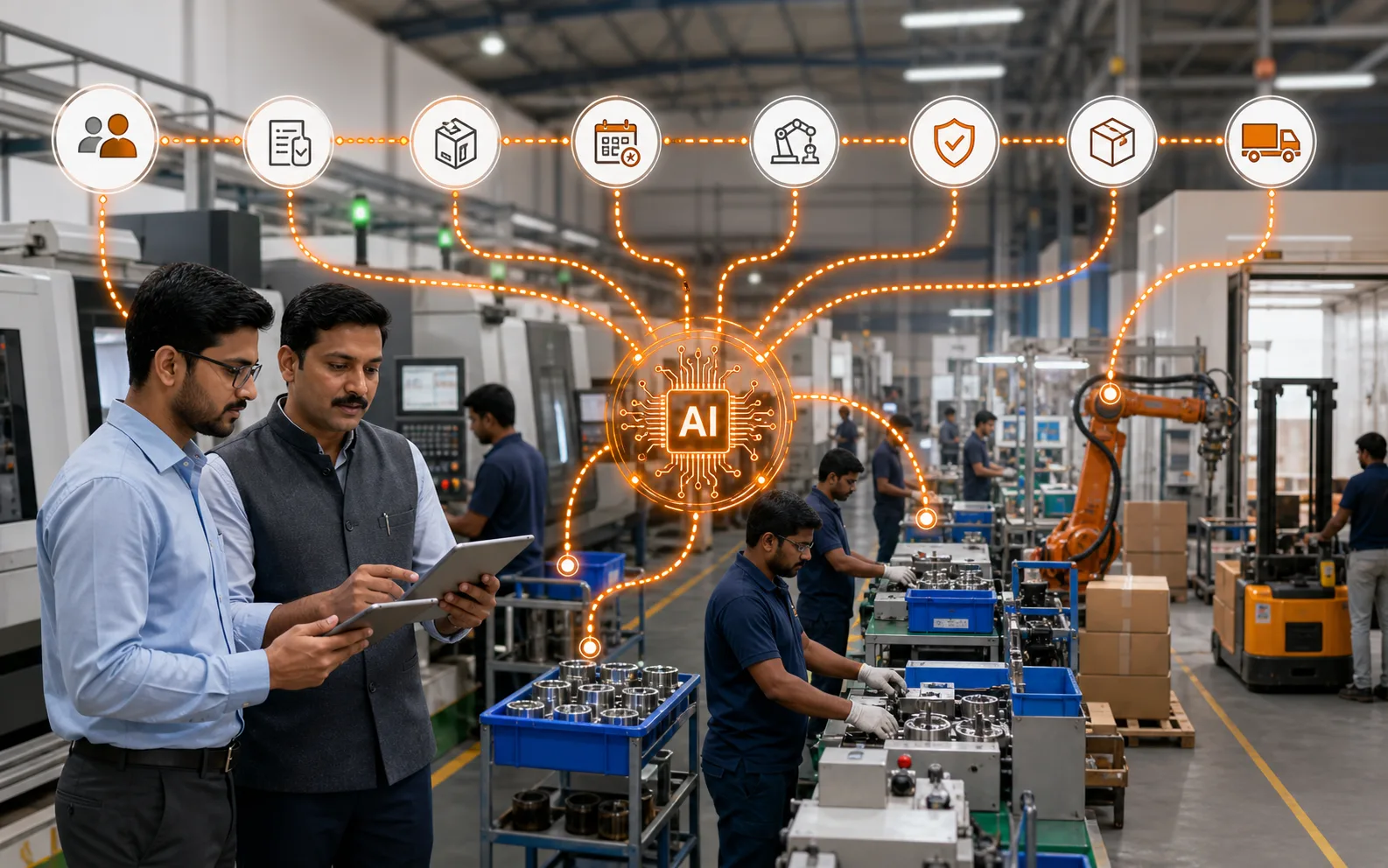
Real Manufacturing Companies Share Their ERP Stories
Real ERP stories are useful because they show what manufacturers actually struggle with.
Not in theory. In operations.
ERP decisions often begin with feature lists, price comparisons, and vendor demos. Those are important, but they do not always show the human reality: messy data, growing locations, inaccurate BOMs, disconnected departments, late reports, shop-floor confusion, and the pressure to deliver on time.
Customer stories help because they reveal patterns.
A trailer manufacturer may need better BOM accuracy and multi-location control. A precision manufacturer may need order-driven production visibility. A small business inside a larger group may need ERP that is powerful enough but not too heavy. A manufacturer using dashboards may need faster cross-department communication.
The names change. The lesson repeats: ERP succeeds when it solves real operating problems, not when it only adds software.
Quick Answer
Real manufacturing ERP stories show that manufacturers often invest in ERP to improve visibility, BOM accuracy, production control, scalability, shop-floor communication, forecasting, inventory, and decision-making. Public examples from vendors such as Infor and Microsoft show manufacturers using ERP to support growth, improve data access, and coordinate operations.
But these stories should be read carefully. A successful ERP story does not mean the same system will automatically work for every manufacturer. The lesson is to study the problem solved, the implementation context, and the process changes behind the result.
Story Pattern 1: Growth Creates Visibility Problems
One public Infor story discusses Novae, a trailer manufacturer that expanded across many facilities and brands using Infor VISUAL. The story highlights supply chain visibility, integration, time-to-market, and BOM accuracy improvements.
The lesson is clear.
As manufacturers grow, the old way of managing information breaks down. More products, locations, brands, suppliers, and production requirements create more coordination pressure.
ERP becomes valuable when growth needs structure.
For a growing manufacturer, questions become harder:
- Which location has stock?
- Which BOM version is correct?
- Which product configuration is approved?
- Which supplier is delayed?
- Which production unit is overloaded?
- Can leadership see one consolidated view?
Growth without systems creates operational drag.
Story Pattern 2: Complex Manufacturing Needs Order Visibility
Infor also has public material around Major Tool and Machine, a precision manufacturing company focused on complex fabricated and machined parts and assemblies.
This type of manufacturing needs more than basic inventory.
Complex jobs require visibility into orders, operations, resources, quality, cost, and delivery. When parts are high-value or technically demanding, the cost of poor visibility is serious.
The lesson for manufacturers is this: the more complex your jobs, the more important ERP fit becomes.
A simple system may track orders. A manufacturing ERP must help control the journey from order to production to inspection to delivery.
Story Pattern 3: Dashboards Improve Cross-Department Communication
Infor has a public resource about Exhibit Concepts using VISUAL ERP dashboards to help employees pass information between departments quickly and easily. The resource also references shop-floor mobile, document maintenance, and real-time cost visibility.
This highlights a common ERP benefit: better communication.
Many factories do not lack effort. They lack shared information.
Sales, production, stores, purchase, quality, and finance may all work hard but still operate from different data.
ERP dashboards help when they give teams the same operating truth.
Story Pattern 4: Small Businesses Need ERP That Fits Their Scale
Microsoft has a public customer story about Michelin using Dynamics 365 Business Central for its small and medium-sized businesses, noting that its corporate ERP was suitable for central operations but exceeded the needs and IT budget of those smaller entities.
This lesson is important.
Bigger ERP is not always better.
A small manufacturer may need serious capability, but not unnecessary complexity. ERP should match the operating scale of the business.
The best system is not always the most famous or most expensive. It is the one that the team can implement, afford, use, and grow with.
Story Pattern 5: Data Access Supports Forecasting and Planning
Microsoft also has a public story about Hartmann's using Dynamics 365 Business Central, where the company emphasizes the importance of quick data access and using sales and stock information to forecast production needs.
This is another common ERP lesson.
Manufacturing planning improves when sales, stock, and production information are connected.
If what you sell and what you have in stock are disconnected, production forecasting becomes guesswork. ERP helps by putting planning inputs into one system.
What These Stories Have in Common
Across ERP stories, the same themes appear:
- Visibility matters.
- Data accuracy matters.
- BOM control matters.
- Inventory and production must connect.
- Dashboards must support decisions.
- ERP must fit company size.
- Implementation partners matter.
- Users need adoption support.
- Process change matters as much as software.
The industry may differ, but the operating principles repeat.
How to Read ERP Stories Critically
ERP stories can be inspiring, but they are also marketing assets.
Read them with useful questions:
- What problem did the company have before ERP?
- What size and industry was the company?
- Which modules were implemented?
- What data was cleaned?
- What process changed?
- How long did implementation take?
- What role did the partner play?
- What measurable result was claimed?
- Is the result relevant to my business?
- What is not mentioned?
A story is useful when it helps you ask better questions.
Do Not Copy Another Company Blindly
A manufacturer should not choose ERP only because another company used it successfully.
Your products, users, data maturity, budget, process complexity, and support needs may be different.
Use stories as evidence, not as final decision.
The best evaluation is still a real workflow demo using your own scenario.
Take one customer order and ask the vendor to show the full flow:
- Enquiry
- Quotation
- BOM
- Material planning
- Purchase
- Work order
- Production
- Quality
- Dispatch
- Costing
- Reports
That reveals fit better than logos.
Where AICAN Optiwise Fits
AICAN Optiwise is built from the same practical lessons manufacturers learn in ERP journeys: visibility must improve, data must connect, shop-floor reality must be respected, and owners need faster answers.
Optiwise brings together CRM, quotations, production, inventory, purchase, work orders, layered BOM, cost estimation, quality, shop-floor tracking, IoT, reports, and AI agents.
For Indian MSME manufacturers, Optiwise focuses on practical adoption:
- Connected workflows from enquiry to dispatch
- Inventory and purchase visibility
- Production and work order control
- Quality and rejection tracking
- IoT and shop-floor visibility
- AI alerts and summaries
- Owner dashboards for daily decisions
Explore AICAN Optiwise and About AICAN.
Practical Lesson for Your Factory
When reading any ERP story, translate it into your own factory language.
If the story talks about BOM accuracy, ask whether your BOMs are reliable.
If the story talks about dashboards, ask whether your managers trust current reports.
If the story talks about multi-location growth, ask whether your locations share one truth.
If the story talks about forecasting, ask whether sales, stock, and production data are connected.
The value of ERP stories is not admiration. It is reflection.
FAQ
Are ERP customer stories useful?
Yes, if you use them to understand problems solved, process changes, and implementation lessons. Do not choose ERP only based on customer logos.
What do manufacturing ERP stories usually show?
They often show improvements in visibility, BOM accuracy, production planning, reporting, inventory, scalability, shop-floor communication, and decision-making.
Should I ask ERP vendors for customer references?
Yes. Ask for references similar to your industry, size, manufacturing type, and complexity.
Can I rely on vendor case studies completely?
No. Vendor case studies are useful but selective. Validate fit through demos, reference calls, process mapping, and total cost analysis.
What should I learn from ERP success stories?
Look for the operational problem, the implementation approach, the process change, the adoption effort, and the measurable impact.
How does AICAN Optiwise apply these lessons?
AICAN Optiwise focuses on practical manufacturing workflows, production visibility, inventory, purchase, quality, IoT, AI agents, and reports for MSME manufacturers.
Founder’s Note
ERP stories are valuable when they are honest about the problem, not just proud of the result.
Manufacturers do not need fantasy stories. They need to see how other companies moved from scattered information to better control.
At AICAN, we believe every factory has its own journey, but the need for clarity is universal.
Final Thought
Real manufacturing ERP stories show one thing clearly: software matters, but fit matters more.
Study the stories. Learn the patterns. Then evaluate ERP based on your own factory’s process, people, data, and growth plans.

Related Posts
A Manufacturing Alternative to SAP: Optiwise
Run your factory in Optiwise, a manufacturing alternative to SAP Business One with connected operations, AI agents and no-code workflows.
14 Jun 2026Read more →How Do I Know If My Manufacturing Business Really Needs an ERP?
A practical guide for manufacturers to identify when spreadsheets, manual follow-ups, and disconnected systems are no longer enough — and when ERP becomes an operational necessity.
14 Jun 2026Read more →Production Management System Optimized | Optiwise
Learn best practices for optimizing a production management system across planning, scheduling, material readiness, quality, and reporting.
12 Jun 2026Read more →
What Is the Best ERP for Pharmaceutical Manufacturing?
Learn how to choose the best ERP for pharmaceutical manufacturing, with guidance on batch control, quality workflows, traceability, inventory, documentation, and GMP discipline.
10 Jun 2026Read more →