
Sensor selection based on industry vertical
Learn how sensor selection changes across manufacturing industries such as food, automotive, textiles, packaging, metalworking, chemicals, and electronics.
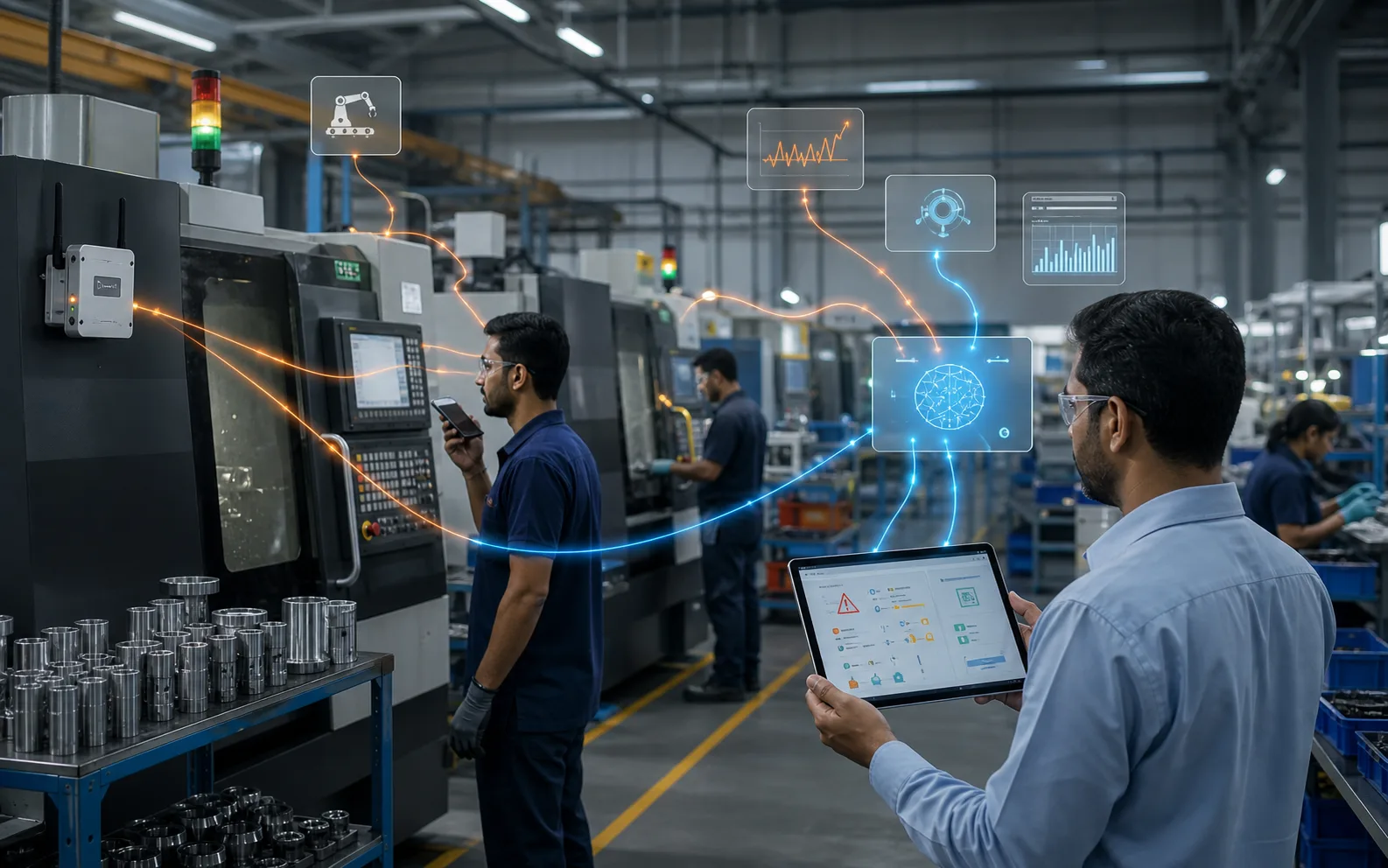
Sensor Selection Based on Industry Vertical
The right sensor depends heavily on the industry using it.
A sensor that works well in a clean electronics line may struggle in a dusty fabrication shop. A sensor suitable for a packaging conveyor may not survive washdown in food processing. A vibration sensor useful on a motor may not solve a textile thread break problem.
Sensor selection should match the process, material, environment, quality requirement, and maintenance capability of the industry.
For manufacturers using AICAN Optiwise, industry context matters because each vertical needs different dashboards, alerts, and decision signals.
Food and beverage manufacturing
Food and beverage environments may involve washdown, humidity, temperature control, hygiene requirements, and traceability.
Useful sensors may include temperature, pressure, flow, level, humidity, metal detection, vision inspection, and machine status sensors. Sensor housings, cables, and connectors may need protection against water, cleaning chemicals, and hygiene-related exposure.
Data may support quality records, batch traceability, cleaning routines, and process stability.
Automotive and component manufacturing
Automotive suppliers often need repeatability, traceability, cycle monitoring, and quality control.
Common sensors include proximity sensors, displacement sensors, force sensors, vision systems, torque monitoring, current sensors, vibration sensors, barcode or QR readers, and process condition sensors.
The value lies in stable production, defect prevention, traceability, and quick root-cause analysis.
Textiles and garments
Textile environments may involve dust, lint, speed, tension, humidity, and continuous movement.
Sensor choices may include thread break detection, speed sensors, humidity sensors, temperature sensors, machine status monitoring, vibration sensors, and energy monitoring. Optical sensors must be chosen carefully because lint and dust can affect performance.
Useful analytics may focus on stoppages, machine utilization, quality variation, and energy use.
Packaging and printing
Packaging lines often need high-speed detection, counting, label inspection, fill verification, and rejection control.
Photoelectric sensors, vision systems, barcode readers, proximity sensors, encoder signals, colour sensors, and weight or checkweigher data may be useful. Lighting, reflectivity, transparent materials, and line speed matter a lot.
The main goal is to prevent mispacks, missed labels, count errors, and line stoppages.
Metalworking and fabrication
Metalworking environments can be harsh.
Heat, chips, coolant, vibration, oil mist, and electrical noise can affect sensor reliability. Useful sensors include inductive proximity sensors, current sensors, vibration sensors, temperature sensors, pressure sensors, flow sensors, and machine status signals.
Sensor protection and rugged mounting are especially important.
Chemical and process industries
Chemical and process manufacturing often depends on stable process conditions.
Pressure, temperature, flow, level, pH, conductivity, gas, and environmental sensors may be important. Material compatibility and safety requirements must be considered carefully.
Data may support process control, compliance records, safety awareness, and batch consistency.
Electronics manufacturing
Electronics production may involve small parts, precision, clean environments, traceability, and inspection.
Vision systems, barcode readers, presence sensors, temperature and humidity sensors, ESD monitoring, and machine status signals may be relevant. Accuracy and data traceability can be more important than ruggedness in some areas.
The sensor strategy should support quality and traceability without slowing production.
Selection should follow the decision, not the industry label alone
Industry gives direction, but the exact use case still matters.
A food plant and a metalworking plant may both need vibration sensors for motors. A packaging line and electronics line may both use vision systems. The industry helps define constraints, but the operating question defines the sensor.
Ask what decision the signal will improve.
Where AICAN Optiwise fits
AICAN Optiwise helps manufacturers bring machine and sensor signals into dashboards, alerts, and reports suited to production, maintenance, quality, and management workflows. Industry context helps make those views more relevant.
AICAN works with manufacturers across different operating realities, helping teams digitize without forcing every plant into the same template. Learn more at About AICAN.
Founder’s Note
No factory is “generic.” The right sensor choice respects what is being made, how it is made, and what can go wrong during the shift. Industry context is not a marketing category; it is a practical design input.
FAQs
Can the same sensor be used across industries?
Sometimes, but environment, material, speed, hygiene, and accuracy needs must be checked.
Which industry needs the most rugged sensors?
Metalworking, fabrication, outdoor, washdown, and heavy process environments often need rugged selection.
Are vision systems useful in every industry?
They can be useful, but lighting, inspection complexity, line speed, and ROI must be evaluated.
Should I select sensors by industry or by use case?
Use industry to understand constraints, then select by use case and decision need.
How does AICAN Optiwise adapt to different industries?
It can use connected signals to build dashboards and workflows relevant to each factory’s production, maintenance, and quality priorities.

Related Posts

Kanban System | Optiwise
Learn how a Kanban system works in manufacturing, where it helps, where it fails, and how Optiwise connects Kanban signals with inventory, purchase, and production planning.
12 Jun 2026Read more →Erp In Operations Management | Optiwise
Learn how ERP improves operations management by connecting planning, inventory, purchase, production, quality, dispatch, finance, and reporting.
12 Jun 2026Read more →ERP for FMCG Companies in India
A practical guide to ERP for FMCG companies in India, covering distributor orders, batch tracking, expiry, inventory, production, schemes, costing, and reporting.
11 Jun 2026Read more →
Optiwise, Odoo, Acumatica and Business Central for Manufacturing
Compare manufacturing workflows in Optiwise, Odoo, Acumatica and Dynamics 365 Business Central. See what your factory can run in Optiwise.
11 Jun 2026Read more →