
What Software Is Used in Automotive Manufacturing Plants?
Understand the main software systems used in automotive manufacturing plants, including ERP, MES, quality systems, inventory tools, maintenance software, and analytics dashboards.

What Software Is Used in Automotive Manufacturing Plants?
Automotive manufacturing plants use several types of software, but the most important point is not the number of systems. It is whether those systems work together.
A factory can have ERP, machine dashboards, quality software, spreadsheets, accounting tools, maintenance logs, barcode systems, and customer portals. If they are disconnected, people still spend hours asking for status, reconciling reports, and correcting mismatched data.
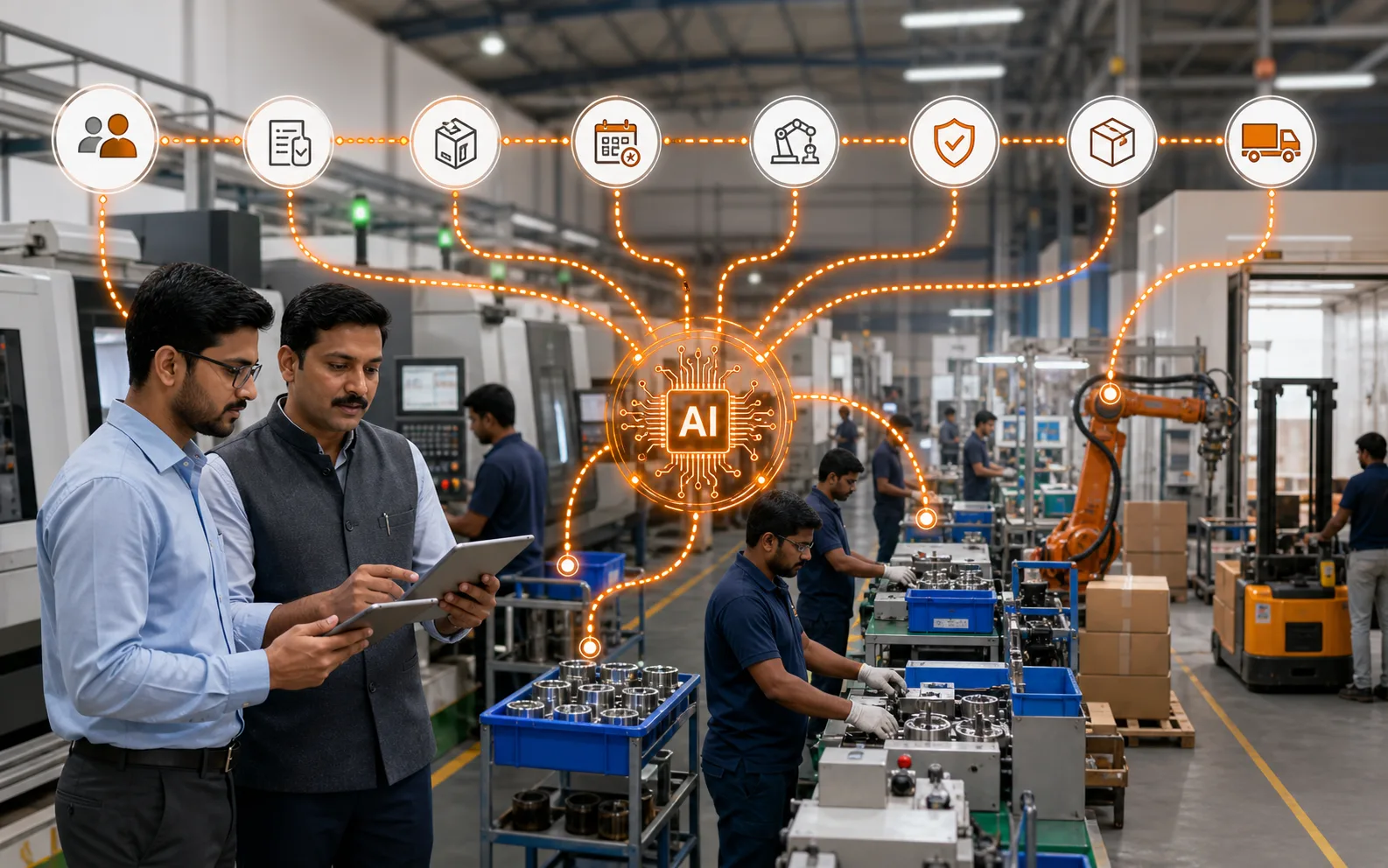
The best automotive plants treat software as an operating system for the factory. Each tool should support a clear workflow: customer demand, production planning, material control, machine execution, quality checks, maintenance, dispatch, and management review.
For manufacturers that want this connected view, AICAN Optiwise is designed to bring key factory operations into one practical system rather than leaving teams scattered across disconnected tools.
ERP: The Core Business and Operations System
ERP is usually the central system in an automotive manufacturing company. It manages the business flow from order to dispatch and connects departments such as sales, purchase, stores, production, quality, finance, and management.
In an automotive plant, ERP typically supports:
- Customer orders and schedules.
- BOM and routing.
- Material requirement planning.
- Purchase orders and supplier follow-up.
- Inventory management.
- Production orders.
- Job work and subcontracting.
- Quality checks.
- Rejection and rework.
- Dispatch and invoicing.
- Costing and reporting.
ERP is important because it gives the business a shared source of truth. Without ERP, many decisions depend on spreadsheets, calls, and manual registers.
However, ERP must be manufacturing-ready. A generic billing or accounting system is not enough for automotive production. The system must understand material flow, process flow, WIP, inspection, and traceability.
MES: Shopfloor Execution and Real-Time Production
MES, or Manufacturing Execution System, sits closer to the shopfloor. While ERP plans and controls the business flow, MES helps manage execution on the line.
MES may track:
- Machine status.
- Operator activity.
- Production counts.
- Cycle time.
- Downtime.
- Work order progress.
- Line performance.
- Process parameters.
- Shift output.
In larger plants, MES can be connected to machines, sensors, PLCs, barcode scanners, and operator terminals. In smaller or mid-sized factories, some MES-like functions may be handled inside a manufacturing ERP if the system supports shopfloor reporting.
The practical question is not whether a company must buy a separate MES immediately. The question is whether production execution data is visible and reliable enough for decisions.
Quality Management Software
Automotive manufacturing depends heavily on quality control. Quality software may manage inspection plans, incoming inspection, in-process inspection, final inspection, nonconformance, rework, corrective actions, customer complaints, supplier quality, and audit records.
Quality software should help answer:
- Which material passed incoming inspection?
- Which production batch failed in-process inspection?
- What defect was found?
- Who reviewed it?
- What corrective action was taken?
- Which customer dispatch may be affected?
- Which supplier is linked to repeated defects?
Some plants use separate QMS software. Others use quality modules inside ERP. The key is integration. If quality results are not connected to production, inventory, and dispatch, the factory may release material without full context.
AICAN focuses on making this operational data usable. Quality should not be a file cabinet. It should be part of the live manufacturing flow.
Inventory and Warehouse Management Tools
Automotive plants need accurate inventory across raw material, bought-out parts, WIP, finished goods, rejected stock, packing material, and material at subcontractor locations.
Warehouse or inventory software may include:
- Barcode scanning.
- Bin location tracking.
- GRN and inspection status.
- Material issue to production.
- Stock transfer.
- Finished goods movement.
- Dispatch picking.
- Cycle counting.
Inventory tools are valuable only when transactions are captured on time. If the software is too difficult, users delay entries and stock reports become unreliable.
A practical ERP should make inventory movement easy enough for stores and production teams to use daily.
Maintenance Management Software
Machine uptime is critical in automotive production. Maintenance software helps teams track preventive maintenance, breakdowns, spare parts, work orders, machine history, and downtime reasons.
A maintenance system can help answer:
- Which machines are due for preventive maintenance?
- Which machines break down repeatedly?
- Which spare parts are consumed often?
- How much downtime is linked to maintenance?
- Which breakdowns affected production commitments?
In some factories, maintenance is handled through CMMS software. In others, ERP includes maintenance workflows. Either way, maintenance data becomes more useful when it connects with production loss and planning impact.
Machine Monitoring and IIoT Systems
Modern automotive plants may use machine monitoring or Industrial IoT systems to collect data directly from machines. These systems can track machine status, runtime, idle time, alarms, energy use, process values, and output counts.
Machine connectivity is especially useful for CNC, VMC, presses, injection moulding machines, assembly lines, and automated stations.
But machine data alone is not enough. A machine dashboard may show downtime, but the business still needs to know which order was affected, which dispatch is at risk, and what corrective action is needed.
The strongest value comes when machine data connects to ERP or production planning.
Product Lifecycle and Engineering Software
Automotive companies may also use CAD, CAM, PLM, and document control systems. These tools manage drawings, designs, engineering changes, process documents, and technical specifications.
For component manufacturers, engineering change control is important. A revised drawing or BOM must reach production, purchase, quality, and costing at the right time. If engineering data is disconnected, the factory may produce using outdated information.
ERP does not replace engineering software, but it should reflect approved BOMs, routings, revisions, and process requirements.
Analytics and Management Dashboards
Management dashboards turn operating data into decisions. They may track production output, delivery performance, rejection trends, inventory value, purchase delays, machine downtime, and profitability.
Dashboards are useful when the underlying data is accurate. If the factory data is late or incomplete, the dashboard only displays polished uncertainty.
A strong dashboard should show risk, not just history. For example:
- Which dispatches are at risk?
- Which materials are short?
- Which suppliers are delayed?
- Which quality issues are repeating?
- Which machines are affecting production?
- Which orders are behind plan?
This is the type of visibility AICAN Optiwise aims to support for manufacturing teams.
Spreadsheets Still Exist, But They Should Not Run the Factory
Excel and Google Sheets are useful. They are flexible and familiar. But when spreadsheets become the main production planning system, the factory becomes dependent on manual updates.
Common spreadsheet risks include:
- Multiple versions of the truth.
- Manual formula errors.
- Delayed updates.
- No proper approval flow.
- Poor traceability.
- No connection to live stock or production.
Spreadsheets can support analysis, but core operations should sit in a controlled system.
How to Choose the Right Software Stack
Automotive manufacturers should not buy software because every competitor is using it. They should map their operating problems first.
Ask:
- Do we have accurate inventory?
- Can we plan production from customer demand?
- Can we trace material and quality issues?
- Can we track WIP clearly?
- Can we see machine downtime impact?
- Can we manage supplier delays?
- Can we prepare audit data quickly?
- Can management see risk before customers complain?
Once the problems are clear, software selection becomes easier.
Put Optiwise to work in your factory
Run your automotive manufacturing workflow in Optiwise. Plan nested BOMs, allocate machines and workers, capture production output, track subcontract material and apply quality inspections before accepting finished goods.
For companies using separate tools for machines, quality, or engineering, the goal should be integration. The factory should not become a collection of disconnected screens.
You can read more about AICAN and its work at About AICAN.
Founder’s Note
Software should reduce confusion, not create a second factory made of screens and reports. The best systems respect how the shopfloor works and then make the truth easier to see.
In automotive manufacturing, the winning stack is not always the biggest stack. It is the most connected one. That is the point we keep coming back to at AICAN.
FAQs
What software is commonly used in automotive manufacturing plants?
Common systems include ERP, MES, quality management software, inventory tools, maintenance software, machine monitoring systems, engineering tools, and analytics dashboards.
Is ERP enough for an automotive plant?
For many small and mid-sized manufacturers, a strong manufacturing ERP can cover core workflows. Larger plants may add MES, machine monitoring, PLM, or dedicated QMS tools depending on complexity.
Why is integration important?
Integration prevents departments from working with disconnected data. It helps production, purchase, stores, quality, and management see the same operating reality.
Can AICAN Optiwise replace spreadsheets?
AICAN Optiwise can reduce dependency on spreadsheets for core factory workflows by connecting production, inventory, purchase, quality, and reporting in one system.
What should manufacturers evaluate first?
They should evaluate their biggest operational gaps: planning, inventory accuracy, quality traceability, supplier delays, WIP visibility, machine downtime, and dispatch control.

Related Posts
A Manufacturing Alternative to SAP: Optiwise
Run your factory in Optiwise, a manufacturing alternative to SAP Business One with connected operations, AI agents and no-code workflows.
14 Jun 2026Read more →How Do I Know If My Manufacturing Business Really Needs an ERP?
A practical guide for manufacturers to identify when spreadsheets, manual follow-ups, and disconnected systems are no longer enough — and when ERP becomes an operational necessity.
14 Jun 2026Read more →Production Management System Optimized | Optiwise
Learn best practices for optimizing a production management system across planning, scheduling, material readiness, quality, and reporting.
12 Jun 2026Read more →What Is the Best ERP for Pharmaceutical Manufacturing?
Learn how to choose the best ERP for pharmaceutical manufacturing, with guidance on batch control, quality workflows, traceability, inventory, documentation, and GMP discipline.
10 Jun 2026Read more →