
What Software Is Used in Machine Shops?
Understand the main software used in machine shops, including ERP, job card systems, quotation tools, CAD/CAM, production tracking, quality software, machine monitoring, and dashboards.

What Software Is Used in Machine Shops?
Machine shops use different types of software depending on their size, process complexity, and customer requirements. The most common software includes ERP, quotation tools, job card systems, CAD/CAM, production tracking, quality management, inventory software, machine monitoring, and accounting tools.
But the real question is not how many tools a machine shop uses. The real question is whether the tools are connected enough to run jobs with control.
A machine shop may quote in Excel, program in CAM software, track jobs on paper, manage stock in accounting software, inspect parts in separate files, and prepare dispatch documents elsewhere. This can work, but it creates gaps. Owners spend too much time asking for status and too little time improving capacity and profitability.
AICAN Optiwise helps machine shops connect job work workflows from enquiry to dispatch.
ERP for Machine Shops
ERP is the central system that connects commercial and production workflows.
A machine shop ERP should support:
- Enquiry management.
- Quotation.
- Job cards.
- Machine scheduling.
- Material tracking.
- Production reporting.
- WIP visibility.
- Quality checks.
- Rework and rejection.
- Job-wise costing.
- Dispatch.
- Reports and dashboards.
ERP gives the shop a shared operating record.
Quotation Software
Quotation software helps estimate job cost and prepare customer offers.
It should consider:
- Material cost.
- Machine time.
- Setup time.
- Tooling.
- Fixtures.
- Outside processes.
- Inspection effort.
- Quantity breaks.
- Delivery urgency.
- Margin.
A strong quotation workflow should connect to job cards after order confirmation. This allows the shop to compare estimated and actual cost later.
Job Card and Production Tracking Software
Job card software turns customer orders into shopfloor instructions.
It should show:
- Part details.
- Drawing revision.
- Operation sequence.
- Machine allocation.
- Planned quantity.
- Actual quantity.
- Rejection.
- Rework.
- Operation status.
- Due date.
Production tracking helps supervisors know where each job stands.
CAD/CAM Software
CAD and CAM tools are used for design review, programming, toolpath generation, simulation, and machining preparation.
These tools are essential for many CNC and precision shops, but they usually do not manage the full business workflow. They should connect logically with ERP through drawing references, program references, and revision control.
Quality Management Software
Quality software helps manage inspection, measurement, rejection, rework, customer complaints, and documentation.
Machine shops may need:
- First-piece inspection.
- In-process inspection.
- Final inspection.
- Measurement records.
- Nonconformance tracking.
- Corrective action.
- Customer complaint tracking.
Quality data should connect with job cards, machines, operators, and material.
Inventory and Material Tracking
Machine shops need to track raw material, customer material, tools, consumables, WIP, rejected parts, and finished goods.
Inventory software should show:
- Material received.
- Material issued to job.
- Balance stock.
- Customer-supplied material.
- Material sent outside.
- Finished goods ready.
- Scrap and rejection.
Material visibility reduces delays and costing errors.
Machine Monitoring Software
Machine monitoring software tracks machine status, running time, idle time, downtime, cycle count, and utilization.
It is useful for:
- CNC utilization.
- Downtime tracking.
- OEE improvement.
- Capacity planning.
- Maintenance planning.
- Supervisor visibility.
Machine monitoring becomes more valuable when connected to job cards and ERP.
Accounting Software
Accounting software handles invoices, payments, ledgers, taxes, and financial records. Some machine shops begin with accounting software and then add production tracking later.
The limitation is that accounting software usually does not provide deep job-wise production control. It may show sales and purchase, but not machine scheduling, WIP, inspection, and actual job cost.
Dashboards and Reports
Dashboards help owners and managers see performance.
Useful reports include:
- Pending quotations.
- Jobs in production.
- Jobs delayed.
- Machine utilization.
- Rejection trends.
- Job-wise profitability.
- Dispatch pending.
- WIP aging.
- Customer-wise work.
Reports are only useful when the data is updated on time.
How to Choose Software
Machine shops should begin by identifying the biggest pain:
- Quotation errors.
- Job status confusion.
- Machine scheduling issues.
- Material shortages.
- Quality documentation gaps.
- Poor costing visibility.
- Dispatch delays.
- Manual report preparation.
Then choose software that solves the core workflow, not only one isolated task.
How AICAN Optiwise Helps
AICAN Optiwise helps machine shops connect quotation, job cards, production tracking, inventory, quality, costing, and dispatch. It is useful when the shop wants one operating view instead of scattered files.
AICAN focuses on manufacturing visibility. Learn more at About AICAN.
Founder’s Note
A machine shop does not need software clutter. It needs a system that respects how jobs actually move: enquiry, quotation, programming, production, inspection, and delivery.
The best software reduces status chasing and helps the shop learn from every job. That is where profitability improves.
FAQs
What software is commonly used in machine shops?
Machine shops commonly use ERP, quotation tools, job card systems, CAD/CAM, production tracking, quality management, inventory tools, machine monitoring, and accounting software.
Is CAD/CAM the same as ERP?
No. CAD/CAM supports design and machining preparation. ERP manages business and production workflows such as quotations, job cards, inventory, quality, costing, and dispatch.
Do small machine shops need ERP?
Small shops may start with simple tools, but ERP becomes useful when job tracking, quotations, WIP, quality, and costing become hard to manage manually.
Why should machine monitoring connect with ERP?
ERP adds job context to machine data, showing which job was affected by downtime, slow cycle time, or machine availability.
How does AICAN Optiwise help machine shops?
AICAN Optiwise connects core job shop workflows so owners and supervisors can see job progress, costs, quality, and delivery status clearly.

Related Posts

Will AI Create More Jobs Than It Destroys?
Explore whether AI will create more jobs than it destroys, with a practical view of manufacturing, automation, new roles, reskilling, and business transformation.
13 Jun 2026Read more →Manufacturing AI vs. Hiring More Workers
Compare manufacturing AI with hiring more workers and learn when automation, better systems, training, or additional people are the right answer.
7 Jun 2026Read more →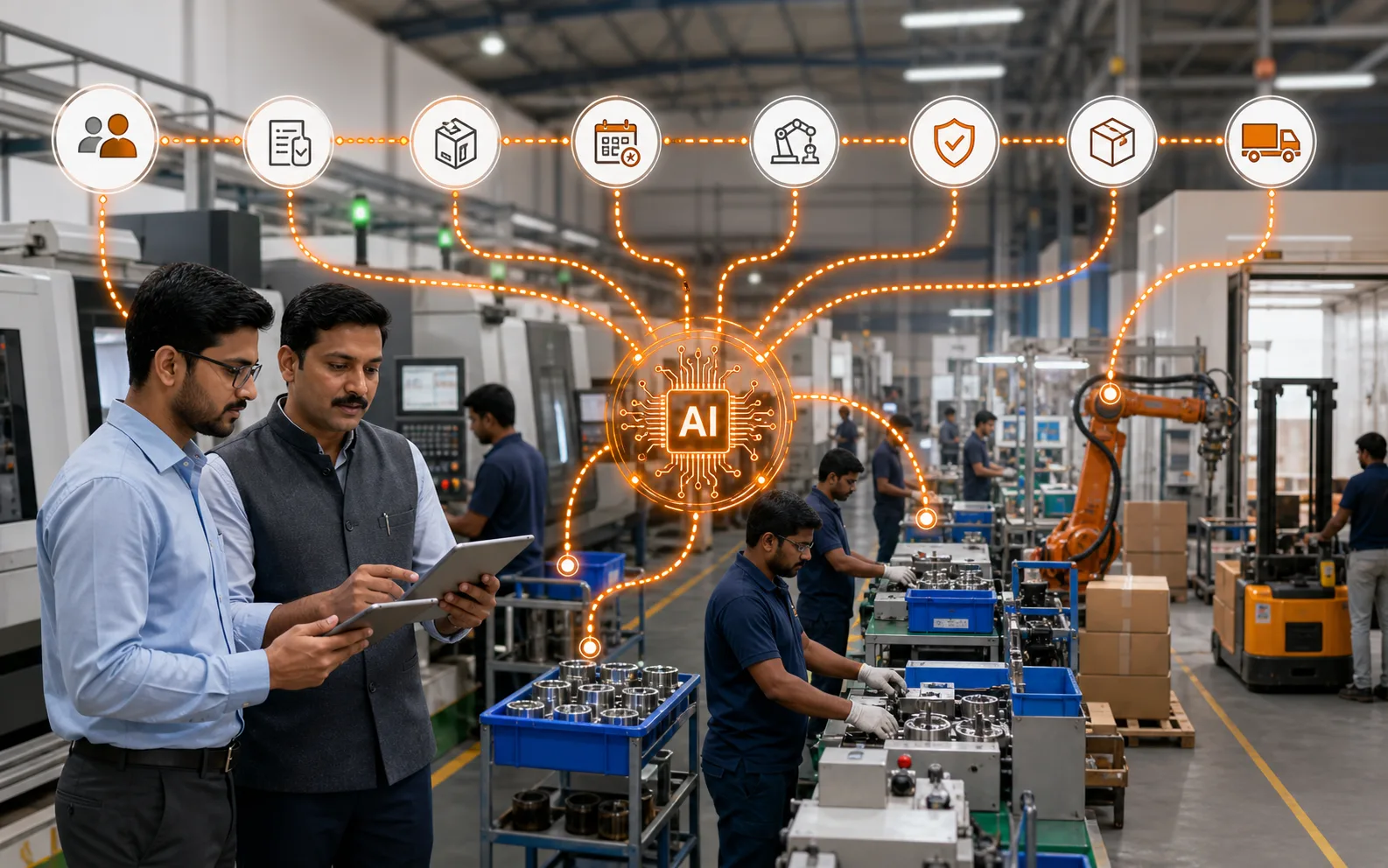
Will AI Replace My Production Planning Job?
Understand how AI affects production planning jobs, what tasks may change, and how planners can become more valuable with AI-supported scheduling and visibility.
6 Jun 2026Read more →Do I Need Special Skills to Use AI in Manufacturing?
Learn what skills manufacturing teams need to use AI, including process knowledge, data discipline, prompt clarity, review judgment, ERP understanding, and change readiness.
6 Jun 2026Read more →