
How Do Steel Plants Monitor Machines?
Learn how steel plants monitor machines using IoT, PLC data, operator updates, downtime tracking, maintenance alerts, production dashboards, and ERP-connected visibility.
How Do Steel Plants Monitor Machines?
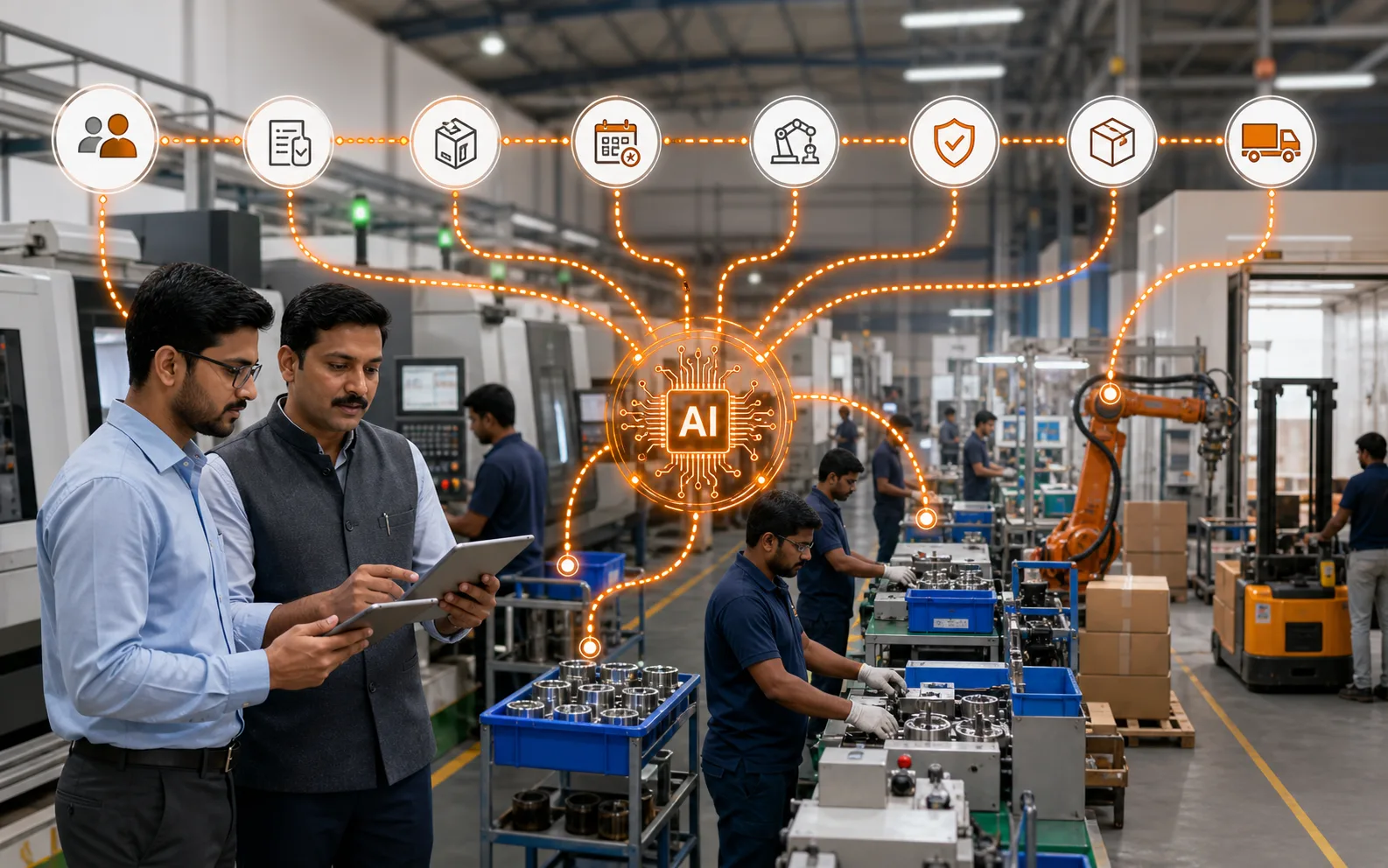
Steel plants monitor machines by collecting operating status, downtime, production counts, alarms, energy or runtime signals, operator updates, and maintenance information from machines and shop-floor processes. The data is then shown on dashboards and connected to production planning, quality, maintenance, and dispatch.
A steel plant may have cutting machines, bending machines, rolling equipment, welding stations, cranes, shot blasting units, painting lines, compressors, furnaces, CNC equipment, and material handling systems. Each machine affects production differently. Some are bottlenecks. Some support flow. Some create quality risk when they are unstable.
Machine monitoring is useful only when it tells the plant what needs attention. A dashboard that simply shows many green and red boxes is not enough. The system should help answer: which machine is down, why it is down, which job is affected, who is responsible, what production is at risk, and whether maintenance action is needed.
AICAN Optiwise supports this connected view by linking machine visibility with ERP workflows such as production planning, job tracking, quality, maintenance, and dispatch.
What Machine Monitoring Should Capture
A practical steel plant monitoring system should capture the signals that affect production decisions.
Important data points include:
- Machine running, idle, stopped, or breakdown status
- Shift-wise runtime
- Job or production order linked to the machine
- Planned versus actual output
- Downtime reason
- Alarm or fault where available
- Operator or shift assignment
- Maintenance request status
- Quality hold linked to machine output
- Energy or utility indicators where relevant
The exact data depends on machine type. A cutting machine, welding bay, and crane do not need identical dashboards.
IoT And PLC Integration
Modern machine monitoring may use IoT devices, PLC data, controller integration, sensors, or operator inputs. In many plants, a mixed approach is practical because machines vary by age, make, and connectivity options.
Newer machines may provide direct data through controllers or PLCs. Older machines may need sensors or electrical signal monitoring. Some manual or semi-automatic operations may still require operator updates.
The goal is reliable operational visibility, not technical perfection from day one.
Downtime Tracking
Downtime is one of the most important machine monitoring areas. But downtime data is useful only when reasons are captured clearly.
Common downtime reasons include:
- Breakdown
- Setup change
- Tool or consumable shortage
- Material not available
- Operator not available
- Waiting for crane or handling
- Power or utility issue
- Maintenance activity
- Quality hold
- No job assigned
If all downtime is recorded as “machine stopped,” the plant cannot improve. Reason-wise downtime helps management find repeat causes.
Machine Monitoring And Production Planning
Machine monitoring should connect to production planning. If a key machine goes down, the system should show which jobs are affected and what delivery commitments are at risk.
This connection helps planners resequence work, shift jobs to alternate machines, inform customers earlier, or prioritize maintenance.
Without ERP integration, machine monitoring remains technical data. With ERP integration, it becomes operational intelligence.
Maintenance Visibility
Machine monitoring can also support maintenance. Repeated stoppages, abnormal idle patterns, alarms, and breakdown history can help maintenance teams identify problem machines.
A useful system should show:
- Breakdown frequency
- Response time
- Repair time
- Repeat fault patterns
- Preventive maintenance schedule
- Maintenance pending status
- Machine history
This helps move the plant from reactive maintenance toward better preventive planning.
Operator Updates Still Matter
Not every machine condition can be captured automatically. Operators and supervisors may need to enter downtime reasons, job status, quantity, rejection, or remarks.
The update process should be simple. If the system is too heavy, data becomes late. If it is too light, management loses context. The right balance depends on the plant.
Dashboards By Role
Different people need different machine views.
The production head needs bottlenecks and job impact. Maintenance needs breakdown and alarm history. Supervisors need live status and shift output. Owners need utilization, delays, and dispatch risk. Quality needs machine-related rejection patterns.
One dashboard should not force everyone into the same view. Role-specific dashboards make the data easier to act on.
Where AICAN Optiwise Fits
AICAN Optiwise helps steel and fabrication plants connect machine monitoring with production, material, quality, maintenance, and dispatch. This is important because machine downtime is not only a maintenance issue. It affects jobs, customers, inventory, costing, and delivery.
When machine data is connected to ERP, teams can act faster and with better context.
Founder’s Note
At AICAN, we believe machine monitoring should reduce confusion, not create another screen nobody trusts. A plant needs to know what stopped, why it stopped, which job is affected, and what should happen next.
AICAN Optiwise is built around that practical operating view. Learn more about the company on About AICAN.
FAQs
What is machine monitoring in steel plants?
It is the process of tracking machine status, runtime, downtime, output, alarms, maintenance issues, and production impact.
Can old machines be monitored?
In many cases, yes. Older machines may need sensors, electrical signal monitoring, or operator-assisted updates if direct data integration is not available.
Why is downtime reason tracking important?
Because knowing that a machine stopped is not enough. The plant needs to know why it stopped to prevent repeat delays.
Should machine monitoring connect with ERP?
Yes. ERP connection links machine status with jobs, production plans, maintenance, quality, dispatch, and costing.
Can machine monitoring reduce downtime?
It can help by making downtime visible faster and showing repeat causes. Actual reduction comes from maintenance and process action.
How can AICAN Optiwise help?
AICAN Optiwise helps connect machine monitoring with production planning, maintenance, quality, dispatch, and factory dashboards.

Related Posts

Kanban System | Optiwise
Learn how a Kanban system works in manufacturing, where it helps, where it fails, and how Optiwise connects Kanban signals with inventory, purchase, and production planning.
12 Jun 2026Read more →Erp In Operations Management | Optiwise
Learn how ERP improves operations management by connecting planning, inventory, purchase, production, quality, dispatch, finance, and reporting.
12 Jun 2026Read more →ERP for FMCG Companies in India
A practical guide to ERP for FMCG companies in India, covering distributor orders, batch tracking, expiry, inventory, production, schemes, costing, and reporting.
11 Jun 2026Read more →
Optiwise, Odoo, Acumatica and Business Central for Manufacturing
Compare manufacturing workflows in Optiwise, Odoo, Acumatica and Dynamics 365 Business Central. See what your factory can run in Optiwise.
11 Jun 2026Read more →