
Is It Worth Upgrading From Basic Shop Management Software to ERP?
Learn when manufacturers should upgrade from basic shop management software to ERP, what changes, what benefits to expect, and how to avoid overbuying too early.
Is It Worth Upgrading From Basic Shop Management Software to ERP?
It is worth upgrading from basic shop management software to ERP when your business has outgrown simple tracking and now needs connected control.
Basic shop management software can be useful. It may help manage job cards, schedules, customer orders, quotations, or simple inventory. For a small shop, that may be enough for a while.
But as a manufacturer grows, the work becomes more connected. A job is not only a job. It affects material planning, purchase, inventory, machine scheduling, quality, labour, costing, dispatch, customer communication, and finance.
If your current software handles one piece of the puzzle but leaves the rest in spreadsheets, WhatsApp, paper, or memory, ERP may be the next step.
The decision should not be driven by software ambition. It should be driven by operational pain.
Quick Answer
Upgrade from basic shop management software to ERP when you need stronger control over inventory, purchase, production planning, work orders, BOMs, quality, costing, dispatch, reporting, and multi-department visibility. If your current system only tracks jobs but does not connect the full manufacturing flow, ERP can provide better control.
You may be ready for ERP if:
- Inventory is inaccurate.
- Purchase planning is reactive.
- Work orders are not linked to material and cost.
- Quality records are separate.
- Job costing is unclear.
- Reports are manual.
- Sales, production, stores, and finance use different data.
- Owners cannot see real-time status.
- The company is growing and complexity is increasing.
ERP is worth it when disconnected operations cost more than the upgrade.
What Basic Shop Management Software Usually Does Well
Basic shop management tools often solve immediate problems.
They may help with:
- Job tracking
- Customer order list
- Simple scheduling
- Quotation records
- Job card creation
- Basic stock tracking
- Task assignment
- Delivery reminders
- Simple reports
For a very small shop, this can be a major improvement over paper.
The problem begins when the shop needs deeper integration.
Where Basic Software Starts Falling Short
Basic shop software often struggles when the business needs connected manufacturing control.
Common limitations include:
- Inventory is not linked properly to work orders.
- Purchase is not driven by BOM and production demand.
- Material shortages are visible too late.
- Quality rejection is tracked separately.
- Job costing is incomplete.
- Machine load is not clear.
- WIP is hard to track.
- Finance does not connect with operations.
- Reports require manual export.
- Multi-location control is weak.
- Custom workflows are difficult.
These gaps become expensive as the business grows.
ERP Connects the Full Manufacturing Flow
ERP goes beyond job tracking.
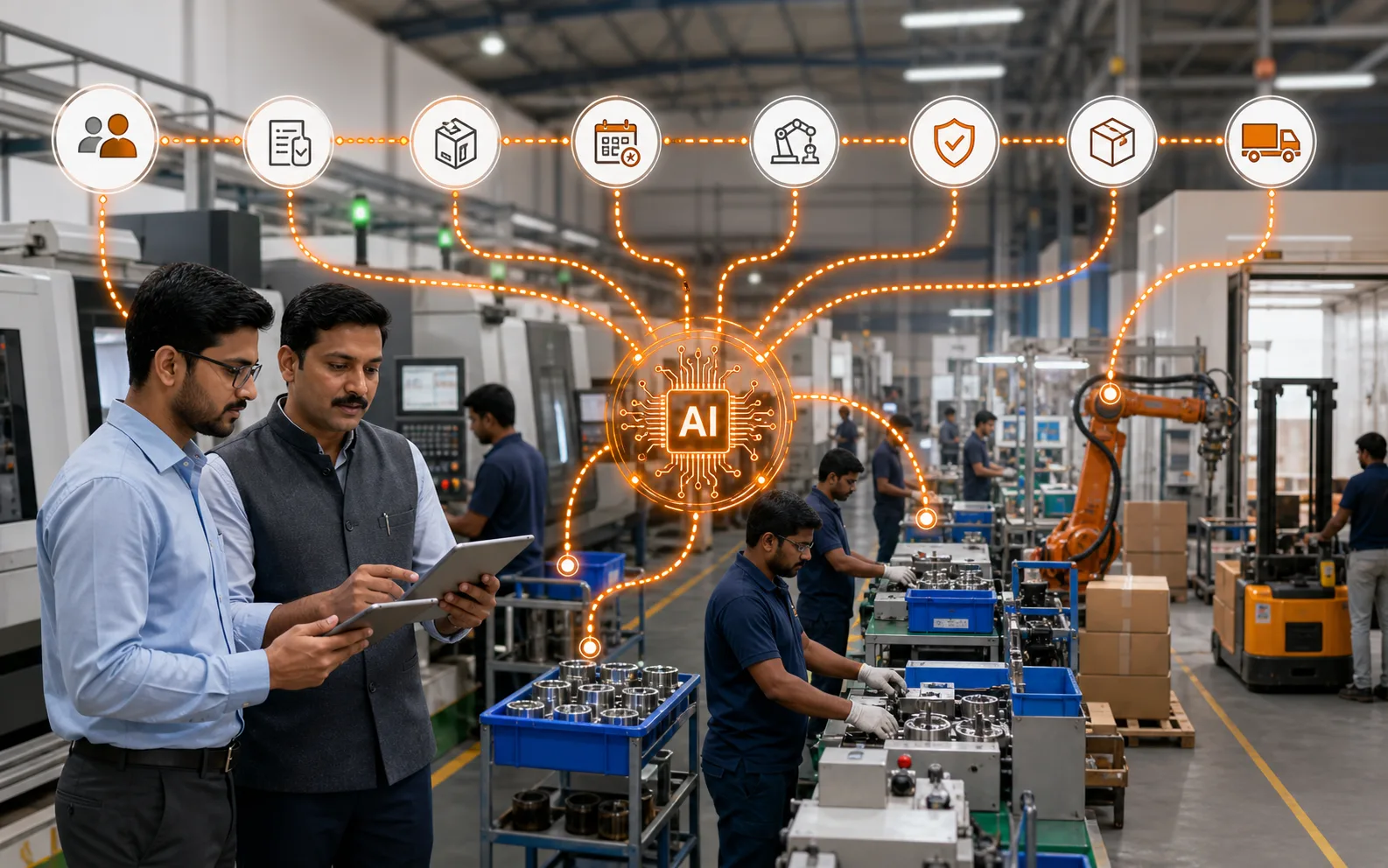
It connects:
- Sales and CRM
- Quotations
- Customer orders
- BOMs
- Inventory
- Purchase
- Work orders
- Production planning
- Shop-floor updates
- Quality control
- Dispatch
- Costing
- Finance
- Reports and dashboards
This connection is the main reason to upgrade.
A job is no longer isolated. It becomes part of the full operating system.
Upgrade When Inventory Becomes a Problem
Inventory is often the first sign that basic software is not enough.
If stock records are unreliable, production suffers.
ERP helps show:
- Available stock
- Reserved stock
- Material issued to work orders
- Pending purchase
- Quality hold stock
- Low stock alerts
- Stock by location
- Consumption history
If your current system cannot provide this reliably, ERP may be worth it.
Upgrade When Job Costing Matters
Basic shop software may track job status but not true cost.
ERP can connect material, labour, machine time, subcontracting, rejection, rework, and overhead to a job.
This matters for custom manufacturers and job shops.
If you do not know which jobs are profitable, you are pricing with incomplete information.
ERP helps protect margin.
Upgrade When Quality Needs Traceability
As customers become more demanding, quality control becomes more important.
ERP can link quality checks with work orders, material batches, suppliers, production, rejection, rework, and dispatch.
If quality records are scattered, audits and customer complaints become stressful.
ERP helps create traceability.
Upgrade When Reports Are Manual
If your team spends hours preparing reports from multiple tools, ERP can reduce that effort.
Owners need dashboards that show:
- Production status
- Inventory alerts
- Purchase delays
- Work order progress
- Quality issues
- Dispatch readiness
- Cost exceptions
Basic software may not provide this connected view.
Do Not Upgrade Too Early Without Readiness
ERP is more powerful, but it also requires discipline.
Do not upgrade if the company is unwilling to clean data, train users, define processes, and use the system consistently.
ERP will not help if everyone continues using old spreadsheets as the real system.
Upgrade when leadership is ready to make ERP the operating truth.
How to Upgrade Without Disruption
A practical upgrade path is phased:
- Map current shop software usage.
- Identify gaps.
- Clean item, customer, vendor, and stock data.
- Start with inventory, purchase, and production workflows.
- Add work orders and BOMs.
- Add quality and costing.
- Add dashboards, IoT, and AI after core data stabilizes.
- Retire old tools once ERP is trusted.
This reduces risk.
Where AICAN Optiwise Fits
AICAN Optiwise is built for manufacturers who have outgrown basic tools and need connected factory operations.
Optiwise supports CRM, custom quotations, production, inventory, purchase, work orders, layered BOM, cost estimation, quality control, shop-floor tracking, IoT, reports, and AI agents.
For manufacturers upgrading from basic shop management software, Optiwise helps move from job tracking to full operational control:
- Enquiry to quotation
- Quotation to work order
- BOM to purchase planning
- Inventory to production issue
- Production to quality
- Quality to dispatch
- Costing to owner dashboard
- Shop-floor activity to AI alerts
Explore AICAN Optiwise and About AICAN.
Practical Example
A machine shop uses basic software to track jobs. It knows which jobs are pending, but not whether material is available, which job is profitable, which machine is overloaded, or what quality issues are recurring.
The owner still asks supervisors for updates every day.
ERP connects job tracking with material, machine, quality, cost, and reports. The business gains control, not just a better job list.
FAQ
When should I upgrade from shop management software to ERP?
Upgrade when you need connected control over inventory, purchase, production, work orders, quality, costing, dispatch, and reports.
Is basic shop software enough for small manufacturers?
It may be enough at an early stage. But as complexity grows, ERP becomes more valuable.
What does ERP do that shop software may not?
ERP connects sales, inventory, purchase, production, quality, costing, finance, dashboards, and reporting across the business.
Will ERP be harder to use?
ERP can be more complex, but a manufacturing-focused ERP with role-based workflows can be practical for teams if implemented properly.
Should I replace shop software immediately?
Use a phased approach. Migrate key workflows first, validate data, train users, and retire old tools once ERP is stable.
How does AICAN Optiwise help with upgrading?
AICAN Optiwise helps manufacturers move from basic job tracking to connected ERP across CRM, production, inventory, purchase, quality, IoT, AI agents, and reports.
Founder’s Note
Basic tools are not bad. They often help manufacturers take the first step toward digitization.
But there comes a point where the business needs more than tracking. It needs connected truth.
At AICAN, we see ERP as the next step when a manufacturer wants production, inventory, purchase, quality, and cost to speak the same language.
Final Thought
Upgrading from shop management software to ERP is worth it when your operations need connection, not just tracking.
If your current system shows jobs but cannot control material, cost, quality, purchase, and visibility, ERP may be the upgrade your factory needs.

Related Posts
A Manufacturing Alternative to SAP: Optiwise
Run your factory in Optiwise, a manufacturing alternative to SAP Business One with connected operations, AI agents and no-code workflows.
14 Jun 2026Read more →How Do I Know If My Manufacturing Business Really Needs an ERP?
A practical guide for manufacturers to identify when spreadsheets, manual follow-ups, and disconnected systems are no longer enough — and when ERP becomes an operational necessity.
14 Jun 2026Read more →Production Management System Optimized | Optiwise
Learn best practices for optimizing a production management system across planning, scheduling, material readiness, quality, and reporting.
12 Jun 2026Read more →
What Is the Best ERP for Pharmaceutical Manufacturing?
Learn how to choose the best ERP for pharmaceutical manufacturing, with guidance on batch control, quality workflows, traceability, inventory, documentation, and GMP discipline.
10 Jun 2026Read more →