
What Happens to Factory Workers When AI Takes Over?
A practical look at how AI changes factory jobs, why workers remain central to manufacturing, and how Indian factories can manage the transition responsibly.
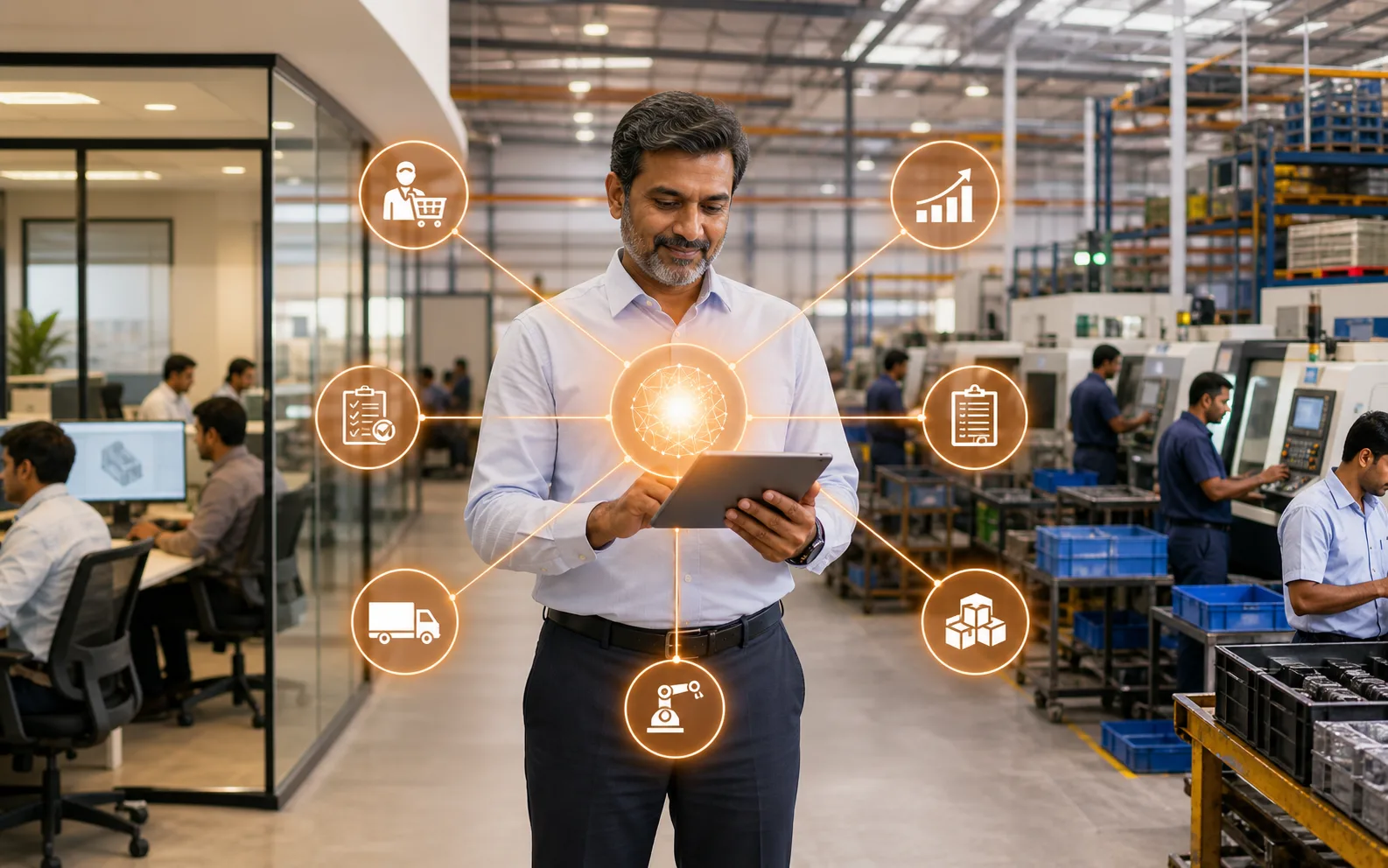
What Happens to Factory Workers When AI Takes Over?
When factory owners hear the phrase "AI takes over," the first picture is usually dramatic: machines running everything, people pushed out, and the shopfloor becoming fully automatic overnight. Real manufacturing does not change that way. A factory is not only a set of machines. It is planning, judgement, adjustment, exception handling, vendor follow-up, quality calls, dispatch pressure, customer promises, and hundreds of small decisions that happen between departments every day.
AI changes factory work, but it does not remove the need for capable people. In most Indian manufacturing businesses, the bigger problem is not too many workers. It is that skilled people spend too much time chasing information, correcting manual records, waiting for approvals, and firefighting avoidable issues. Artificial intelligence in manufacturing becomes useful when it removes this drag and gives workers better visibility.
The honest answer is this: some repetitive tasks will reduce, some roles will change, and new responsibilities will appear. The factories that handle this well will not treat AI as a replacement project. They will treat it as an operating discipline that helps people make better decisions faster.
AI Usually Takes Over Tasks Before It Takes Over Jobs
In practical manufacturing environments, AI first affects tasks such as data entry, variance spotting, reorder suggestions, production alerts, quality trend analysis, report preparation, and exception reminders. These are important tasks, but they are rarely the full job of a worker, supervisor, planner, or manager.
A store executive may no longer need to manually chase every low-stock item if the system highlights risk early. A production supervisor may spend less time preparing end-of-shift summaries and more time solving bottlenecks. A purchase team may get suggested follow-ups instead of scanning old emails and spreadsheets. These changes do not eliminate the role. They move the role from recording work to managing work.
The biggest shift is mental. Workers who were earlier valued mainly for remembering details become more valuable when they can interpret system signals and take timely action.
Which Factory Roles Change the Most?
Shopfloor operators may see AI through machine alerts, digital work instructions, inspection checklists, or production tracking screens. Their job becomes less dependent on memory and verbal instructions, and more dependent on following clear process signals.
Supervisors may see the largest change. Instead of walking around only to find what went wrong, they can monitor production status, delays, downtime reasons, and quality exceptions in one place. This makes the supervisor more accountable, but also more empowered.
Planning, inventory, purchase, and sales coordination roles also change. AI can help identify material shortages, delayed orders, unusual consumption, or missed commitments. The human role becomes deciding what action to take, which trade-off matters, and who needs to be informed.
The Jobs Most at Risk Are Poorly Defined Manual Coordination Roles
If a role exists only because data is scattered across notebooks, WhatsApp messages, Excel files, and phone calls, that role will be affected. But this does not mean the person has no future. It means the factory must redesign the work.
A person who earlier copied numbers into reports can become responsible for checking data accuracy, closing open issues, coordinating exceptions, or training teams on process discipline. The same person may become more valuable once the system removes low-value manual work.
The risk is highest when management brings AI without explaining the transition. Workers become defensive when technology appears to threaten their place. They become cooperative when they understand how the system reduces rework, blame, confusion, and unnecessary pressure.
What Workers Need From Management
Workers need clarity before they need training. They should know why the system is being introduced, what it will track, what it will not track, and how performance will be evaluated. If AI is presented only as a surveillance tool, adoption will suffer.
Factories should explain that the purpose is to improve visibility, reduce manual mistakes, and make work easier to manage. They should also identify champions from within each department. A respected supervisor or store executive who understands the system can reduce fear much faster than a presentation from outside.
Training should be practical. Workers do not need abstract AI theory. They need to know how to read alerts, update status, raise issues, check dashboards, and trust the system when the data is correct.
Put Optiwise to work in your factory
AICAN Optiwise is built around the reality that factories run through people, not software screens alone. It connects production, inventory, purchase, sales, finance, reporting, IoT readiness, and AI workflows so teams can see the same operating truth instead of working from separate files.
Give workers and supervisors the information needed for their next action. In Optiwise, they can follow orders, stock, production progress and inspection queues in one system. Our AI agents help them retrieve records and carry out tasks within their role permissions.
Founder’s Note
AICAN’s founder-led view is that Indian manufacturing does not need technology that makes people feel replaceable. It needs systems that make good people more effective. The goal is not to remove the judgement of factory teams, but to reduce the noise around them so their judgement can be used where it matters.
That is why AI in manufacturing should be introduced with respect for workers, not fear. A factory becomes stronger when operators, supervisors, planners, and owners are aligned around one reliable system.
FAQ
Will AI replace factory workers completely?
In most factories, no. AI is more likely to replace repetitive manual tracking and reporting tasks than complete factory roles. Human judgement remains essential for exceptions, quality decisions, customer commitments, and process improvement.
Which workers should be trained first?
Start with supervisors, store teams, production planners, quality teams, and department heads. These roles influence daily adoption and can help others trust the system.
How can owners reduce fear among workers?
Be transparent about what the system will do, involve department champions early, and explain how AI reduces confusion and rework. Avoid positioning AI as a threat or surveillance-only tool.
Can small factories manage this transition?
Yes. Small factories often benefit faster because decisions are closer to the shopfloor. The key is to start with clear use cases instead of trying to automate everything at once.
Final Thought
AI does not take over a factory in one dramatic step. It quietly changes how information moves, how decisions are made, and how people spend their time. The best manufacturers will not ask, "How many workers can AI remove?" They will ask, "How much better can our people perform when the system supports them?"
Next step: Explore AICAN Optiwise to see how connected manufacturing workflows can help your team adopt AI without losing the human strength of your factory.

Related Posts
Will AI Create More Jobs Than It Destroys?
Explore whether AI will create more jobs than it destroys, with a practical view of manufacturing, automation, new roles, reskilling, and business transformation.
13 Jun 2026Read more →Manufacturing AI vs. Hiring More Workers
Compare manufacturing AI with hiring more workers and learn when automation, better systems, training, or additional people are the right answer.
7 Jun 2026Read more →
Will AI Replace My Production Planning Job?
Understand how AI affects production planning jobs, what tasks may change, and how planners can become more valuable with AI-supported scheduling and visibility.
6 Jun 2026Read more →Do I Need Special Skills to Use AI in Manufacturing?
Learn what skills manufacturing teams need to use AI, including process knowledge, data discipline, prompt clarity, review judgment, ERP understanding, and change readiness.
6 Jun 2026Read more →