
Who Uses ERP Systems In A Manufacturing Business? | Optiwise
Learn who the primary ERP users are in manufacturing, how owners, sales, purchase, inventory, production, accounts, and management use ERP, and how Optiwise supports connected workflows.

Who Uses ERP Systems In A Manufacturing Business?
An ERP system is not only for the owner or accounts team. In a manufacturing business, ERP becomes useful only when the people who create daily transactions actually use it.
Sales enters customer demand. Purchase creates supplier orders. Stores records stock movement. Production updates work status. Accounts checks bills and payments. Dispatch records shipments. Management reviews reports.
If only one department uses ERP, the system becomes another isolated tool. If the whole workflow uses it correctly, ERP becomes the business record.
AICAN Optiwise is built for manufacturing SMEs that need connected workflows across sales, purchase, inventory, production, accounts, and reporting.
What Is An ERP User?
An ERP user is anyone in the business who enters, reviews, approves, or uses information inside the ERP system.
Not every user needs the same access. A stores user may record inward and outward stock. A production user may update work orders. An owner may view dashboards. An accounts user may review invoices and payments.
Good ERP implementation gives each user the access they need and avoids clutter they do not need.
Primary Users Of ERP Systems
1. Business Owners And Directors
Owners use ERP to see the health of the business. They may not enter every transaction, but they need reliable reports.
They look at sales, pending orders, stock value, purchase commitments, production delays, receivables, payables, profitability, and overall performance.
For owners, ERP should reduce dependence on verbal updates.
2. Sales Team
Sales teams use ERP to create inquiries, quotations, sales orders, customer records, dispatch requests, and order status updates.
A good ERP helps sales know whether stock is available, whether production is pending, and whether customer orders are on track.
3. Purchase Team
Purchase users create purchase requests, purchase orders, vendor records, rate comparisons, pending purchase reports, and supplier follow-ups.
They rely on ERP to know what material is required, what is already ordered, and what is pending.
4. Stores And Inventory Team
Stores users record material inward, outward, stock transfer, issue to production, returns, stock adjustments, and physical stock checks.
Their role is critical because wrong stock entries affect everyone else.
5. Production Team
Production users work with BOMs, work orders, material issue, WIP status, completed quantity, rejection, and production reports.
ERP helps production connect shop-floor activity with inventory and customer commitments.
6. Quality Team
Quality users record inspection results, rejected quantities, rework, hold status, and quality notes.
This helps the business track supplier issues, production defects, and customer complaint patterns.
7. Accounts And Finance Team
Accounts users handle invoices, vendor bills, receipts, payments, tax records, purchase reconciliation, sales billing, and financial reporting.
They benefit when operational data is already clean. If purchase, sales, and inventory entries are accurate, accounts work becomes easier.
8. Dispatch And Logistics Team
Dispatch users manage packing, delivery challans, shipment status, transport details, and customer dispatch records.
ERP helps them dispatch the right item, in the right quantity, with the right documents.
9. Management And Department Heads
Managers use ERP to review team performance, pending tasks, bottlenecks, approvals, and department-level reports.
They need role-based visibility, not every small transaction.
Why ERP Needs Role-Based Access
Every ERP user should not see or edit everything. Role-based access keeps the system clean and secure.
For example, a stores executive may enter stock movement but should not change sales pricing. A sales user may create quotations but may need approval for special discounts. An accounts user may access invoices but not alter production BOMs.
Good access control improves accountability.
Common ERP User Mistakes
The first mistake is giving ERP only to accounts. Manufacturing ERP should start at operations, not end at accounts.
The second mistake is allowing delayed entries. If users enter data days later, reports become unreliable.
The third mistake is not training department users. ERP adoption fails when teams do not understand why their entries matter.
The fourth mistake is giving too much access to everyone. This increases errors.
The fifth mistake is expecting ERP to work without process discipline.
How ERP Helps Different Teams Work Together
ERP connects departments through shared data. A sales order can trigger production planning. Production can check inventory. Inventory shortage can trigger purchase. Purchase receipt can update stock. Finished goods can support dispatch. Dispatch can support billing.
This chain reduces repeated calls and manual status checking.
When teams work from the same system, disagreements reduce. The conversation shifts from “who has the latest Excel file?” to “what does the system show?”
How Optiwise Helps
Optiwise by AICAN helps manufacturing teams use ERP in a practical way. It connects daily workflows without forcing every user into unnecessary complexity.
Owners get visibility. Sales gets order clarity. Purchase gets material planning. Stores gets stock movement control. Production gets work order tracking. Accounts gets cleaner transaction history.
AICAN focuses on ERP adoption for SMEs because software works only when real users can use it in real operations.
Founder’s Note
ERP is often described as a management system, but it succeeds only when the ground team trusts it. The stores person, production supervisor, purchase executive, and accounts user all shape the accuracy of the final report.
At AICAN, we built AICAN Optiwise with this reality in mind. A system should support the people doing the work, not just impress the people reviewing dashboards.
When every user enters their part correctly, the owner finally gets a clear picture of the business.
FAQs
Who are the primary users of ERP systems?
Primary ERP users include owners, sales, purchase, inventory, production, quality, accounts, dispatch, and management teams.
Is ERP only for accounts?
No. ERP connects operational and financial workflows. In manufacturing, purchase, stores, production, sales, dispatch, and accounts all use ERP.
Why is user training important in ERP?
Training helps each department understand how their entries affect inventory, production, billing, reports, and decision-making.
What is role-based access in ERP?
Role-based access gives each user permission based on their job. It improves security, accountability, and data quality.
How does Optiwise support ERP users?
Optiwise by AICAN supports connected workflows for sales, purchase, inventory, production, accounts, dispatch, and management reporting.

Related Posts
Kanban System | Optiwise
Learn how a Kanban system works in manufacturing, where it helps, where it fails, and how Optiwise connects Kanban signals with inventory, purchase, and production planning.
12 Jun 2026Read more →Erp In Operations Management | Optiwise
Learn how ERP improves operations management by connecting planning, inventory, purchase, production, quality, dispatch, finance, and reporting.
12 Jun 2026Read more →ERP for FMCG Companies in India
A practical guide to ERP for FMCG companies in India, covering distributor orders, batch tracking, expiry, inventory, production, schemes, costing, and reporting.
11 Jun 2026Read more →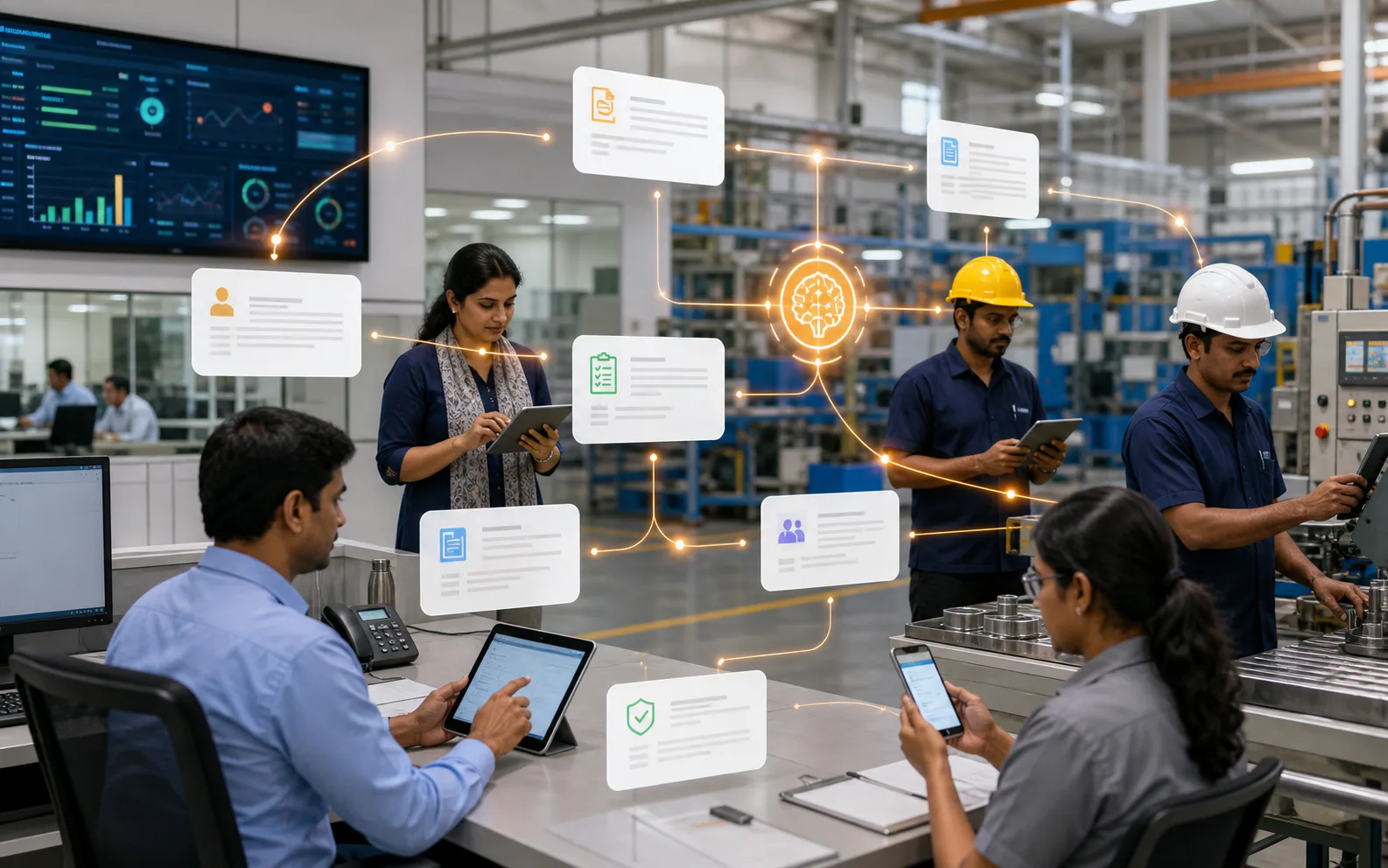
Optiwise, Odoo, Acumatica and Business Central for Manufacturing
Compare manufacturing workflows in Optiwise, Odoo, Acumatica and Dynamics 365 Business Central. See what your factory can run in Optiwise.
11 Jun 2026Read more →