
Why ERP Is Important For Manufacturing SMEs | Optiwise
Learn why ERP is important for manufacturers, how it improves visibility, inventory, production, purchase, sales, accounts, and decision-making, and how Optiwise helps SMEs scale with control.

Why ERP Is Important For Manufacturing SMEs
A growing manufacturing business does not become difficult because people stop working hard. It becomes difficult because the information becomes scattered.
Sales has one sheet. Purchase has another. Stores keeps a register. Production updates on calls. Accounts waits for documents. The owner asks five people for one answer and gets five versions of the truth.
ERP is important because it connects these moving parts into one business system.
ERP stands for Enterprise Resource Planning. For a manufacturing SME, ERP helps manage sales, purchase, inventory, production, accounts, dispatch, and reports in a connected workflow.
AICAN Optiwise is built for manufacturers who want this control without getting trapped in unnecessary complexity.
Why ERP Matters
ERP matters because manufacturing is connected by nature. A sales order affects production. Production affects inventory. Inventory affects purchase. Purchase affects cash flow. Dispatch affects billing. Billing affects receivables.
If these departments work in separate files, delays and mistakes become normal.
ERP creates a shared operating record. It helps each department see what it needs and helps the owner see the business as a whole.
Benefits Of ERP In Manufacturing
1. Better Inventory Visibility
ERP helps teams know what stock is available, reserved, consumed, ordered, rejected, or pending. This reduces stockouts, excess purchases, and duplicate buying.
2. Improved Production Planning
Production can plan based on sales orders, BOMs, material availability, and work orders. This reduces last-minute surprises and helps teams prioritise better.
3. Stronger Purchase Control
Purchase teams can see material requirements, pending orders, supplier performance, and inward status. This improves coordination with stores and production.
4. Faster Sales Order Tracking
Sales teams can check order status, stock availability, dispatch progress, and pending production before committing updates to customers.
5. Cleaner Accounting
Accounts teams get cleaner transaction records when purchase, sales, inventory, and dispatch data are entered correctly at source.
6. Better Decision-Making
Owners can review dashboards and reports instead of relying only on verbal updates. This helps with pricing, planning, cash flow, capacity, and growth decisions.
ERP Reduces Manual Follow-Ups
In many factories, managers spend too much time asking for status. Has material arrived? Is production started? What is pending? Is dispatch ready? Has the invoice been made?
ERP reduces this follow-up load because the status is recorded in the system. People still need to communicate, but they are not starting from zero each time.
ERP Improves Accountability
When work happens through ERP, entries are traceable. The business can see who created an order, who approved it, who received material, who issued stock, and who updated production.
This does not mean ERP should be used for blame. It means the business can find gaps and fix process issues.
ERP Supports Growth
A small business can run on memory for some time. But growth increases product variety, order volume, customer expectations, supplier complexity, and reporting needs.
ERP helps the business scale by creating repeatable processes. New employees can follow the system instead of learning everything informally from one senior person.
ERP And Working Capital
ERP can improve working capital control by showing stock value, slow-moving items, purchase commitments, receivables, payables, and production status.
This is important because manufacturing businesses often have money locked in inventory and WIP. Better visibility helps owners decide where cash is stuck.
Common ERP Implementation Mistakes
The first mistake is buying ERP without cleaning item data.
The second mistake is treating ERP as only an accounts tool.
The third mistake is not training users.
The fourth mistake is trying to automate a broken process without first defining it.
The fifth mistake is choosing software too complex for the team’s daily reality.
ERP succeeds when it fits the business workflow and users actually adopt it.
How Optiwise Helps
Optiwise by AICAN helps manufacturing SMEs connect inventory, purchase, sales, production, accounts, and reports in a practical system.
Optiwise is designed for owners who want clearer control over daily operations: what is in stock, what needs purchase, what is in production, what is ready for dispatch, what is pending, and where money is blocked.
AICAN focuses on making ERP usable for real teams, not just impressive in demos.
Founder’s Note
ERP is important because it gives the owner back visibility. Not theoretical visibility. Daily visibility. The kind that helps answer: Can we deliver this order? Why is production delayed? What should we purchase? Which stock is stuck? Who needs to act today?
At AICAN, we built AICAN Optiwise for that practical layer of control. ERP should not make a manufacturer feel buried under software. It should make the business easier to run.
FAQs
Why is ERP important?
ERP is important because it connects business processes, improves visibility, reduces manual follow-ups, and helps teams make decisions from shared data.
Why is ERP important in manufacturing?
Manufacturing involves sales, purchase, inventory, production, quality, dispatch, and accounts. ERP connects these workflows so the factory can operate with better control.
Can small businesses use ERP?
Yes. SMEs can use ERP when they need better control over stock, orders, production, purchase, and reporting. The key is choosing a practical system.
Does ERP replace employees?
No. ERP supports employees by giving them clearer workflows and better information. People still make decisions and manage exceptions.
How does Optiwise help with ERP?
Optiwise by AICAN helps manufacturers connect daily operations across inventory, purchase, sales, production, accounts, dispatch, and reports.

Related Posts
Kanban System | Optiwise
Learn how a Kanban system works in manufacturing, where it helps, where it fails, and how Optiwise connects Kanban signals with inventory, purchase, and production planning.
12 Jun 2026Read more →Erp In Operations Management | Optiwise
Learn how ERP improves operations management by connecting planning, inventory, purchase, production, quality, dispatch, finance, and reporting.
12 Jun 2026Read more →ERP for FMCG Companies in India
A practical guide to ERP for FMCG companies in India, covering distributor orders, batch tracking, expiry, inventory, production, schemes, costing, and reporting.
11 Jun 2026Read more →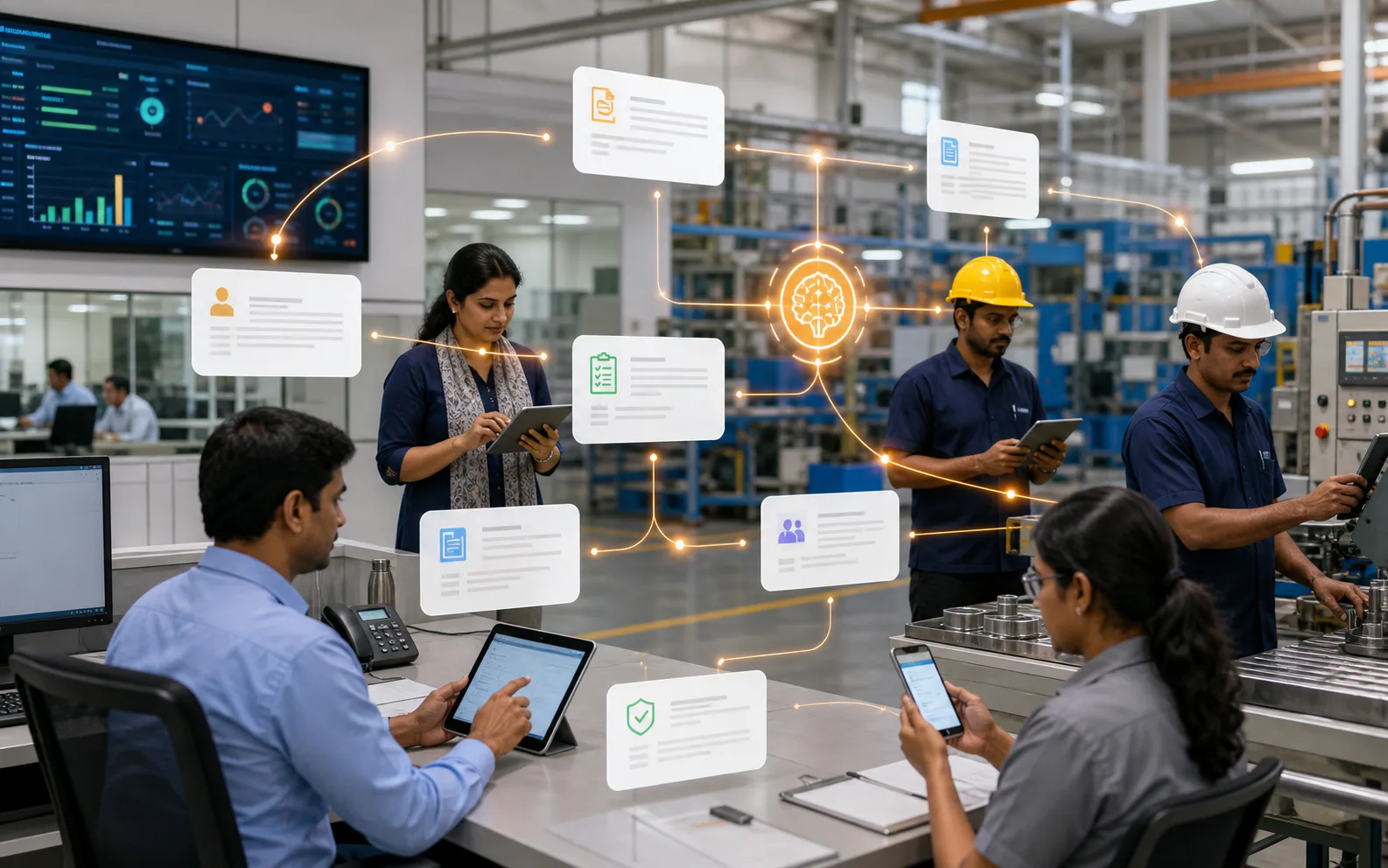
Optiwise, Odoo, Acumatica and Business Central for Manufacturing
Compare manufacturing workflows in Optiwise, Odoo, Acumatica and Dynamics 365 Business Central. See what your factory can run in Optiwise.
11 Jun 2026Read more →