
Why Manufacturers Struggle With Digital Transformation
Learn why manufacturers struggle with digital transformation and how workflow clarity, user adoption, leadership, data quality, and right-fit software can help.

Why Manufacturers Struggle With Digital Transformation
Manufacturers often know they need digital transformation, but the journey becomes difficult because factories are complex. A plant is not just one process. It is a connected chain of sales, purchase, stores, production, quality, dispatch, finance, vendors, customers, and machines.
If transformation ignores this reality, it becomes another software project that users avoid.
Unclear Processes
Many factories run on informal knowledge. One person knows vendor rates. Another knows stock adjustments. A supervisor knows machine priorities. Before digitization, these workflows must be mapped clearly.
Software cannot fix a process nobody has defined.
Poor Data Quality
Old item masters, duplicate vendor records, wrong stock balances, inconsistent units, and missing BOMs can weaken any digital system. Digital transformation needs clean data or at least a practical cleanup plan.
Resistance From Users
Factory teams may resist software if it slows them down or feels like extra work. Users adopt systems when they see direct value: less chasing, fewer mistakes, faster approvals, clearer instructions.
Training matters, but design and relevance matter more.
Choosing the Wrong Software
Some manufacturers choose software that is too generic, too complex, or too rigid. Others buy tools department by department and end up with disconnected systems.
Right-fit software should support the actual workflow and scale with the business.
Lack of Leadership Follow-Through
Digital transformation needs leadership discipline. If owners and managers allow teams to bypass the system, adoption falls apart.
Where AICAN Optiwise Fits
AICAN Optiwise is built for manufacturers who need connected, practical transformation across CRM, purchase, inventory, production, quality, dispatch, finance visibility, and AI workflows. It helps reduce the gap between strategy and day-to-day factory execution.
FAQ
Why does digital transformation fail in manufacturing?
It often fails because processes are unclear, data is poor, users resist, or software does not match operations.
What should manufacturers digitize first?
Start with high-pain workflows such as inventory, purchase, production tracking, or reporting.
How can adoption improve?
Use simple workflows, train users, involve department heads, and make system usage part of daily management.
Final Thought
Digital transformation fails when it is treated as a software purchase. It succeeds when it becomes a disciplined change in how the factory runs.

Related Posts

Kanban System | Optiwise
Learn how a Kanban system works in manufacturing, where it helps, where it fails, and how Optiwise connects Kanban signals with inventory, purchase, and production planning.
12 Jun 2026Read more →Erp In Operations Management | Optiwise
Learn how ERP improves operations management by connecting planning, inventory, purchase, production, quality, dispatch, finance, and reporting.
12 Jun 2026Read more →ERP for FMCG Companies in India
A practical guide to ERP for FMCG companies in India, covering distributor orders, batch tracking, expiry, inventory, production, schemes, costing, and reporting.
11 Jun 2026Read more →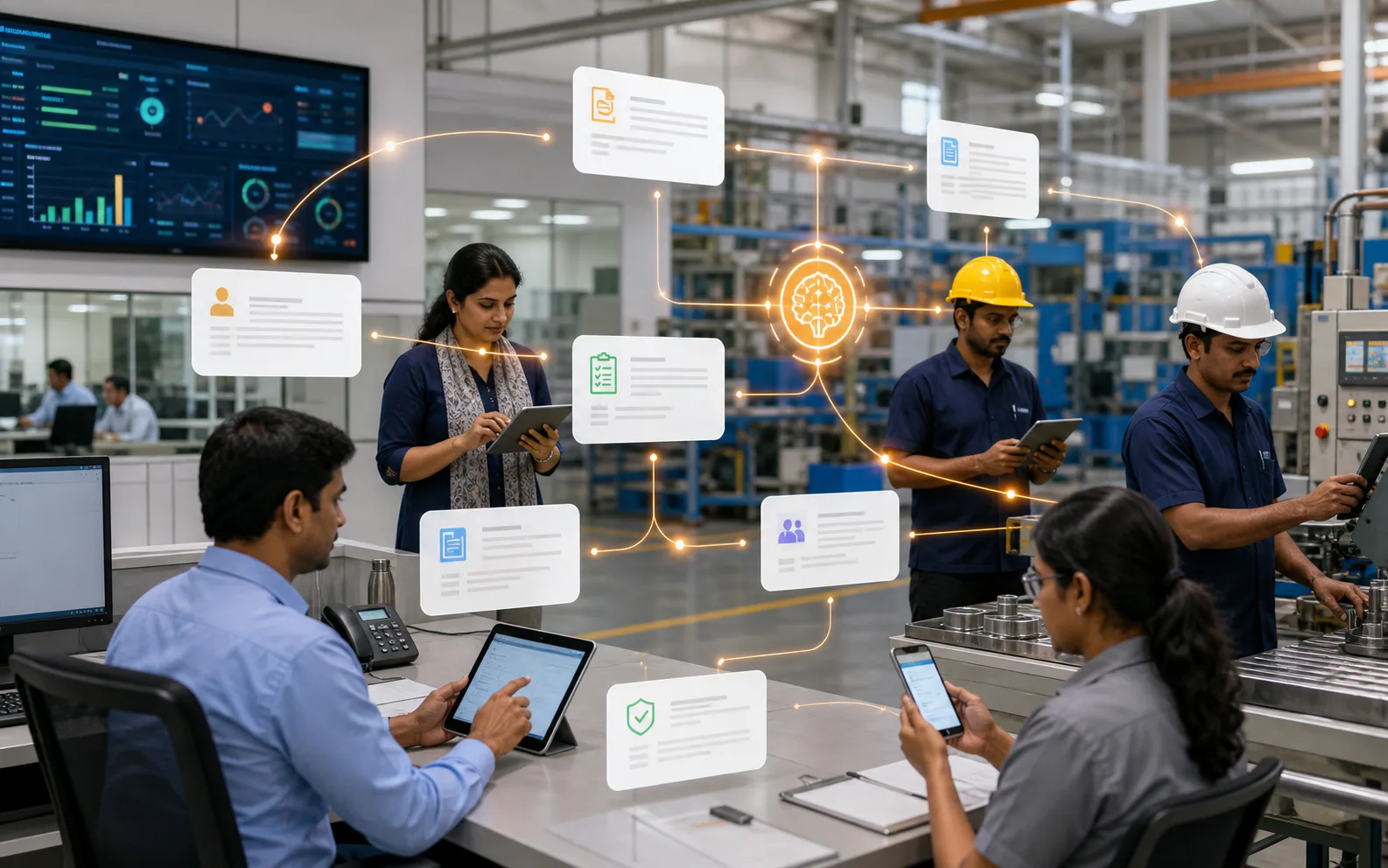
Optiwise, Odoo, Acumatica and Business Central for Manufacturing
Compare manufacturing workflows in Optiwise, Odoo, Acumatica and Dynamics 365 Business Central. See what your factory can run in Optiwise.
11 Jun 2026Read more →