
Common Software Problems Manufacturers Face
Discover the common software problems manufacturers face, from disconnected systems and poor data quality to ERP complexity, reporting gaps, and low adoption.
Common Software Problems Manufacturers Face
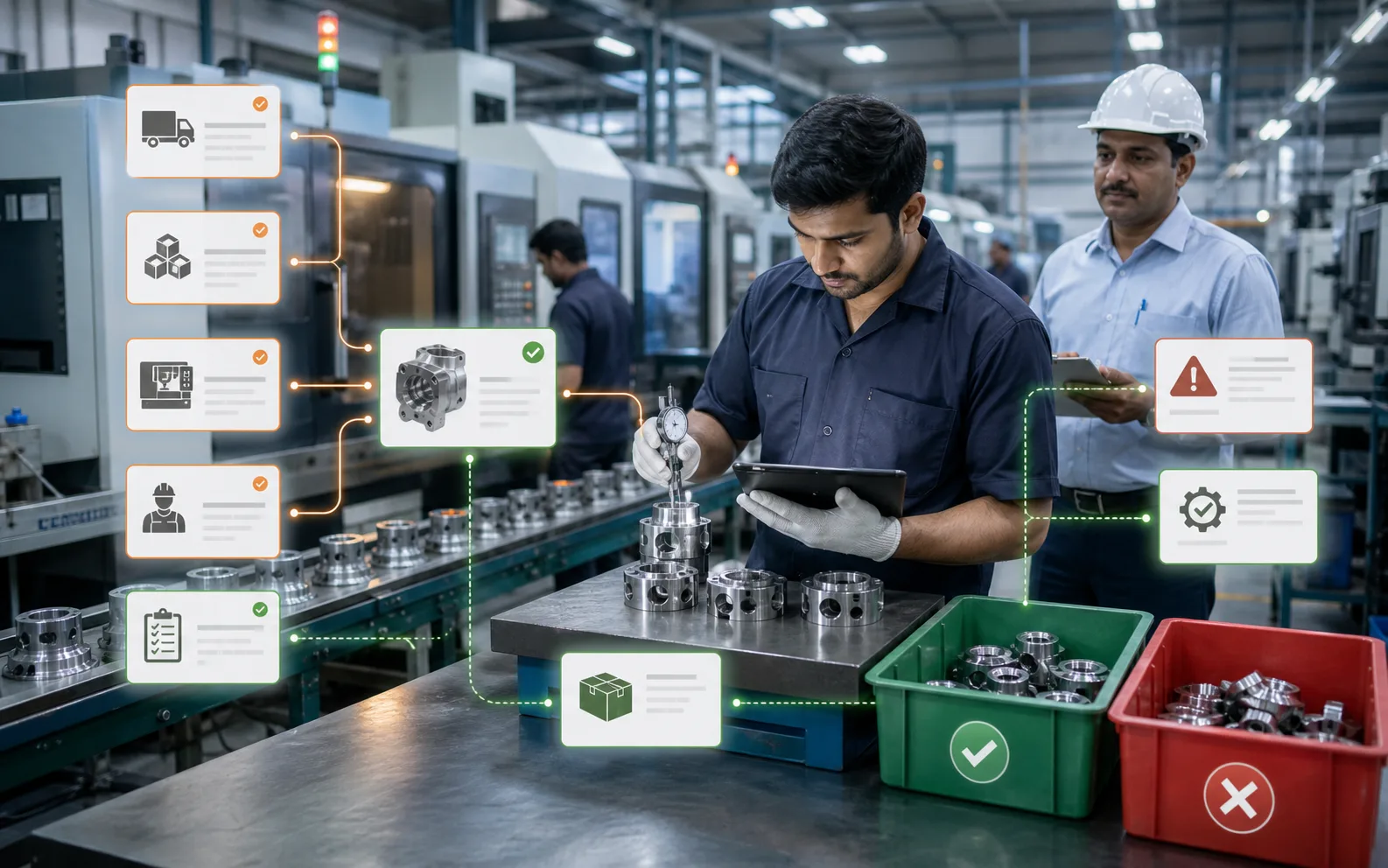
Manufacturers do not usually struggle because they lack software completely. Many already use accounting tools, spreadsheets, legacy ERP systems, barcode tools, production registers, and reporting templates. The bigger problem is that these tools often do not work together.
When systems are disconnected, teams lose time, data quality drops, and decisions become slower.
Disconnected Data
Sales may have one sheet. Purchase may use another tool. Stores may maintain manual stock. Production may update registers. Finance may reconcile later.
This creates multiple versions of the truth. Nobody is fully sure which number is current.
Poor Inventory Accuracy
Inventory problems are common in manufacturing. Stock may be physically available but missing in the system, or visible in the system but not usable. Causes include delayed entries, wrong units, unrecorded consumption, rejection, scrap, and location mismatches.
Reporting Delays
Many owners and managers receive reports after the damage is done. Delayed reports make it hard to act on production bottlenecks, purchase delays, quality issues, and dispatch risks.
ERP Complexity
Some manufacturers buy ERP systems that are too heavy, too rigid, or poorly implemented. Users avoid the system and return to spreadsheets. The software exists, but adoption fails.
Low User Adoption
Factory teams are busy. If software is slow, confusing, or not connected to their daily work, they will not use it properly. Adoption is a design and implementation problem, not only a training problem.
Where AICAN Optiwise Fits
AICAN Optiwise addresses these problems by connecting core manufacturing workflows in one AI-native ERP system: CRM, purchase, inventory, production, quality, dispatch, finance visibility, and AI agents. The goal is not just digitization, but usable operational clarity.
FAQ
What is the biggest software problem in manufacturing?
Disconnected data is one of the biggest problems because it affects every department.
Why do ERP implementations fail?
They fail when workflows are poorly understood, users are not trained, or the system is too complex for daily operations.
How can manufacturers improve software adoption?
Choose practical tools, map real workflows, train users, and keep screens simple.
Final Thought
Manufacturing software problems are rarely just technical. They are workflow problems, data problems, and adoption problems. Solving them requires software that fits how factories actually run.

Related Posts

Kanban System | Optiwise
Learn how a Kanban system works in manufacturing, where it helps, where it fails, and how Optiwise connects Kanban signals with inventory, purchase, and production planning.
12 Jun 2026Read more →Erp In Operations Management | Optiwise
Learn how ERP improves operations management by connecting planning, inventory, purchase, production, quality, dispatch, finance, and reporting.
12 Jun 2026Read more →ERP for FMCG Companies in India
A practical guide to ERP for FMCG companies in India, covering distributor orders, batch tracking, expiry, inventory, production, schemes, costing, and reporting.
11 Jun 2026Read more →
Optiwise, Odoo, Acumatica and Business Central for Manufacturing
Compare manufacturing workflows in Optiwise, Odoo, Acumatica and Dynamics 365 Business Central. See what your factory can run in Optiwise.
11 Jun 2026Read more →