
Do I Really Need Digital Job Travelers in My ERP?
Understand what digital job travelers do, why manufacturers use them, and how ERP-connected job travelers improve shop floor tracking, quality, costing, and delivery visibility.
Do I Really Need Digital Job Travelers in My ERP?
Introduction
A job traveler is simple in concept.
It tells the factory what needs to happen to a job as it moves through production.
Traditionally, this may be a printed sheet travelling with material from process to process.
It may include job details, routing, quantities, drawings, inspection points, material requirements, operation steps, and sign-offs.
The problem is that paper travelers are easy to lose, update late, or separate from the real system.
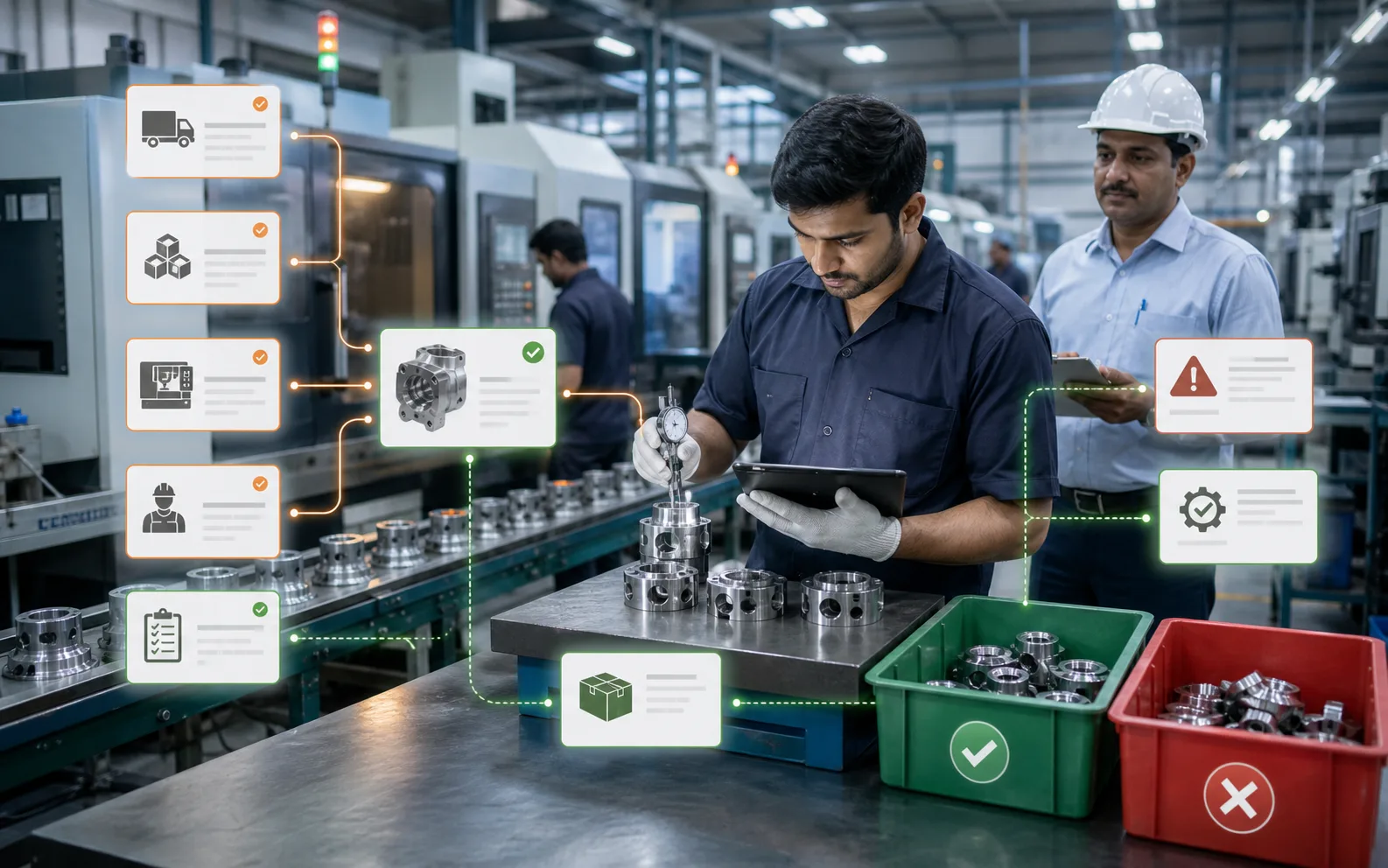
Digital job travelers solve this by connecting the traveler to ERP.
The job status becomes visible as work happens.
Why Job Travelers Matter
Manufacturing work often moves across departments.
Material is issued.
Cutting happens.
Machining happens.
Assembly happens.
QC happens.
Packing happens.
Dispatch happens.
If each stage updates status informally, managers do not know where the job really stands.
A digital job traveler creates a structured trail.
Who worked on the job?
Which operation is complete?
What quantity passed?
What quantity was rejected?
Is QC pending?
Is rework needed?
Is dispatch blocked?
This visibility matters for delivery, costing, and accountability.
How ERP Improves Job Travelers
A digital job traveler becomes more powerful when connected to ERP.
The traveler can link to the work order, BOM, material issue, operation sequence, QC checks, labor time, rework, and dispatch.
Instead of a paper document being updated separately, the job traveler becomes part of the operational record.
AICAN Optiwise supports production planning, work orders, shopfloor workflows, QC, inventory, and AI-assisted follow-ups. This allows job status to connect with material availability, production progress, and quality visibility.
For managers, the benefit is simple.
They do not need to ask five people where the job is.
The system should show it.
A Real Manufacturing Scenario
A fabrication company used printed job travelers. They worked well until order volume increased.
Papers were updated late. Supervisors kept informal notes. QC results were sometimes recorded after the job moved ahead. Dispatch teams had to call production for status.
After moving to digital job travelers, the company gained stage-wise visibility.
Production delays were easier to identify. QC holds became visible. Rework could be linked to the job. Delivery commitments became more reliable.
The job traveler stopped being only a document.
It became a live control tool.
Frequently Asked Questions
What is a digital job traveler?
A digital job traveler is an ERP-connected record that tracks a job through production stages, operations, QC, and completion.
Do all manufacturers need job travelers?
Not all. They are most useful when jobs pass through multiple steps, departments, machines, or quality checkpoints.
How do job travelers help costing?
They can capture actual labor, process time, rework, rejection, and material movement by job.
Can digital job travelers reduce delays?
Yes. They make job status and bottlenecks visible earlier.
Conclusion
Digital job travelers are valuable when production needs traceability and stage-wise control.
They help the factory see where work is, what is pending, and what is blocking completion.
For growing manufacturers, that visibility can reduce confusion and improve delivery reliability.
A Final Thought
A job traveler should not be paperwork for the sake of paperwork.
It should help the factory move work with clarity.
When the traveler becomes digital and connected to ERP, it becomes a live view of execution.
Manufacturers interested in digital production workflows can explore AICAN Optiwise at aican.co.in.
— Vedant Awasthi

Related Posts

Will AI Create More Jobs Than It Destroys?
Explore whether AI will create more jobs than it destroys, with a practical view of manufacturing, automation, new roles, reskilling, and business transformation.
13 Jun 2026Read more →Manufacturing AI vs. Hiring More Workers
Compare manufacturing AI with hiring more workers and learn when automation, better systems, training, or additional people are the right answer.
7 Jun 2026Read more →
Will AI Replace My Production Planning Job?
Understand how AI affects production planning jobs, what tasks may change, and how planners can become more valuable with AI-supported scheduling and visibility.
6 Jun 2026Read more →Do I Need Special Skills to Use AI in Manufacturing?
Learn what skills manufacturing teams need to use AI, including process knowledge, data discipline, prompt clarity, review judgment, ERP understanding, and change readiness.
6 Jun 2026Read more →