
How ERP Helps You Meet e-Invoicing and Compliance Requirements
Learn how ERP supports e-invoicing, GST-ready records, dispatch documentation, audit trails, invoice accuracy, and compliance discipline for Indian manufacturers.
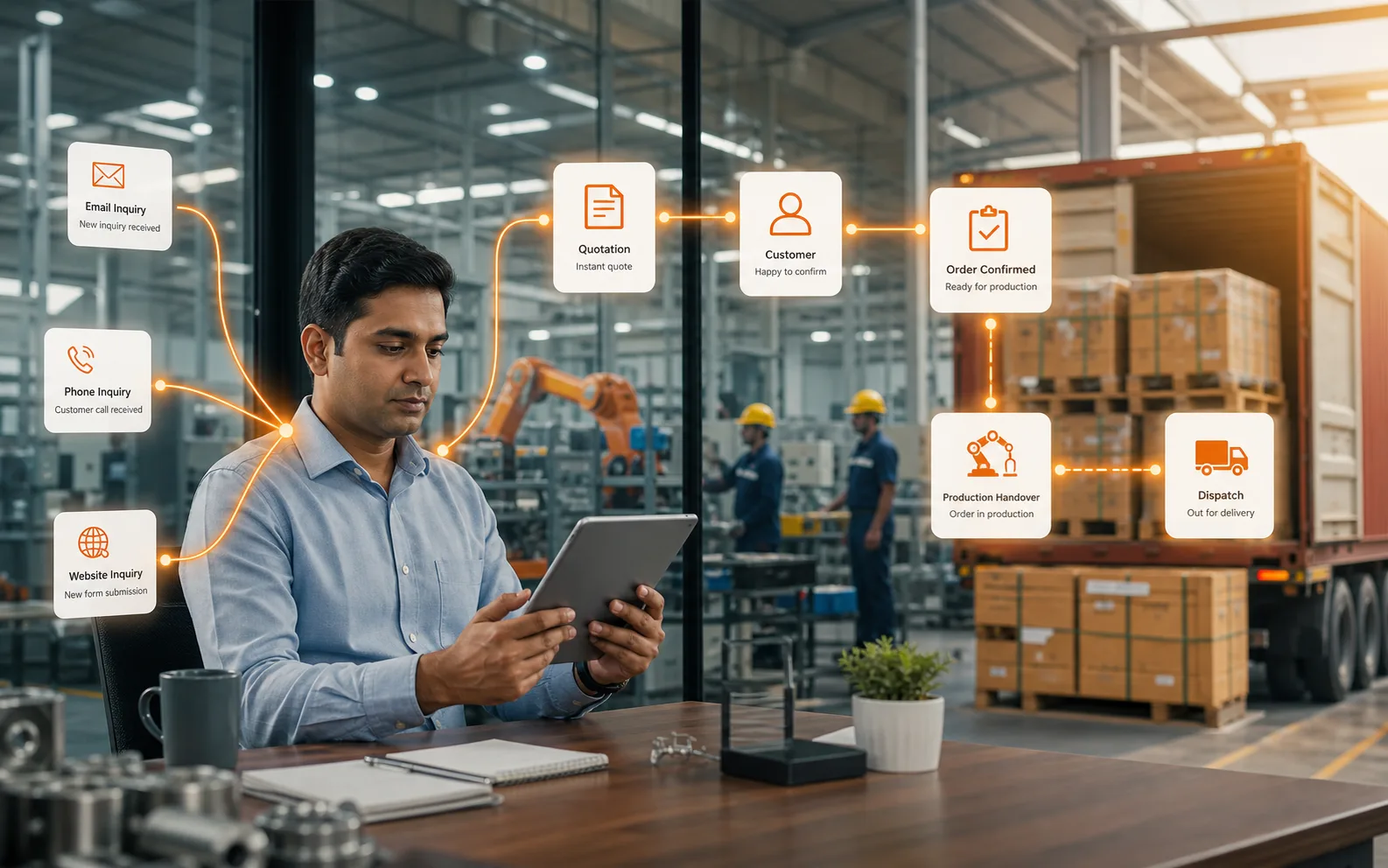
How ERP Helps You Meet e-Invoicing and Compliance Requirements
ERP helps with e-invoicing and compliance by improving the accuracy, consistency, and traceability of business data before invoices are generated.
Compliance does not start at filing time. It starts when customer details are entered, item tax settings are configured, orders are dispatched, and invoices are created.
For Indian manufacturers, ERP can reduce the daily friction behind compliance.
Why Compliance Becomes Difficult
Compliance problems often come from operational gaps:
- Wrong customer GST details
- Incorrect item tax mapping
- Quantity mismatch between dispatch and invoice
- Missing transport details
- Purchase and sales records not aligned
- Manual invoice corrections
- No clear approval trail
- Stock movement not matching billing
These issues create stress during filing, audits, and reconciliation.
How ERP Supports e-Invoicing
Depending on configuration and integrations, ERP can help prepare cleaner invoice data for e-invoicing requirements.
It can support:
- Correct customer master data
- Item-wise tax mapping
- Invoice numbering discipline
- Sales order to invoice flow
- Dispatch-linked billing
- Credit and debit note tracking
- Record history
- Error reduction before submission
Businesses should always confirm current e-invoicing applicability and rules with their tax advisor or official GST sources, because thresholds and requirements can change.
ERP and GST-Ready Records
ERP can improve the quality of GST-related records by connecting purchase, sales, inventory, and finance workflows.
For example:
- Purchase records connect to supplier invoices.
- Sales orders connect to dispatch and invoices.
- Returns are recorded systematically.
- Stock movement is traceable.
- Tax settings are standardized.
This does not replace tax review, but it reduces operational errors.
Audit Trail and Accountability
A good ERP records who created, approved, changed, or cancelled transactions. This audit trail is useful when reviewing mistakes or answering internal questions.
Without ERP, many changes happen through calls or chats, and the reason is forgotten later.
Dispatch and Documentation
Manufacturers often face compliance pressure during dispatch. ERP can help align goods movement with invoice data, transport information, packing details, and customer order references.
This reduces last-minute coordination between stores, dispatch, sales, and accounts.
What ERP Cannot Do Alone
ERP is not a substitute for compliance judgment. It cannot decide tax treatment in complex cases without proper configuration and professional input.
You still need:
- Correct tax setup
- Accounting review
- Compliance monitoring
- Updated understanding of rules
- Professional advice for special cases
ERP supports compliance. It does not remove responsibility.
Where AICAN Optiwise Fits
AICAN Optiwise connects manufacturing workflows with finance visibility, helping Indian MSMEs keep sales, dispatch, purchase, inventory, and invoice-related data more consistent. This operational discipline supports compliance readiness and reduces manual chasing.
FAQ
Is ERP mandatory for e-invoicing?
ERP itself may not be mandatory, but businesses covered by e-invoicing rules need accurate invoice data and proper processes. Check current applicability with a tax advisor.
Can ERP generate e-invoices?
Some ERP systems support e-invoice generation directly or through integrations. Capabilities vary by vendor.
Does ERP help with GST returns?
ERP can help organize GST-related transaction data, but returns should be reviewed by accounting or tax professionals.
What data should be clean for compliance?
Customer GSTIN, supplier records, item tax settings, invoice series, transport details, and transaction records should be accurate.
Final Thought
Compliance becomes easier when daily business records are clean.
ERP helps manufacturers reduce errors before they reach accounting, filing, or audit. That is where the real compliance value begins.

Related Posts

Kanban System | Optiwise
Learn how a Kanban system works in manufacturing, where it helps, where it fails, and how Optiwise connects Kanban signals with inventory, purchase, and production planning.
12 Jun 2026Read more →Erp In Operations Management | Optiwise
Learn how ERP improves operations management by connecting planning, inventory, purchase, production, quality, dispatch, finance, and reporting.
12 Jun 2026Read more →ERP for FMCG Companies in India
A practical guide to ERP for FMCG companies in India, covering distributor orders, batch tracking, expiry, inventory, production, schemes, costing, and reporting.
11 Jun 2026Read more →
Optiwise, Odoo, Acumatica and Business Central for Manufacturing
Compare manufacturing workflows in Optiwise, Odoo, Acumatica and Dynamics 365 Business Central. See what your factory can run in Optiwise.
11 Jun 2026Read more →