
ERP Mobile Access and Remote Management for Owners
Learn how mobile ERP access helps MSME manufacturing owners manage orders, inventory, purchase, production, dispatch, approvals, and dashboards remotely.

ERP Mobile Access and Remote Management for Owners
A manufacturing owner is rarely sitting in one place all day. There are customer visits, supplier calls, factory rounds, bank work, travel, and management reviews. If business visibility depends on being physically present in the office, decisions slow down.
ERP mobile access helps owners manage the business without personally chasing every update.
The goal is not to run the factory from a phone. The goal is to see the right information and approve the right actions at the right time.
What Owners Should See on Mobile ERP
A practical mobile ERP should show:
- Pending orders
- Delayed dispatches
- Low stock alerts
- Purchase approvals
- Production status
- Customer follow-ups
- Pending payments
- Quality issues
- Daily dashboards
Mobile access should focus on decisions, not every small transaction.
Why Remote Visibility Matters
Without mobile ERP, owners rely on calls and messages:
- “What is the order status?”
- “Has material arrived?”
- “Why is dispatch delayed?”
- “Which payment is pending?”
- “Is production on schedule?”
These questions interrupt teams and still may not produce accurate answers.
With ERP, the owner can check live status and then call only when action is needed.
Approvals on the Go
Mobile ERP is useful for approvals such as:
- Purchase orders
- Discounts
- Credit limits
- Stock adjustments
- Production changes
- Dispatch exceptions
Approvals should be controlled through permissions so speed does not compromise discipline.
Remote Management Does Not Mean Micromanagement
The danger of mobile access is overchecking. Owners should use ERP to review exceptions, not monitor every user constantly.
Good dashboards show what needs attention: delayed orders, shortages, pending approvals, and overdue follow-ups.
Security Matters
Mobile ERP should have strong login security, role-based access, device control, and permission settings. Sensitive finance and customer data should not be exposed casually.
Where AICAN Optiwise Fits
AICAN Optiwise gives MSME owners connected visibility across sales, purchase, inventory, production, quality, dispatch, and finance workflows. Its AI-assisted visibility can help owners focus on exceptions instead of manually asking for every update.
This is especially useful when owners manage multiple responsibilities or are frequently away from the factory office.
FAQ
Can ERP be used on mobile?
Many modern ERP systems support mobile or browser-based access. Capabilities vary by vendor.
What should owners use mobile ERP for?
Dashboards, approvals, alerts, delayed orders, low stock, purchase status, and customer follow-ups.
Is mobile ERP secure?
It can be secure if the system uses proper authentication, permissions, and access controls.
Should shopfloor workers use mobile ERP?
In some workflows, yes. Mobile updates can help production, quality, and stores teams if the interface is simple.
Final Thought
Mobile ERP gives owners something more valuable than remote access: remote clarity.
When the system shows what needs attention, owners can make faster decisions without becoming the bottleneck for every update.

Related Posts
Kanban System | Optiwise
Learn how a Kanban system works in manufacturing, where it helps, where it fails, and how Optiwise connects Kanban signals with inventory, purchase, and production planning.
12 Jun 2026Read more →Erp In Operations Management | Optiwise
Learn how ERP improves operations management by connecting planning, inventory, purchase, production, quality, dispatch, finance, and reporting.
12 Jun 2026Read more →ERP for FMCG Companies in India
A practical guide to ERP for FMCG companies in India, covering distributor orders, batch tracking, expiry, inventory, production, schemes, costing, and reporting.
11 Jun 2026Read more →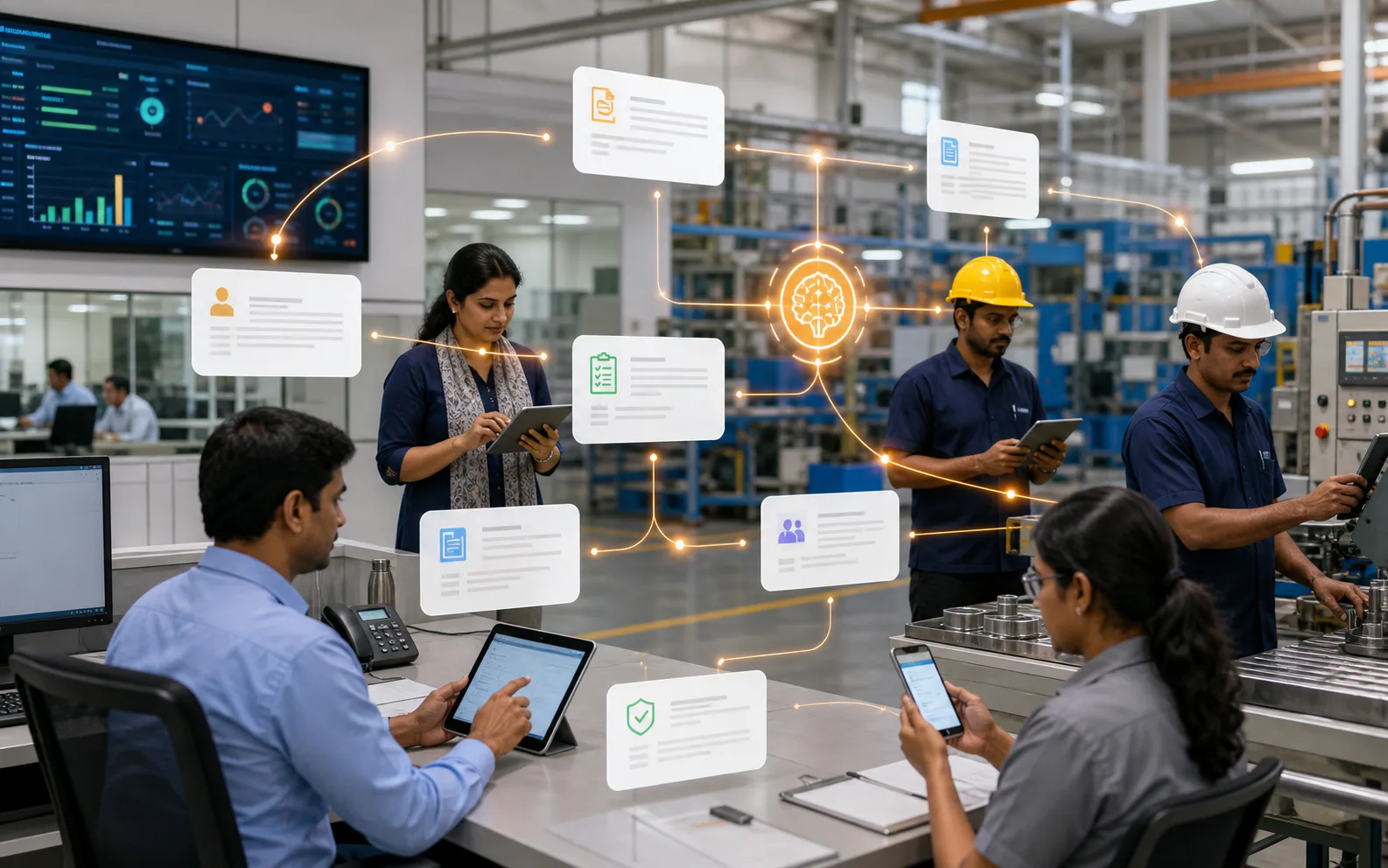
Optiwise, Odoo, Acumatica and Business Central for Manufacturing
Compare manufacturing workflows in Optiwise, Odoo, Acumatica and Dynamics 365 Business Central. See what your factory can run in Optiwise.
11 Jun 2026Read more →