
How to Evaluate ERP Vendors and Demo Systems Effectively
A practical ERP vendor evaluation guide for MSME manufacturers covering demos, process fit, support, cost, implementation plan, scalability, references, and red flags.
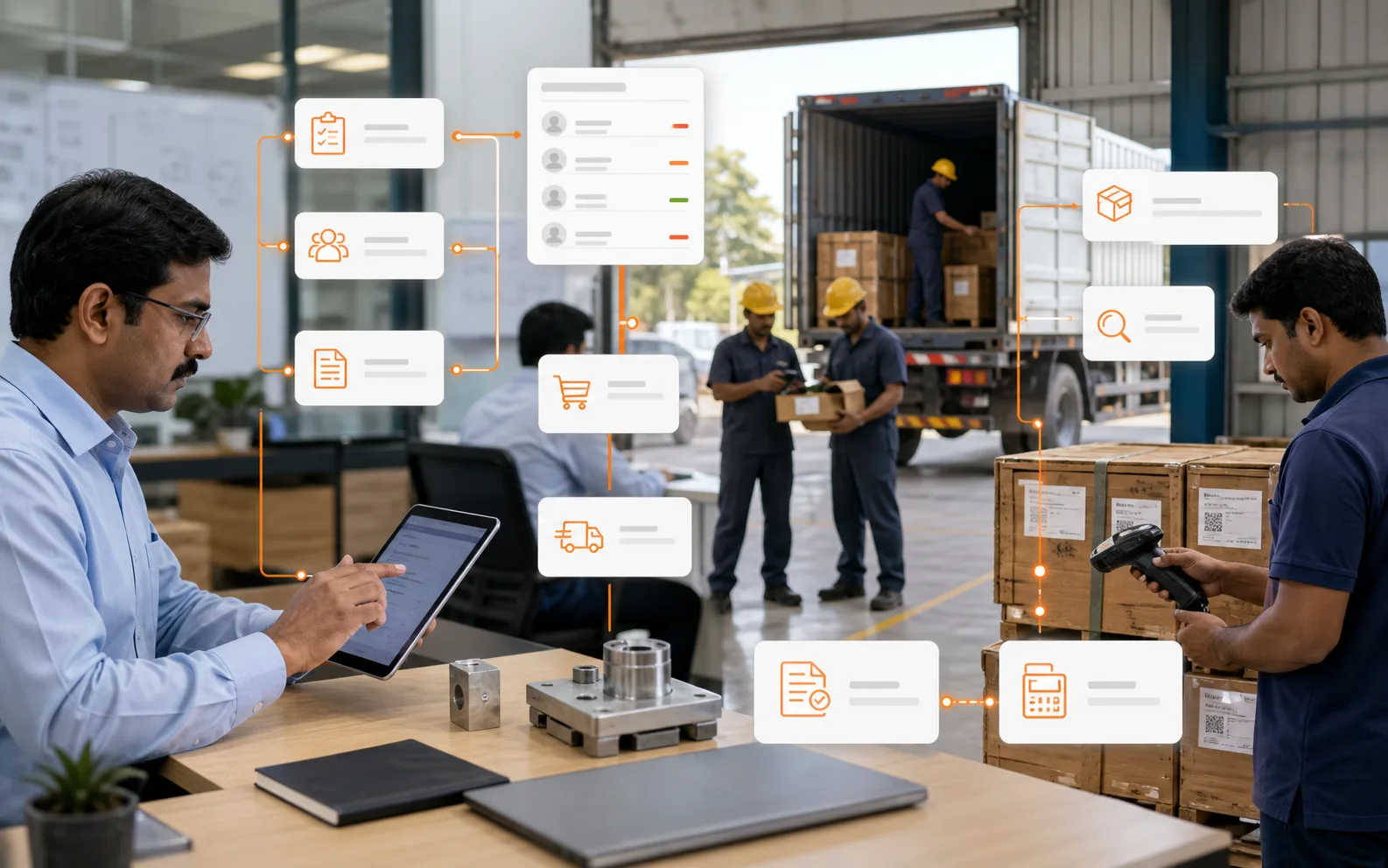
How to Evaluate ERP Vendors and Demo Systems Effectively
ERP demos can be misleading if you only watch the vendor show polished dashboards. Every decent ERP can look good in a controlled demo. The real test is whether it can handle your business workflow.
For MSME manufacturers, ERP evaluation should be structured, practical, and based on daily work.
Prepare Before the Demo
Before meeting vendors, write down your real process:
Enquiry → Quotation → Sales Order → Purchase → Inventory → Production → QC → Dispatch → Invoice → Payment Follow-up
Also list your current pain points:
- Stock mismatch
- Delayed orders
- Manual reports
- Poor follow-up
- Production visibility gaps
- Quality tracking issues
Give this to the vendor before the demo.
Ask for a Workflow Demo
Do not accept only a module tour. Ask the vendor to demonstrate your workflow from start to finish.
For example:
- Create a customer enquiry
- Prepare quotation
- Convert to sales order
- Check stock
- Raise purchase
- Receive material
- Issue to production
- Update production stage
- Record QC
- Dispatch order
- Show dashboard
This reveals fit quickly.
Use a Scorecard
Evaluate each vendor on:
- Manufacturing fit
- Ease of use
- Inventory depth
- Production tracking
- CRM and sales flow
- Quality management
- Reporting
- Support quality
- Implementation plan
- Total cost
- Scalability
- Integration ability
Score each area honestly.
Watch for Red Flags
Be careful if the vendor:
- Avoids showing manufacturing workflows
- Says every gap can be customized
- Cannot explain implementation clearly
- Has unclear pricing
- Offers weak support details
- Does not ask about your process
- Shows dashboards without transaction depth
- Pushes urgency instead of fit
Ask About Implementation
A good vendor should explain:
- Timeline
- Data requirements
- User roles
- Training plan
- Go-live support
- Internal responsibilities
- Risks
- Phase-wise rollout
If implementation is vague, the project risk is high.
Ask About Support and Updates
ERP needs long-term support. Ask about support channels, response time, update policy, bug fixes, training for new users, and change request pricing.
Check Scalability
Even if you start small, ask whether the system can support more users, locations, modules, reports, integrations, and automation later.
Where AICAN Optiwise Fits
When evaluating AICAN Optiwise, the useful test is the same: run your actual manufacturing flow through the system. Optiwise is designed around connected workflows for MSME manufacturers, so the demo should show sales, purchase, inventory, production, quality, dispatch, finance visibility, and AI-assisted insights in one operating story.
FAQ
How many ERP vendors should I evaluate?
Shortlist three to five vendors, then evaluate deeply using your actual workflows.
What is the biggest demo mistake?
Watching a generic dashboard demo without testing real transactions.
Should price decide the ERP vendor?
Price matters, but fit, support, implementation quality, and scalability matter more.
What should I ask during an ERP demo?
Ask the vendor to show your enquiry-to-dispatch workflow and explain implementation, support, costs, and limitations.
Final Thought
A good ERP demo should make your business clearer, not just the software look attractive.
Evaluate vendors by how well they understand your factory, your team, and your growth path.

Related Posts

Kanban System | Optiwise
Learn how a Kanban system works in manufacturing, where it helps, where it fails, and how Optiwise connects Kanban signals with inventory, purchase, and production planning.
12 Jun 2026Read more →Erp In Operations Management | Optiwise
Learn how ERP improves operations management by connecting planning, inventory, purchase, production, quality, dispatch, finance, and reporting.
12 Jun 2026Read more →ERP for FMCG Companies in India
A practical guide to ERP for FMCG companies in India, covering distributor orders, batch tracking, expiry, inventory, production, schemes, costing, and reporting.
11 Jun 2026Read more →
Optiwise, Odoo, Acumatica and Business Central for Manufacturing
Compare manufacturing workflows in Optiwise, Odoo, Acumatica and Dynamics 365 Business Central. See what your factory can run in Optiwise.
11 Jun 2026Read more →