
How Do I Manage Multiple Production Lines at Once?
Learn how manufacturers can manage multiple production lines with real-time visibility, shared schedules, clear priorities, bottleneck alerts, and connected production data.
How Do I Manage Multiple Production Lines at Once?
Managing one production line is already demanding. Managing multiple lines at the same time is where many factories start to feel stretched. One line is waiting for material, another line is running behind schedule, a third line has a machine issue, and a fourth line looks fine until someone checks the actual output at the end of the shift.
The problem is rarely lack of effort. Most manufacturing teams are working hard. The real problem is that information is scattered. Production plans may be in Excel. Machine status may be known only to operators. Material availability may sit with stores. Dispatch pressure may come from sales. Quality holds may be tracked separately. By the time the plant head gets the full picture, the day is already half gone.
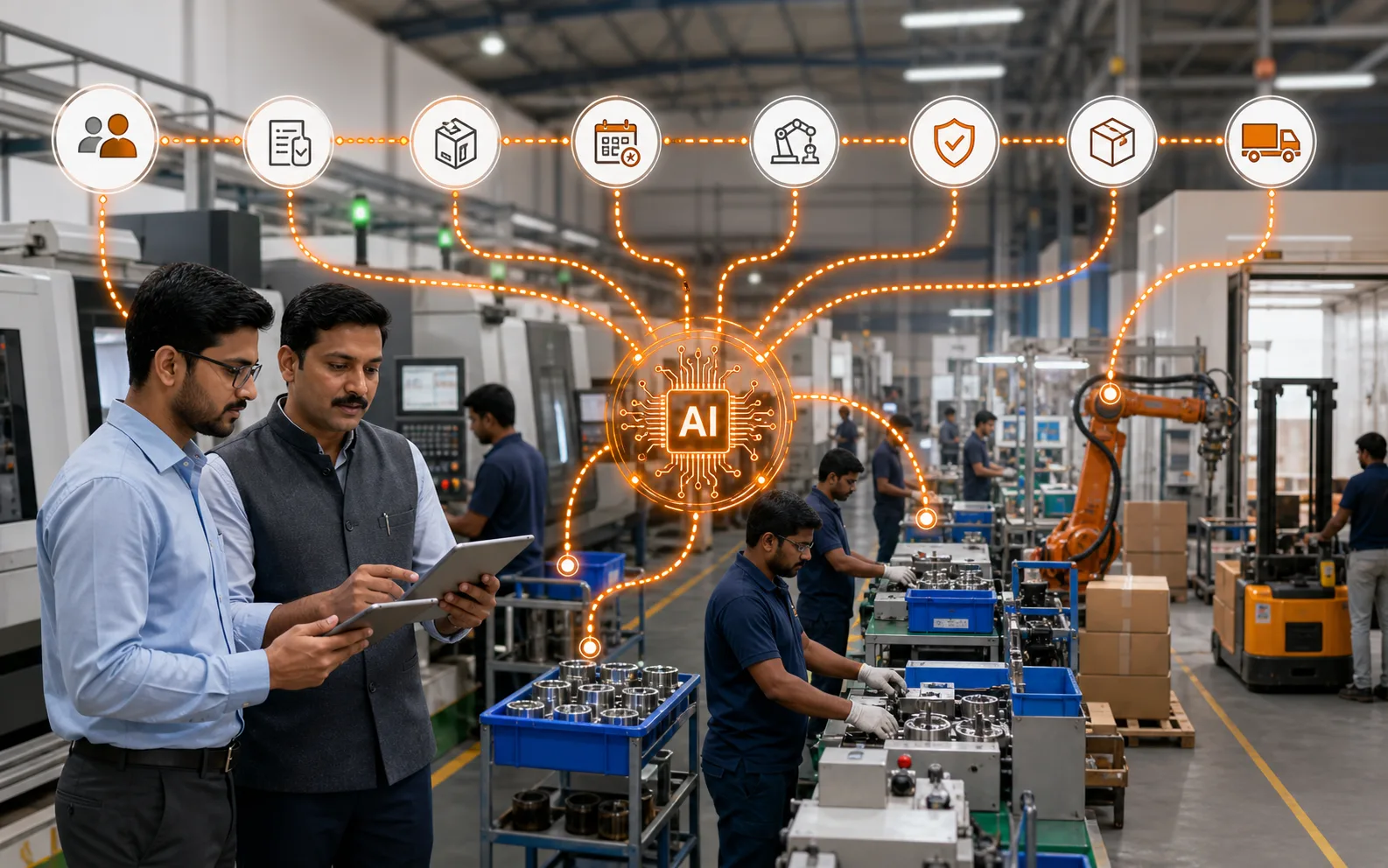
Multi-line production control needs more than a daily plan. It needs factory floor visibility that shows what is happening now, what is likely to slip, and where management attention is actually required.
Why Multiple Production Lines Become Hard to Control
A factory with multiple production lines has more moving parts than it appears from outside. Each line may have its own product mix, machine sequence, operator skill requirement, changeover time, quality checkpoints, and material dependency. Even if the lines are physically close to each other, they behave like separate systems.
The difficulty grows when one line affects another. A delay in cutting may slow assembly. A packaging shortage may block finished goods. A quality hold on one batch may consume inspection capacity needed by another line. A maintenance issue on a common machine may disturb several orders at once.
When this is handled manually, the plant team spends too much time asking basic questions:
- Which line is running right now?
- Which order is on each line?
- What was planned versus what has actually been produced?
- Which line is idle, and why?
- Which machine is causing repeated delays?
- Which material shortage will affect the next shift?
- Which orders are at risk of missing dispatch?
These questions should not require phone calls, floor walks, and end-of-day Excel updates. They should be visible in one place.
The First Requirement: Line-Wise Production Visibility
To manage multiple lines properly, every line must have a clear live status. This does not mean a complex dashboard with too many charts. It means a practical, line-wise view that answers the essentials.
For each production line, the system should show:
- Current job or work order
- Planned quantity
- Completed quantity
- Balance quantity
- Start time
- Expected completion time
- Current stage
- Machine or station status
- Operator or shift responsibility
- Downtime reason, if any
- Quality hold or rejection status
This line-wise view becomes the control room for daily production. Instead of asking ten people for updates, the production manager can quickly see which lines are healthy and which ones need attention.
A good rule is simple: if a supervisor cannot understand the condition of all active lines within two minutes, the visibility system is still too weak.
Planned vs Actual Output Must Be Tracked Continuously
Many factories know their plan in the morning and their actual output at night. The gap between those two points is where most losses hide.
For multi-line control, planned versus actual output should be visible throughout the shift. If Line 1 was expected to produce 500 units by 2:00 PM but has produced only 310, the system should show the variance while there is still time to act. Waiting until the shift report is prepared makes the information less useful.
Real-time variance tracking helps managers decide whether to:
- Add manpower to a delayed line
- Move an urgent order to another available line
- Adjust the next shift plan
- Escalate a material issue
- Prioritize maintenance support
- Inform dispatch or customer service early
The goal is not to blame a line for falling behind. The goal is to catch the delay early enough to recover.
Priorities Need to Be Visible Across All Lines
One of the most common causes of production confusion is unclear priority. Sales may push one customer order. Dispatch may push another. The plant may prioritize based on material readiness. Supervisors may continue with the job already running because changeover will take time.
In a multi-line factory, priorities must be visible and shared. Each line should show whether the current job is normal, urgent, export, committed dispatch, trial batch, rework, or maintenance-related. This prevents a situation where a less important job consumes capacity while a critical dispatch order waits unnoticed.
A priority view also helps leaders make trade-offs. If two urgent jobs need the same machine or skilled operator, the decision should be made with complete information, not based on who follows up the loudest.
Bottleneck Detection Matters More Than Activity Tracking
A busy factory is not always an efficient factory. Multiple lines may appear active, but one process could be quietly slowing everything down. In many plants, the same bottleneck repeats every week: one inspection station, one coating machine, one packing table, one senior operator, one material approval step.
Multi-line monitoring should help identify these bottlenecks. It should show where jobs are waiting, how long they have waited, and whether the same stage is repeatedly becoming a constraint.
Useful bottleneck signals include:
- Jobs waiting too long between stages
- Lines with high idle time despite available orders
- Machines with repeated stoppages
- Stages with rising work-in-progress
- Orders delayed after quality inspection
- Common material shortages across lines
- Changeovers taking longer than expected
Once bottlenecks become visible, improvement becomes practical. The team can rebalance manpower, add inspection capacity, improve material planning, adjust batch sizes, or change the sequencing logic.
Material Availability Must Be Connected to Line Planning
A production line can look available on paper but still fail in reality if material is missing. This is especially common when multiple lines draw from the same inventory.
For example, Line A may start a job that consumes material needed for a higher-priority job on Line C. Stores may issue material based on whoever asks first. Purchase may not know that a shortage will affect tomorrow morning's schedule. Production may only discover the shortage when the line is ready to start.
A connected system should link production plans with inventory status. Before a job is released to a line, the team should know whether raw material, components, tools, packaging, and consumables are available.
This is where factory floor visibility becomes stronger when connected with ERP. Line planning should not sit separately from inventory, purchase, and dispatch. When these functions are connected, managers can see not only which line is free, but which line can actually run the planned job without interruption.
Downtime Reasons Should Be Captured Properly
When a line stops, the reason matters. If downtime is recorded only as “machine issue” or “operator delay,” management loses the detail needed for improvement.
Factories should define practical downtime categories such as:
- Material not available
- Tooling not ready
- Machine breakdown
- Preventive maintenance
- Quality hold
- No operator available
- Power issue
- Changeover delay
- Waiting for approval
- Waiting for previous process
- Packing or dispatch hold
Line-wise downtime data helps managers separate symptoms from root causes. If one line loses hours due to material shortages, stores and purchase planning need attention. If another line loses time during changeover, standard operating procedures may need improvement. If breakdowns repeat on the same machine, maintenance planning needs to change.
Without reason-wise downtime, every delay becomes a general complaint. With reason-wise downtime, it becomes a solvable problem.
Supervisors Need Simple Input, Not Extra Paperwork
A common mistake in production digitization is asking supervisors to enter too much data. If the system feels like extra clerical work, adoption will suffer.
For multi-line monitoring, shop floor inputs should be quick and structured. Supervisors or operators should be able to update job start, pause, completion, downtime reason, rejection quantity, and remarks with minimal effort. Mobile or tablet access can help, especially when supervisors move across lines.
The best systems reduce manual reporting work. They should replace duplicate entries, not add another layer on top of existing notebooks and spreadsheets.
What a Good Multi-Line Dashboard Should Show
A practical multi-line production dashboard should combine live status with management signals. It should not overwhelm users with decorative charts. It should help decisions.
A useful dashboard may include:
- All active lines and their current job status
- Planned versus actual output by line
- Delayed jobs and delay reasons
- WIP by stage
- Downtime by line and reason
- Orders at dispatch risk
- Material shortages affecting active plans
- Quality holds and rejection trends
- Shift-wise production progress
- Machine utilization
- Supervisor-wise or department-wise performance
The dashboard should support different levels of detail. A plant head may need a summary across all lines. A supervisor may need only their assigned line details. Management may need trends across days or weeks.
How to Manage Exceptions Without Micromanaging
Managing multiple lines does not mean watching every operator every minute. That creates stress and does not scale. The better approach is exception-based control.
The system should highlight only the lines that need attention:
- Line running below target
- Job delayed beyond tolerance
- Machine stopped for more than a defined time
- Material issue blocking the next job
- Quality hold affecting dispatch
- Output variance crossing a threshold
- Rejection rate higher than expected
This helps managers spend time where intervention matters. Healthy lines can continue running without constant interruption.
Daily Production Meetings Become More Useful
In many factories, daily production meetings are spent arguing about numbers. One department has one version of output, another has a different version of delays, and someone is still updating the spreadsheet.
With line-wise visibility, meetings become more action-focused. The team can review yesterday's plan versus actual, understand the main reasons for delay, check today's constraints, and agree on corrective actions.
Instead of asking, “What happened?” the meeting can ask, “What are we doing about it?”
That shift is important. Visibility is not just about seeing the floor. It is about improving the speed and quality of decisions.
Where AICAN Optiwise Fits
AICAN Optiwise helps manufacturing teams connect production, inventory, purchase, sales, dispatch, and finance into one operating system. For factories running multiple production lines, this matters because line performance cannot be managed in isolation.
With Optiwise, a manufacturer can build stronger factory floor visibility through connected work orders, line-wise production tracking, inventory-linked planning, downtime capture, shift reporting, and management dashboards. Instead of waiting for manual updates, leaders can see what is moving, what is stuck, and what needs attention.
AICAN focuses on practical ERP for growing Indian manufacturers, where the challenge is not only software adoption but daily operational discipline. You can also learn more about the company on the About AICAN page.
FAQ
What is the best way to manage multiple production lines?
The best way is to use a connected system that shows live line-wise status, planned versus actual output, downtime reasons, material availability, and dispatch risk. Manual follow-ups may work for a small setup, but they become unreliable as production volume and line count increase.
Do I need a separate dashboard for each production line?
You need both line-level detail and a combined plant view. Supervisors should be able to see their assigned lines in detail, while management should see all lines together with alerts for delays, downtime, bottlenecks, and priority orders.
Can Excel manage multiple production lines?
Excel can help with planning, but it is weak for live control. It depends on manual updates, can easily have multiple versions, and does not automatically connect production with inventory, purchase, quality, and dispatch. For real-time control, a connected ERP or production management system is stronger.
How do I know which production line is underperforming?
Compare each line's planned output, actual output, downtime, rejection, changeover time, and idle time. The underperforming line is not always the one with the lowest output; it may be the line facing the most stoppages, material waits, or quality holds.
Should all lines follow the same KPIs?
Some KPIs should be common, such as output, downtime, quality, and schedule adherence. But each line may also need specific measures depending on product type, machine capacity, batch size, and process complexity.
How often should production line data be updated?
Critical status should be updated as close to real time as possible. At minimum, job start, job completion, downtime, rejection, and material issues should be captured during the shift, not only after the shift ends.
What is exception-based production control?
Exception-based control means the system highlights only the issues that need attention, such as a delayed line, machine stoppage, material shortage, or high rejection rate. This helps managers avoid micromanaging every normal activity.
Founder’s Note
When we speak with manufacturers, one thing becomes clear: most owners do not want a complicated control room. They want a truthful picture of the factory.
If four lines are running, they want to know which one is ahead, which one is behind, and which one will create a delivery problem tomorrow. That sounds simple, but it is difficult when data lives in registers, Excel files, WhatsApp updates, and memory.
Our view at AICAN is that good manufacturing software should make the factory easier to understand. It should help teams act faster without adding unnecessary reporting pressure. Multi-line control is not about watching people more closely. It is about giving everyone the same facts so the right decisions can happen sooner.
Final Thought
Managing multiple production lines is not only a scheduling challenge. It is a visibility challenge. If production, inventory, quality, maintenance, and dispatch are not connected, even a good plan can fail during execution.
The factories that improve fastest are the ones that see problems early. They know which line is slipping, why it is slipping, and what action can recover the day. That is the real value of factory floor visibility: fewer surprises, better decisions, and a production system that can scale without depending on constant manual chasing.

Related Posts
A Manufacturing Alternative to SAP: Optiwise
Run your factory in Optiwise, a manufacturing alternative to SAP Business One with connected operations, AI agents and no-code workflows.
14 Jun 2026Read more →How Do I Know If My Manufacturing Business Really Needs an ERP?
A practical guide for manufacturers to identify when spreadsheets, manual follow-ups, and disconnected systems are no longer enough — and when ERP becomes an operational necessity.
14 Jun 2026Read more →Production Management System Optimized | Optiwise
Learn best practices for optimizing a production management system across planning, scheduling, material readiness, quality, and reporting.
12 Jun 2026Read more →
What Is the Best ERP for Pharmaceutical Manufacturing?
Learn how to choose the best ERP for pharmaceutical manufacturing, with guidance on batch control, quality workflows, traceability, inventory, documentation, and GMP discipline.
10 Jun 2026Read more →