
Mobile Access for ERP Systems
Learn how mobile ERP access helps small manufacturers with approvals, inventory, production updates, sales order status, dispatch, reports, and owner visibility.

Mobile Access for ERP Systems
Mobile ERP access is useful when the right people can check or update the right information at the moment work happens.
It is not useful only because an ERP has an app.
A business does not become more efficient just because screens are available on a phone. Mobile ERP becomes valuable when owners, managers, store teams, sales users, production supervisors, service teams, and dispatch staff can use it for practical decisions.
For a small manufacturer, mobile access can help answer questions like:
- What orders are delayed today?
- Which material is short?
- Has a purchase order been approved?
- What production jobs are in progress?
- Is finished stock ready for dispatch?
- What did the team produce today?
- Which customer order needs attention?
- Can an approval be given without waiting for the owner to reach office?
That is the real purpose of mobile ERP: faster visibility and action.
Mobile ERP Should Not Be a Smaller Desktop Screen
A common mistake is assuming that if ERP opens on a phone, it is mobile-friendly.
That is not enough.
Mobile users need focused workflows. A phone screen cannot carry every field, report, filter, and admin setting from a desktop ERP. If the mobile experience is crowded, users will avoid it.
Good mobile ERP should support short, high-value actions:
- Approve a purchase request
- Check pending orders
- View stock availability
- Update production status
- Upload a field service note
- Check dispatch status
- View owner dashboards
- Search a customer or order
- Receive alerts for exceptions
Mobile access should simplify work, not squeeze the entire ERP into a small screen.
Who Actually Needs Mobile ERP Access?
Not every user needs full mobile ERP access.
Different roles need different mobile capabilities.
Owners and Directors
Owners often need dashboards and approvals.
Useful mobile views include:
- Pending orders
- Delayed orders
- Stock shortage
- Purchase approvals
- Production status
- Dispatch pending
- Customer outstanding
- Daily summary
The owner should not need to call five people to understand what needs attention.
Sales Teams
Sales teams need customer and order visibility.
Useful mobile access includes:
- Customer details
- Quotation status
- Sales order status
- Dispatch status
- Stock availability
- Payment or outstanding visibility where permitted
- Follow-up notes
This helps sales give better customer updates without waiting for office coordination.
Store and Inventory Teams
Store teams may use mobile or tablet access for stock movement.
Useful workflows include:
- Material inward
- Stock issue
- Stock transfer
- Stock lookup
- Barcode scanning if supported
- Physical stock verification
- Rejected or hold stock update
For frequent inventory work, tablets may be more practical than phones.
Production Supervisors
Production supervisors need quick updates.
Mobile or tablet access can support:
- Job card view
- Production progress update
- Material issue visibility
- WIP status
- Delay reason update
- Output entry
- QC handoff
This is useful when supervisors are on the shop floor and not sitting at a desk.
Dispatch Teams
Dispatch users may need:
- Ready-for-dispatch list
- Packing status
- Partial dispatch update
- Delivery note status
- Customer-wise pending dispatch
- Vehicle or courier details
Mobile access can reduce back-and-forth during busy dispatch hours.
Service or Field Teams
For service-led or hybrid businesses, mobile access is even more important.
Field users may need:
- Assigned jobs
- Customer location
- Service history
- Work notes
- Photo upload
- Parts used
- Completion status
- Customer sign-off
Mobile ERP can help service teams update work without returning to office.
Mobile ERP Improves Approvals
Approvals are one of the strongest use cases for mobile ERP.
In many businesses, work gets delayed because one person is not available to approve purchase, stock adjustment, discount, dispatch, or expense.
Mobile approvals can help with:
- Purchase requests
- Purchase orders
- Stock adjustments
- Sales discounts
- Credit limits
- Expense claims
- Dispatch exceptions
- Payment approvals
But approvals must be designed carefully.
Users should see enough context before approving:
- Request details
- Amount or quantity
- Reason
- Previous history if relevant
- Impact on order or production
- Supporting documents
Mobile approval without context can create risk.
Mobile ERP Helps Owners Stay Connected Without Micromanaging
Owners should not have to ask for every update manually.
A mobile dashboard can show exceptions:
- Orders delayed
- Stock below minimum
- Purchase overdue
- Production stuck
- Dispatch pending
- QC rejection high
- Payment overdue
This lets owners focus on what needs attention.
The goal is not to watch every employee constantly. The goal is to see business exceptions early enough to act.
Mobile ERP Can Improve Data Timeliness
ERP reports are only useful when data is updated on time.
Mobile access can help users update status closer to the point of work.
For example:
- A production supervisor updates job progress from the shop floor.
- A storekeeper confirms material receipt immediately.
- A field technician marks service completion at the customer site.
- A dispatch user updates shipment status before the truck leaves.
Timely updates improve report accuracy.
But mobile access does not fix discipline by itself. Users still need training and clear responsibility.
Security Matters More on Mobile
Mobile ERP access creates convenience, but it also creates security risk.
Phones can be lost, shared, unlocked, or used on insecure networks.
A good mobile ERP setup should consider:
- Unique user logins
- Strong passwords
- Multi-factor authentication where available
- Role-based access
- Device-level security
- Session timeout
- Ability to remove access when employees leave
- Restricted export or download
- Audit logs
Do not give full ERP access to every phone by default.
Mobile permissions should match job responsibility.
Offline Access: Useful but Not Always Needed
Some businesses ask whether ERP mobile access works offline.
Offline capability can be useful when internet connectivity is weak, especially for remote sites or field service teams. But offline access adds complexity because data must sync later.
Before insisting on offline access, ask:
- Which tasks truly need offline mode?
- How often is internet unavailable?
- What data should be stored on the device?
- What happens if two users update the same record offline?
- How is sync conflict handled?
- Is sensitive data stored securely?
For many small businesses, reliable online mobile access is enough. Offline mode should be requested only when it solves a real problem.
Mobile ERP and Barcode Scanning
Mobile or tablet ERP can support barcode workflows where needed.
This can help with:
- Material inward
- Stock transfer
- Production issue
- Finished goods receipt
- Packing
- Dispatch
- Stock audit
Barcode scanning is valuable only when item codes, labels, locations, and inventory processes are already clean.
If master data is messy, scanning will not solve the problem. It may only make mistakes faster.
What to Check Before Choosing Mobile ERP
During ERP evaluation, test mobile workflows directly.
Ask the vendor to show:
- Owner dashboard on mobile
- Purchase approval on mobile
- Order status search on mobile
- Stock lookup on mobile
- Production update on tablet or phone
- Dispatch update on mobile
- Role-based mobile access
- Mobile security settings
- Notification or alert system
Do not accept “yes, mobile available” as the full answer.
Test the actual tasks your team will use.
Where AICAN Optiwise Fits
AICAN Optiwise can help manufacturers think about mobile ERP access in a practical way: what owners need to see, what supervisors need to update, what stores need to record, and what sales or dispatch teams need to check.
The AICAN team can help define role-wise access so mobile ERP supports daily work without exposing unnecessary data. That is especially important for small manufacturers where users often move between the office, shop floor, stores, and dispatch area.
For businesses moving from phone calls and WhatsApp follow-ups to ERP, mobile access can make adoption easier when it is tied to real workflows.
You can learn more about AICAN on the About AICAN page.
FAQ
Is mobile ERP useful for small manufacturers?
Yes, when it supports practical tasks such as approvals, stock lookup, production updates, dispatch status, sales order tracking, and owner dashboards.
Should every employee get mobile ERP access?
No. Mobile access should be role-based. Users should see only the information and actions needed for their work.
Can mobile ERP replace desktop ERP?
Not fully. Mobile ERP is best for quick actions, approvals, updates, and dashboards. Complex configuration, data cleanup, and detailed reporting are usually better on desktop.
Is mobile ERP secure?
It can be secure if strong logins, role permissions, session controls, audit logs, and device security are used. Poorly controlled mobile access can create data risk.
Does mobile ERP work offline?
Some systems support offline workflows, but offline access adds sync and security complexity. It should be used only where needed.
What mobile ERP features matter most?
The most useful features are role-wise dashboards, approvals, search, alerts, stock lookup, production updates, dispatch status, and secure access controls.
Founder’s Note
Mobile ERP should make the business quicker, not noisier.
At AICAN, we see mobile access as a way to bring ERP closer to where work happens: the shop floor, store, dispatch area, customer site, or owner’s phone. But access must be thoughtful. The right user should see the right information at the right time.
Good mobile ERP reduces waiting. It should not create another place for confusion.
Final Thought
Mobile access for ERP systems is valuable when it helps people act faster and update work closer to reality.
For small manufacturers, the best mobile ERP use cases are approvals, dashboards, inventory lookup, production updates, dispatch tracking, and customer order visibility. Test the real mobile workflows before choosing a system.

Related Posts
Kanban System | Optiwise
Learn how a Kanban system works in manufacturing, where it helps, where it fails, and how Optiwise connects Kanban signals with inventory, purchase, and production planning.
12 Jun 2026Read more →Erp In Operations Management | Optiwise
Learn how ERP improves operations management by connecting planning, inventory, purchase, production, quality, dispatch, finance, and reporting.
12 Jun 2026Read more →ERP for FMCG Companies in India
A practical guide to ERP for FMCG companies in India, covering distributor orders, batch tracking, expiry, inventory, production, schemes, costing, and reporting.
11 Jun 2026Read more →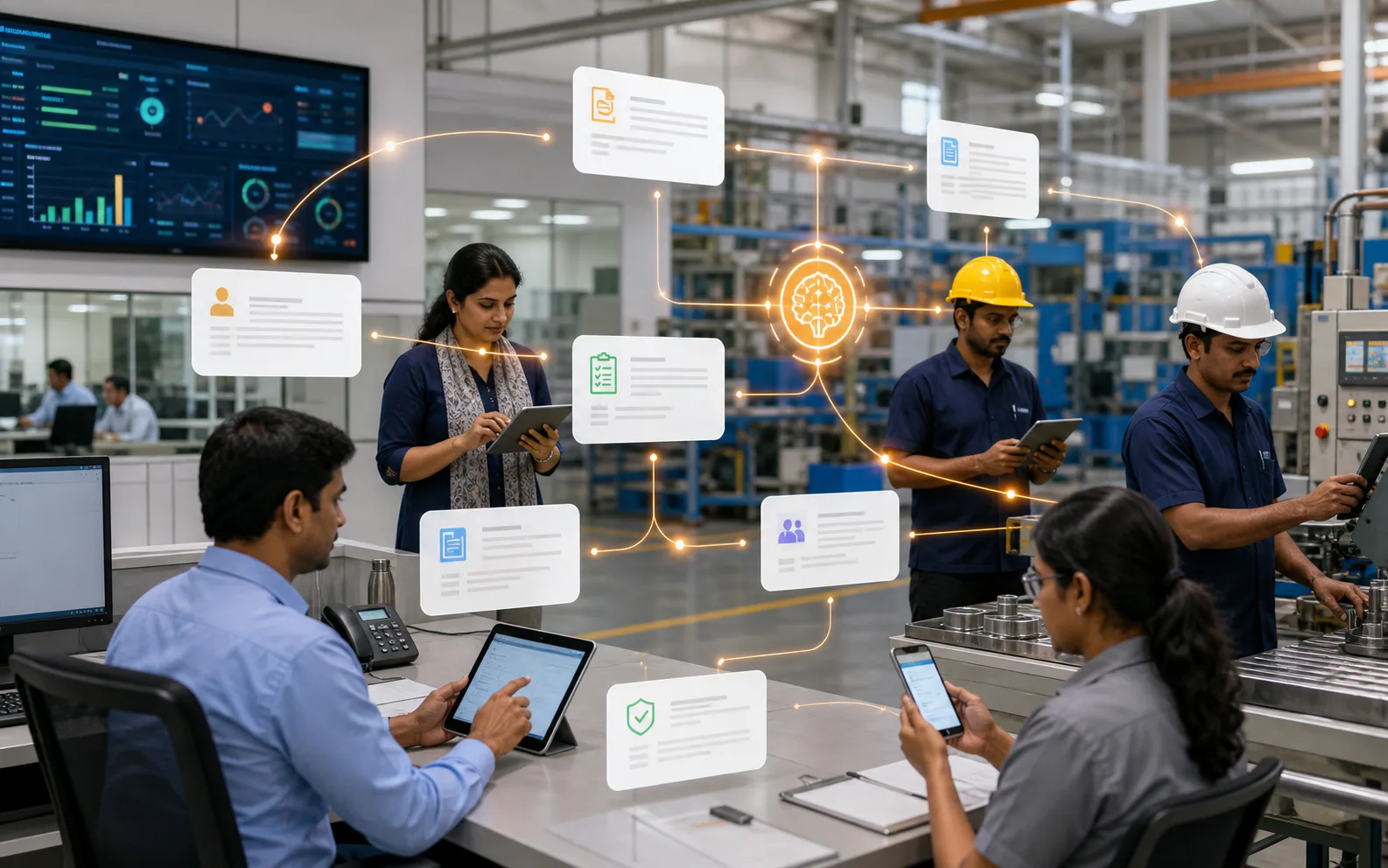
Optiwise, Odoo, Acumatica and Business Central for Manufacturing
Compare manufacturing workflows in Optiwise, Odoo, Acumatica and Dynamics 365 Business Central. See what your factory can run in Optiwise.
11 Jun 2026Read more →