
How Do I Monitor Machine Utilization?
Learn how manufacturers can monitor machine utilization using running time, idle time, downtime, output, planned capacity, maintenance, quality, and ERP or IoT dashboards.

How Do I Monitor Machine Utilization?
Machine utilization is monitored by tracking planned time, running time, idle time, downtime, setup time, output, maintenance events, quality holds, and actual production against capacity. The goal is to understand whether machines are creating value during the time they are available.
A factory may own enough machines and still lose capacity because of poor scheduling, material shortages, slow changeovers, repeated downtime, operator delays, or hidden quality issues. Utilization tracking makes these losses visible.
AICAN Optiwise helps manufacturers connect production, machine status, maintenance, quality, inventory, dispatch, finance, and reporting so machine utilization can be managed with operational context.
Define available machine time
Utilization begins with a clear definition of planned machine time.
Track:
- Machine or work center
- Planned shift time
- Planned maintenance
- Setup time
- Scheduled production time
- Breaks or non-production time where configured
Without a baseline, utilization becomes a rough guess.
Track running and idle time
The system should show whether the machine is running, idle, stopped, under setup, or under maintenance.
Useful views include:
- Running hours
- Idle hours
- Downtime hours
- Setup hours
- Output per shift
- Utilization percentage
IoT can help automate machine status where supported, while ERP connects that status to job and production context.
Capture downtime reasons
Utilization improves when downtime reasons are specific.
Track:
- Machine breakdown
- Material shortage
- Setup delay
- Changeover
- Quality hold
- Maintenance
- Operator issue
- Waiting for approval
Specific data helps teams take specific action.
Link output and quality
A utilized machine must produce usable output. High running time with high rejection is not healthy performance.
Connect utilization with:
- Good output
- Rework quantity
- Rejection quantity
- Defect reason
- Quality hold
- Retest or final release
This prevents false productivity signals.
Where Optiwise fits
Optiwise can help manufacturers monitor machine utilization by connecting production plans, machine status, downtime, output, quality, maintenance, and dashboards.
A practical implementation can focus on:
- Machine master data
- Planned versus actual running time
- Downtime reason capture
- Output tracking
- Quality linkage
- Maintenance follow-up
- Utilization dashboards
AICAN helps manufacturers use machine data to improve planning and capacity.
Founder’s Note
Machine utilization is not about pushing machines blindly. It is about seeing where capacity is being lost and why. At AICAN, we believe utilization data should connect with production, quality, and maintenance so teams can improve the full system. Learn more at About AICAN.
FAQs
How do I monitor machine utilization?
Track planned time, running time, idle time, downtime, setup, output, quality, maintenance, and utilization dashboards.
What is machine utilization?
Machine utilization shows how much available machine time is actually used for productive work.
Can ERP track machine utilization?
Yes. ERP can track planned production, output, downtime, maintenance, and utilization. IoT can add real-time machine status where supported.
Why connect utilization with quality?
Because machine time is valuable only when it produces usable output.
What dashboard helps utilization tracking?
Use dashboards for running time, idle time, downtime reasons, output, quality holds, maintenance alerts, and utilization trends.

Related Posts

Kanban System | Optiwise
Learn how a Kanban system works in manufacturing, where it helps, where it fails, and how Optiwise connects Kanban signals with inventory, purchase, and production planning.
12 Jun 2026Read more →Erp In Operations Management | Optiwise
Learn how ERP improves operations management by connecting planning, inventory, purchase, production, quality, dispatch, finance, and reporting.
12 Jun 2026Read more →ERP for FMCG Companies in India
A practical guide to ERP for FMCG companies in India, covering distributor orders, batch tracking, expiry, inventory, production, schemes, costing, and reporting.
11 Jun 2026Read more →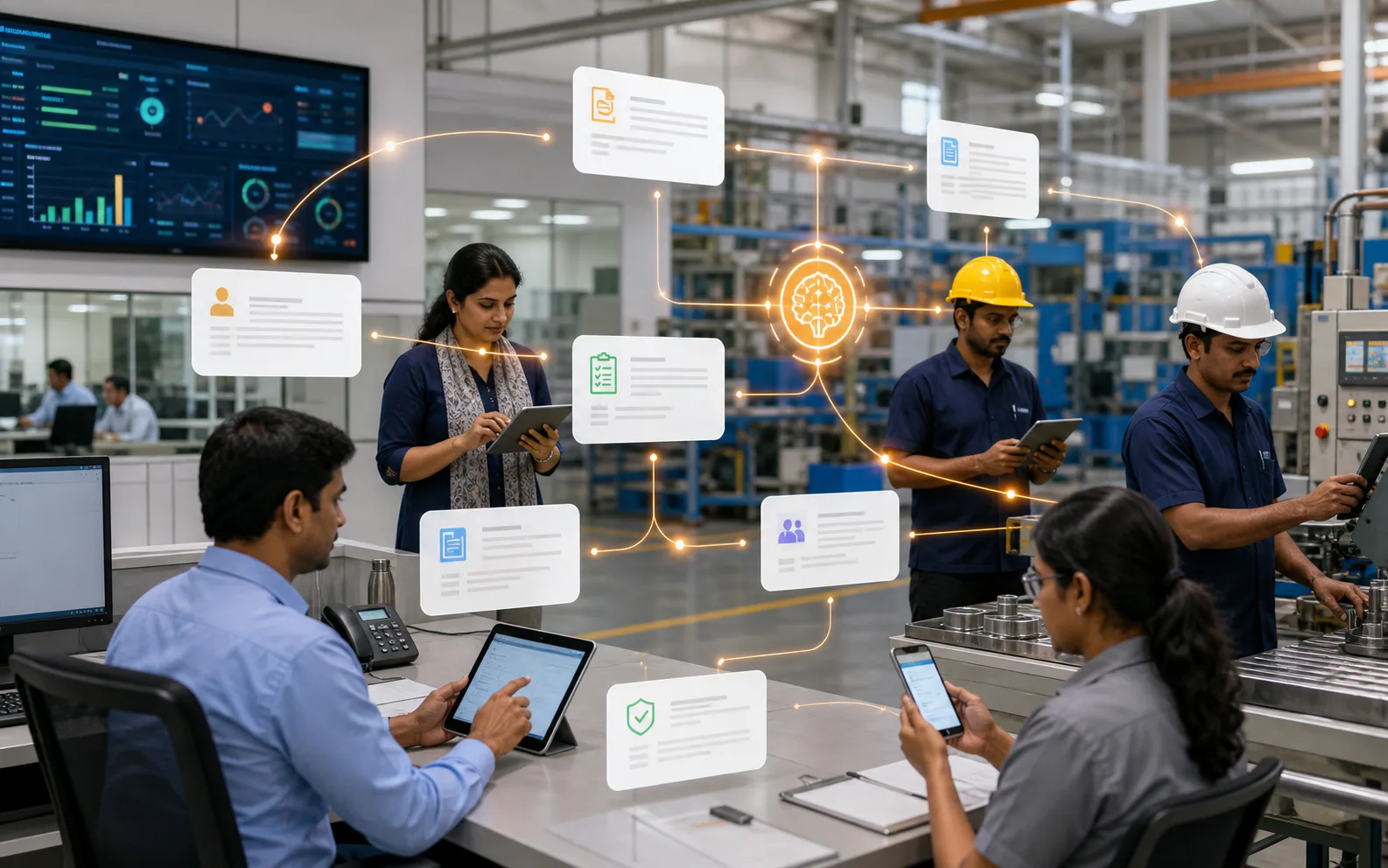
Optiwise, Odoo, Acumatica and Business Central for Manufacturing
Compare manufacturing workflows in Optiwise, Odoo, Acumatica and Dynamics 365 Business Central. See what your factory can run in Optiwise.
11 Jun 2026Read more →