
Production Tracking Software: A Plan-vs-Actual Shift Worksheet
Production Tracking Software. Use a worked manufacturing test, exception checks and direct Optiwise workflow evidence before rollout.
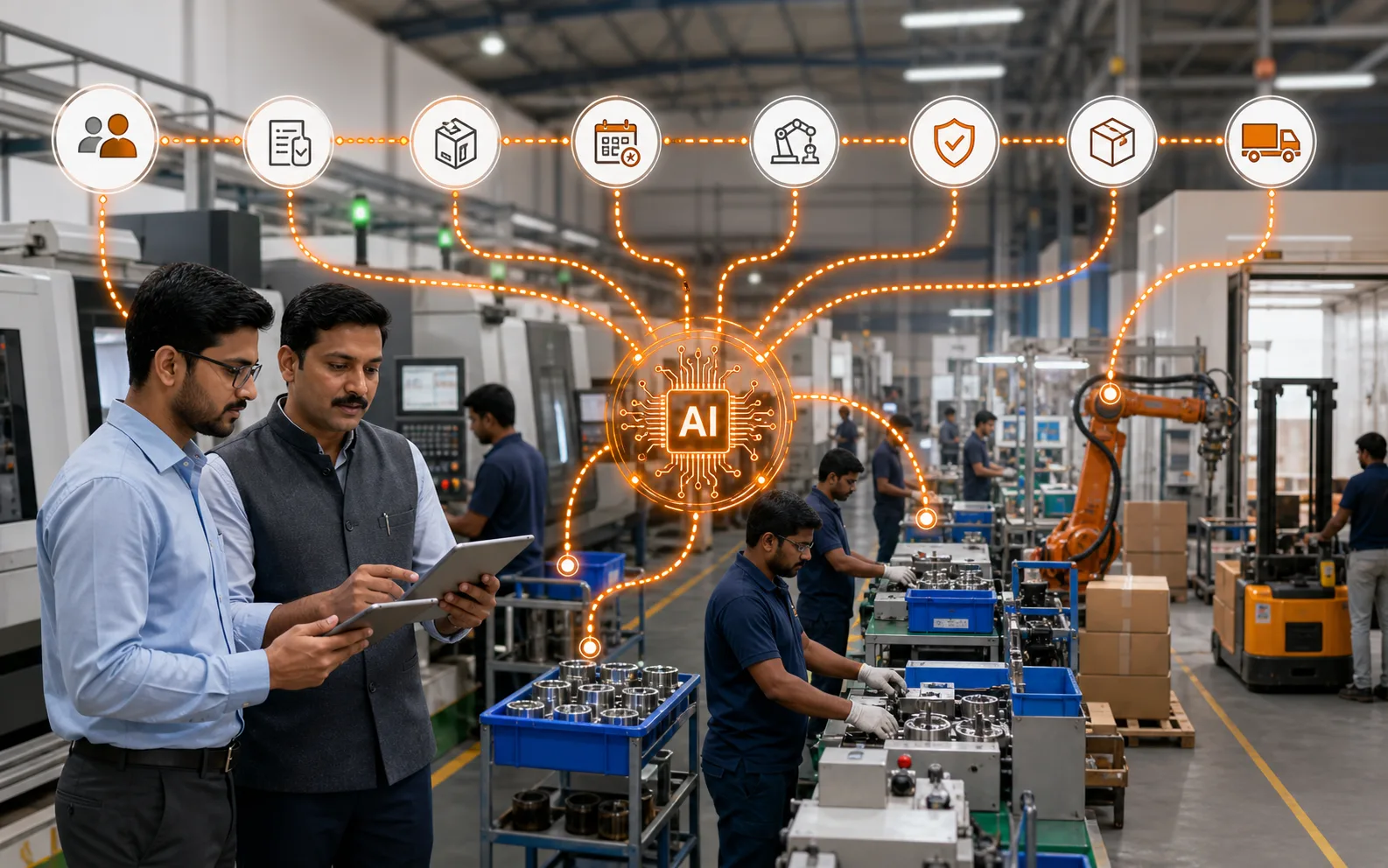
Production Tracking Software: A Plan-vs-Actual Shift Worksheet helps you record enough execution detail to act before the shift ends. Start with one order, one item and one exception. A screen tour cannot prove that records stay connected when the work changes.
A work order releases 100 pieces. The shift records 72 good, four rejected, six in rework and 18 not processed. The supervisor can reconcile all 100 and address the reason attached to the remaining work.
Start with the decision the system must support
Track released, good, rejected, rework and pending quantity by operation, with time and reason.
Optiwise records machine, worker, time and quantity by process, supports rework and output-based consumption, and receives finished goods against the order.
Use ERPNext manufacturing documentation as an external reference for the relevant data or process model. It does not prove an Optiwise feature or a business result; the product statements above come from our current feature record.
| # | Input to prepare | Evidence to retain |
|---|---|---|
| 1 | Work order and operation | Owner and last update |
| 2 | Released and planned quantity | Definition and source |
| 3 | Good, rejected and rework quantity | Acceptance rule |
| 4 | Machine, worker, time and reason | Exception owner |
Run one controlled workflow before expanding scope
- 1. Work order and operation. Confirm who maintains it and which record is authoritative.
- 2. Released and planned quantity. Use the current value in the chosen test order.
- 3. Good, rejected and rework quantity. Record the pass condition before the demo begins.
- 4. Machine, worker, time and reason. Assign the person who resolves a mismatch.
Keep the first test small enough to reconcile by hand. When the system result differs from the source documents, stop and identify whether the problem is master data, timing, transaction ownership or configuration.
Test exceptions alongside the normal flow
- Output exceeds released quantity
- Entry arrives after shift close
- Rework returns to a prior operation
For each exception, record the expected status, permitted action, approver and audit trail. A useful manufacturing system should make the exception visible without allowing an unapproved shortcut to rewrite history.
Verify the connected Optiwise workflow
Review workflow details, product capability, supporting guide, implementation context, connected process, book a demo. In the demo, ask us to execute the scenario with your roles and sample records. Confirm the source transaction, resulting status, notification or action, correction method and report before accepting the workflow.
Questions to ask before rollout
What should we test first?
Choose one current order with a known complication. Prepare the four inputs above, run the transaction sequence and reconcile the result with the source documents.
What result should we accept?
Accept the workflow only when the normal path and named exceptions leave a complete, role-appropriate record. Keep feature validation separate from a promised business outcome.
A manufacturer does not lose control only when a machine stops.
Control is lost earlier. It happens when nobody knows whether material was issued. It happens when WIP is physically moving but not recorded. It happens when the supervisor knows a job is delayed, but sales still thinks dispatch is on time. It happens when quality rejection is discussed verbally but never linked to the work order. It happens when the owner asks for production status and three people give three different answers.
That is exactly why production tracking software matters for manufacturers.
Manufacturing is a chain of dependent steps. Sales orders become production plans. Plans become work orders. Work orders need raw material. Raw material moves to the shop floor. Operations create WIP. WIP becomes finished goods. Finished goods move to dispatch. If any part of this chain is not visible, the business starts running on follow-ups instead of facts.
This guide explains production tracking software for manufacturers in detail: what it does, why it is important, what features matter, what mistakes to avoid, and how AICAN Optiwise helps manufacturing SMEs build a more connected execution system.
What Production Tracking Means in Manufacturing
Production tracking means monitoring the progress of manufacturing work from planning to completion.
It answers questions such as:
- Which work orders are planned today?
- Which work orders have started?
- Is raw material issued?
- Which operation is currently running?
- How much quantity has been completed?
- How much is still pending?
- How much has been rejected or sent for rework?
- Which machine, line, or operator is involved?
- Is the order on track for dispatch?
Production tracking software brings these answers into a structured system. Instead of relying only on calls, registers, spreadsheets, and memory, the business gets a shared production record.
Why Manufacturers Need Production Tracking Software
Manufacturers need production tracking software because production reality changes constantly.
A plan made at 9 AM may be outdated by noon. Material may not arrive. A machine may need maintenance. A priority order may come in. Quality may hold a batch. A worker may be absent. A vendor may delay a component. If the system cannot reflect these changes, teams continue working with old information.
Production tracking software helps manufacturers respond to reality faster.
It does not remove every problem. It makes problems visible earlier, so the team has more time and better context to solve them.
The Cost of Poor Production Tracking
Poor tracking creates operational and financial damage.
Delayed Orders
If production status is unclear, dispatch planning becomes unreliable. Sales may promise dates without knowing the real shop-floor position.
Excess WIP
WIP can accumulate between operations when bottlenecks are not visible. This blocks space, working capital, and attention.
Stock Mismatch
If production consumption and completion are not recorded properly, inventory becomes inaccurate. Purchase decisions then become unreliable.
Higher Rework Cost
When rejection and rework are not tracked at the right stage, quality problems repeat. The business pays for extra material, labour, time, and customer dissatisfaction.
Weak Costing
If actual production time, output, and losses are not captured, costing remains theoretical. Management may not know which products are truly profitable.
Too Much Dependence on People
When status lives in one supervisor’s notebook or memory, the business becomes fragile. If that person is absent, information disappears.
Core Features Manufacturers Should Expect
Work Order Control
A production tracking system should begin with work orders. Each work order should show the product, quantity, planned date, required material, process steps, and current status.
This gives production a clear execution unit. It also gives management a reliable way to review progress.
BOM and Material Linkage
Manufacturing tracking cannot be separate from the bill of materials. The system should connect production orders with required raw materials and components.
When material is issued, stock should reduce. When material is short, the shortage should be visible before production gets stuck.
Shop-Floor Status Updates
The system should allow timely updates such as started, paused, completed, rejected, reworked, or on hold. These statuses should be easy enough for the team to use consistently.
WIP Visibility
WIP is one of the most important areas for manufacturers. A job may not be finished, but it may not be truly pending either. It may be between operations, waiting for inspection, waiting for a machine, or partially completed.
Production tracking software should show where the work is.
Quality Tracking
Quality issues should be captured with quantity and reason. If rejection is only discussed verbally, the business loses the chance to identify patterns.
Quality tracking helps answer:
- Which product has frequent rejection?
- Which process creates defects?
- Which machine needs attention?
- Which vendor material creates quality problems?
- Which rework is affecting delivery?
Delay Reason Capture
A delay without a reason is difficult to improve. The system should capture delay categories such as material shortage, machine breakdown, labour issue, quality hold, power interruption, setup delay, planning error, or customer change.
Inventory Update
Production tracking should update inventory when raw material is consumed and finished goods are completed. This keeps stores, purchase, sales, and dispatch aligned.
Production Reports
Reports should help the business act. Useful reports include pending work orders, completed production, WIP summary, rejection summary, machine-wise output, delayed orders, and planned vs actual production.
Production Tracking Software vs Production Planning Software
Production planning software helps decide what should be produced, when, and in what quantity.
Production tracking software helps monitor what is actually happening after the plan is released.
Both are needed.
Planning without tracking becomes wishful thinking. Tracking without planning becomes reactive reporting. The strongest manufacturing systems connect both, so the business can compare plan vs actual and improve future plans.
Production Tracking Software vs ERP
Production tracking software may be a standalone tool, but manufacturers usually gain more value when tracking is part of ERP.
In a connected ERP system:
- sales orders can drive production requirements
- BOM can define material needs
- inventory can show stock availability
- purchase can respond to shortages
- production can update WIP and output
- quality can record inspection results
- dispatch can see finished goods readiness
- management can review reports from one system
This is where Optiwise by AICAN becomes useful for manufacturing SMEs. It is not only about tracking one activity. It is about connecting the manufacturing workflow.
Example: How Tracking Changes a Factory Day
Imagine a manufacturer producing electrical panels.
The order requires sheet metal, wiring components, assembly, inspection, and packing. The sales team has committed dispatch for Friday.
Without tracking, the owner may ask for status on Thursday and discover that assembly is still waiting for one component. The shop floor knew it. Stores knew it. Purchase knew it. But the information never became a clear business alert.
With production tracking, the issue appears earlier:
- work order released
- material shortage visible
- purchase requirement raised
- assembly status pending due to shortage
- dispatch risk visible to sales
- management can intervene before Thursday
The factory may still need to solve the shortage, but it does not discover the problem at the last minute.
How to Implement Production Tracking Properly
Software implementation should begin with process clarity.
First, define what needs to be tracked. A simple manufacturing unit may start with work order status, material issue, output, and completion. A more complex unit may track operation-wise WIP, machine time, rejection, rework, and downtime.
Second, define update responsibility. Who updates production start? Who records output? Who updates rejection? Who confirms completion? If ownership is unclear, data quality suffers.
Third, keep data entry practical. Shop-floor teams will not adopt a system that takes too much time or feels disconnected from real work.
Fourth, review the data regularly. Tracking should lead to decisions. If no one reviews the reports, updates become a formality.
Fifth, connect tracking with other departments. Production visibility should help purchase, stores, sales, quality, and dispatch.
Mistakes to Avoid
A common mistake is trying to track everything from day one. This overwhelms users. Start with the critical flow and expand once the team is comfortable.
Another mistake is using software as a digital register only. If production data does not affect inventory, purchase, sales, or management reporting, the business still has to reconcile manually.
A third mistake is ignoring shop-floor usability. The system must fit the pace of the factory.
The fourth mistake is treating production tracking as surveillance. The better purpose is operational clarity. The goal is to help teams solve problems earlier, not create fear.
How AICAN Optiwise Helps Manufacturers
AICAN Optiwise helps manufacturers connect production tracking with the wider business workflow.
It supports the practical needs of SMEs that want better control without drowning the team in complexity:
- work order visibility
- inventory linkage
- production status tracking
- purchase and material coordination
- sales order connection
- reporting and dashboards
- better coordination between departments
For a growing manufacturer, this connected view matters because production is not isolated. Every production delay affects inventory, purchase, sales, dispatch, cash flow, and customer trust.
Final Takeaway
Production tracking software helps manufacturers stop guessing about production status.
It gives the business a clearer view of work orders, WIP, material issue, output, quality, delays, and completion. When connected with ERP, it becomes even more valuable because production data supports decisions across the company.
For manufacturers that want better delivery reliability, cleaner inventory, stronger accountability, and practical visibility, production tracking is not a luxury. It is a basic operating system for growth.
Founder’s Note
At AICAN, our view is simple: a factory should not depend on scattered updates to understand its own production status. People can work hard and still lose time if information is late or disconnected.
AICAN Optiwise is built to help manufacturing teams see the real picture earlier. When production, inventory, purchase, sales, and reporting speak to each other, the business becomes calmer, faster, and easier to scale.
FAQs
What is production tracking software for manufacturers?
It is software that helps manufacturers monitor work orders, WIP, output, rejection, delays, material issue, and production completion. It gives teams visibility into actual shop-floor progress.
How is production tracking different from production planning?
Production planning decides what should be produced and when. Production tracking monitors what is actually happening after the plan is released.
Why is WIP tracking important?
WIP tracking shows where unfinished work is stuck between operations. It helps reduce bottlenecks, improve delivery control, and manage working capital better.
Should production tracking be part of ERP?
For many manufacturers, yes. ERP-connected tracking is more useful because production updates can connect with inventory, purchase, sales, quality, and dispatch.
How can Optiwise help manufacturers track production?
Optiwise by AICAN helps manufacturing teams connect work orders, material availability, production status, inventory updates, and reporting in one practical system.

Related Posts
A Manufacturing Alternative to SAP: Optiwise
Run your factory in Optiwise, a manufacturing alternative to SAP Business One with connected operations, AI agents and no-code workflows.
14 Jun 2026Read more →How Do I Know If My Manufacturing Business Really Needs an ERP?
A practical guide for manufacturers to identify when spreadsheets, manual follow-ups, and disconnected systems are no longer enough — and when ERP becomes an operational necessity.
14 Jun 2026Read more →Production Management System Optimized | Optiwise
Learn best practices for optimizing a production management system across planning, scheduling, material readiness, quality, and reporting.
12 Jun 2026Read more →
What Is the Best ERP for Pharmaceutical Manufacturing?
Learn how to choose the best ERP for pharmaceutical manufacturing, with guidance on batch control, quality workflows, traceability, inventory, documentation, and GMP discipline.
10 Jun 2026Read more →