
What Is Industry 4.0?
Learn what Industry 4.0 means for manufacturers, including ERP, IoT, real-time monitoring, automation, data-driven decisions, smart factories, and practical adoption.
What Is Industry 4.0?
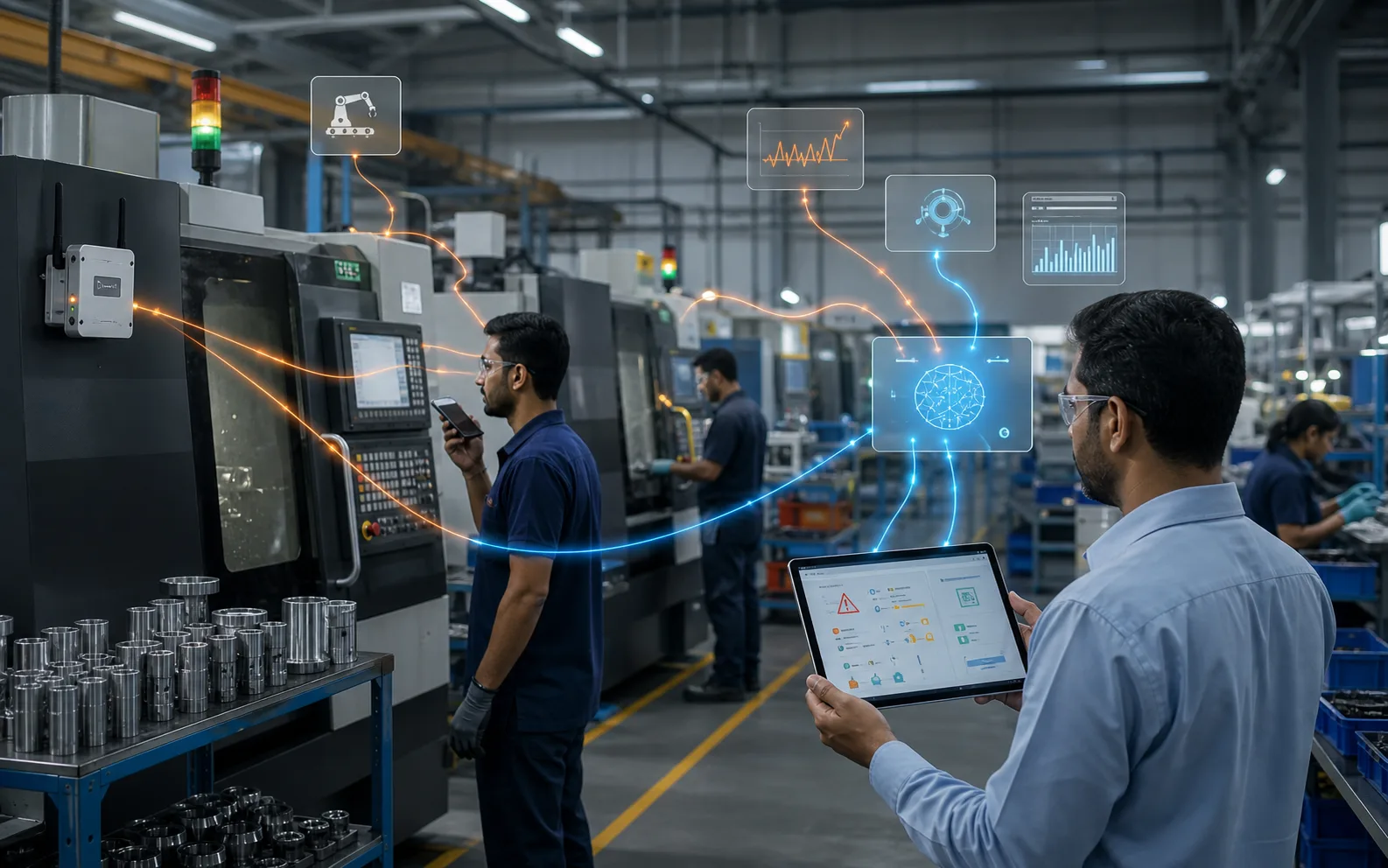
Industry 4.0 is the use of connected systems, ERP, IoT, automation, real-time data, analytics, and digital workflows to make manufacturing more visible, responsive, and efficient. In simple words, it means the factory moves from isolated manual processes to connected digital operations.
Industry 4.0 does not mean every factory must buy robots immediately. For many manufacturers, the first step is connecting inventory, production, quality, maintenance, dispatch, and dashboards so decisions are based on live data rather than delayed reports.
AICAN Optiwise helps manufacturers move toward Industry 4.0 through practical ERP, dashboards, and IoT-ready workflows.
Industry 4.0 starts with connected data
A connected factory brings operational data into one view.
This may include:
- Sales orders
- Inventory
- BOMs
- Production stages
- Machine status
- Quality checks
- Maintenance
- Dispatch
- Finance
When these areas are connected, the factory can respond faster.
ERP is the operating backbone
ERP gives Industry 4.0 projects business context.
ERP connects:
- Demand
- Material
- Production
- Quality
- Cost
- Dispatch
- Finance
- Reporting
Without ERP context, machine data may be interesting but not actionable.
IoT adds machine visibility
IoT can capture machine signals such as running status, downtime, production count, alerts, energy data, or environmental conditions where relevant.
Useful IoT use cases include:
- Downtime monitoring
- OEE tracking
- Remote monitoring
- Energy monitoring
- Predictive maintenance signals where practical
- Environmental monitoring
The best use case is the one tied to a real factory problem.
Automation improves consistency
Automation can include approval workflows, alerts, machine data capture, reporting, production updates, and quality holds.
Practical automation examples include:
- Minimum stock alerts
- Purchase approvals
- Production shortage alerts
- Quality hold notifications
- Maintenance reminders
- Dispatch readiness dashboards
Data-driven decisions are the goal
Industry 4.0 should help managers answer:
- What is delayed?
- What is short?
- Which machine is down?
- Where is quality failing?
- What is costing more than expected?
- What needs action today?
The goal is better decisions, not technology for its own sake.
Where Optiwise fits
Optiwise can help manufacturers build Industry 4.0 foundations through ERP, real-time dashboards, production visibility, quality tracking, maintenance records, and IoT integration where useful.
A practical roadmap can focus on:
- Workflow mapping
- Master data cleanup
- ERP implementation
- Dashboard visibility
- Quality and maintenance tracking
- IoT use cases
- Continuous improvement
AICAN helps factories adopt digital systems in a practical, phased way.
Founder’s Note
Industry 4.0 should not be a buzzword inside a factory. At AICAN, we believe it should mean clearer data, fewer surprises, faster decisions, and better control over daily manufacturing. The right starting point is always the real workflow. Learn more at About AICAN.
FAQs
What is Industry 4.0?
Industry 4.0 is connected manufacturing using ERP, IoT, automation, real-time data, analytics, and digital workflows.
Is Industry 4.0 only for large factories?
No. MSMEs can start with ERP, dashboards, inventory control, production visibility, and selected IoT use cases.
What is the role of ERP in Industry 4.0?
ERP provides business context for inventory, production, quality, cost, dispatch, finance, and reporting.
What is the role of IoT in Industry 4.0?
IoT captures machine and process signals such as downtime, status, alerts, counts, and environmental data where needed.
How can AICAN help with Industry 4.0?
AICAN Optiwise helps manufacturers create practical digital foundations with ERP, dashboards, and IoT-ready workflows.

Related Posts

Kanban System | Optiwise
Learn how a Kanban system works in manufacturing, where it helps, where it fails, and how Optiwise connects Kanban signals with inventory, purchase, and production planning.
12 Jun 2026Read more →Erp In Operations Management | Optiwise
Learn how ERP improves operations management by connecting planning, inventory, purchase, production, quality, dispatch, finance, and reporting.
12 Jun 2026Read more →ERP for FMCG Companies in India
A practical guide to ERP for FMCG companies in India, covering distributor orders, batch tracking, expiry, inventory, production, schemes, costing, and reporting.
11 Jun 2026Read more →
Optiwise, Odoo, Acumatica and Business Central for Manufacturing
Compare manufacturing workflows in Optiwise, Odoo, Acumatica and Dynamics 365 Business Central. See what your factory can run in Optiwise.
11 Jun 2026Read more →