
Consumer Appliances: AI Native OS for assembly, quality, service, and dispatch readiness
How appliance manufacturers can connect demand, component availability, assembly, quality checks, warranty context, and dispatch planning in Optiwise.
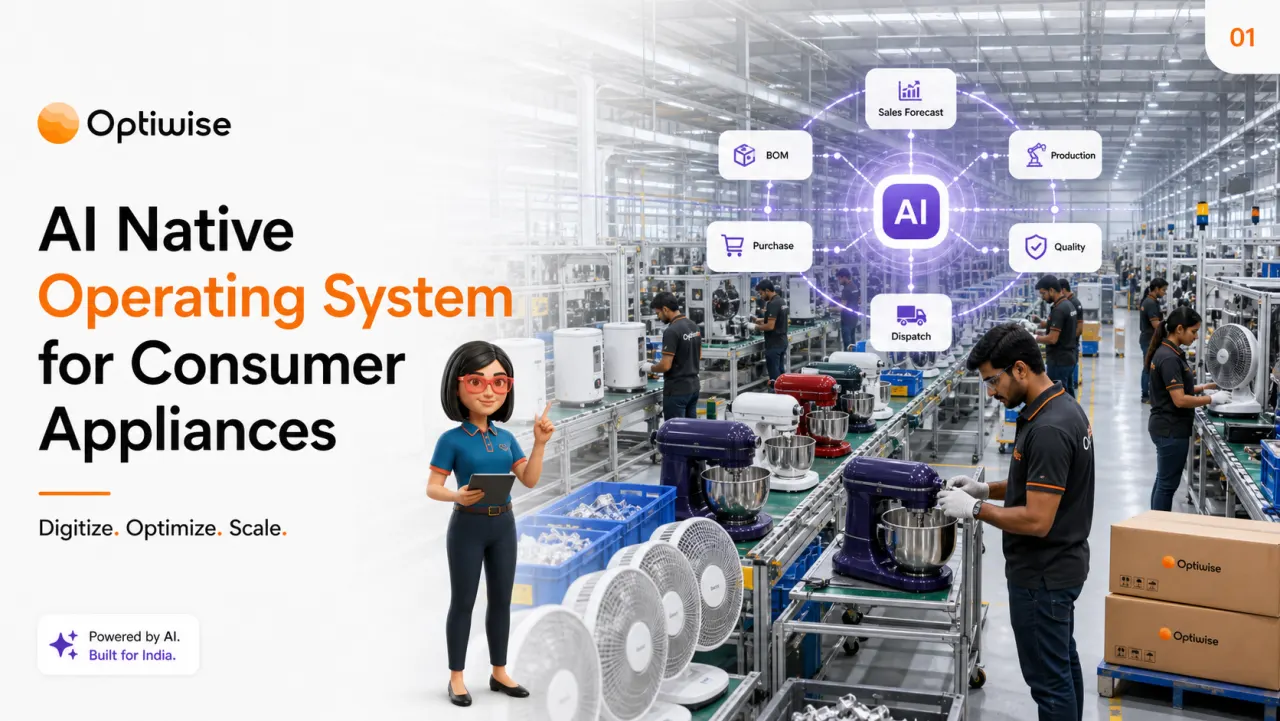
Industry operating map
How Optiwise connects the Appliances factory.
See the owner-level story: where control breaks, how the operating flow connects, where AI acts, and what improves on the factory floor.
What breaks
- Variant BOM confusion
- Assembly shortages
- QC issues repeat
- Service feedback stays separate
What improves
- Faster assembly decisions
- Lower shortage surprises
- Better first-pass quality
- Sharper service intelligence
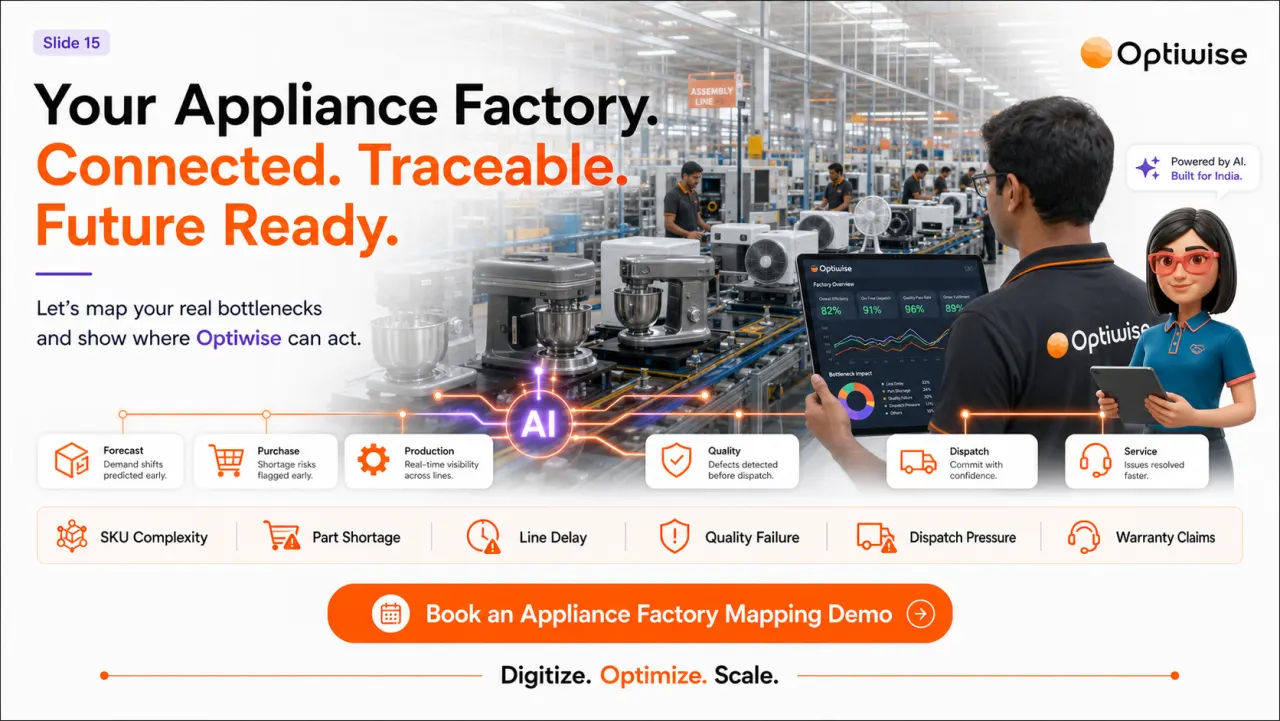
Connected modules
One job, batch, document, task, and decision trail.
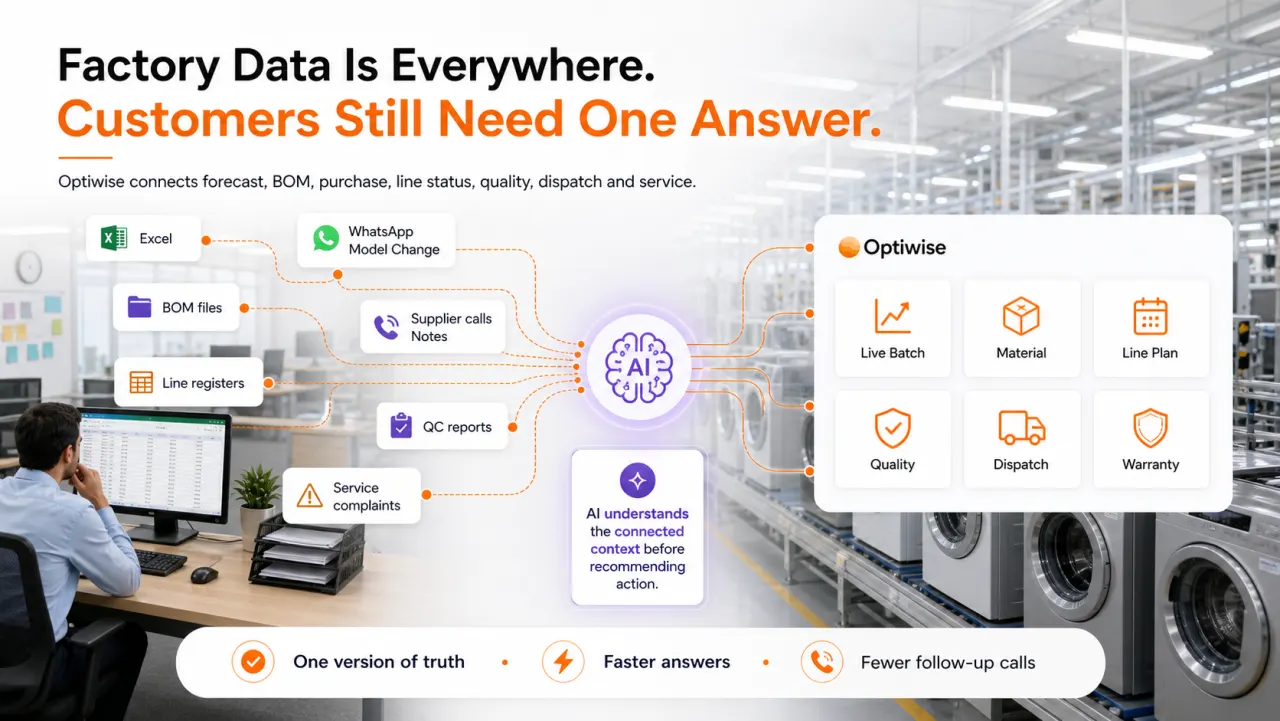
Control problem
The owner should not be the middleware for every decision.
Protect dispatch commitments by keeping component shortages, assembly blockers, QC failures, and service feedback visible.
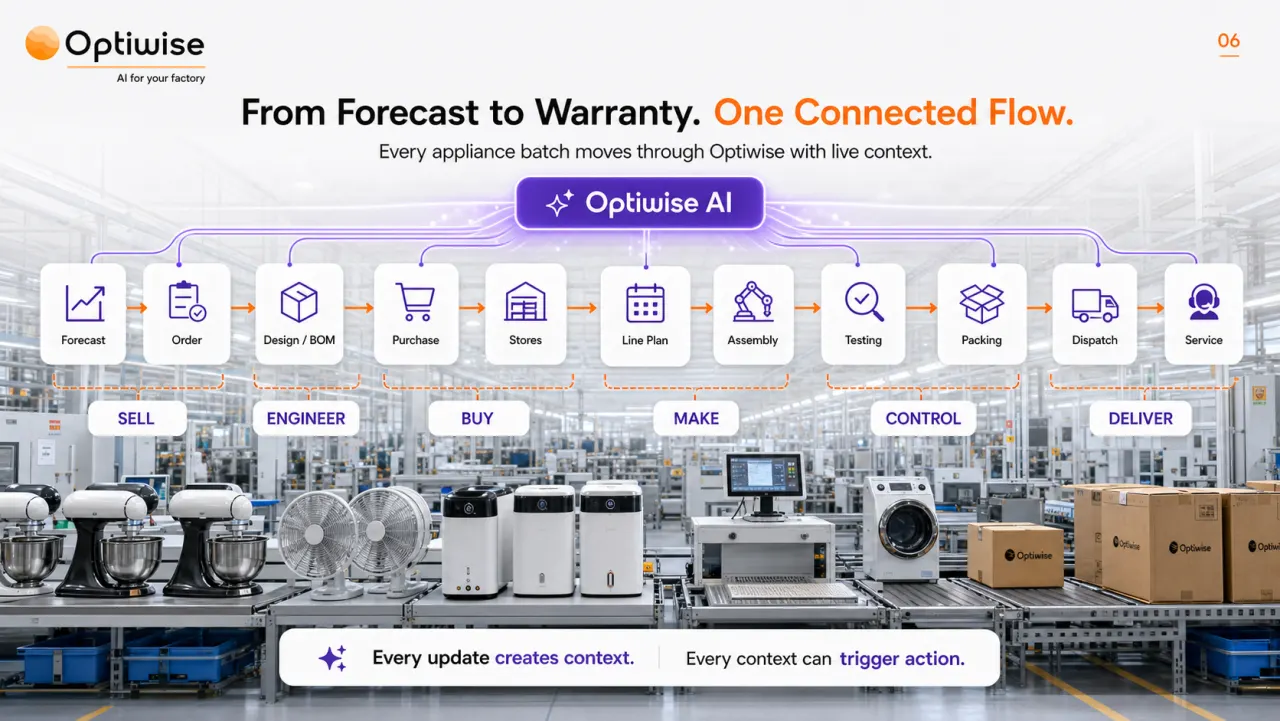
Connected flow
Appliances operations tied to one live factory truth.
Sales, BOM, Inventory, Assembly, Quality and every next action stay connected from enquiry to dispatch.
AI action layer
Every team gets the next action before firefighting starts.
Faster assembly decisions • Lower shortage surprises • Better first-pass quality • Sharper service intelligence
The owner problem
Protect dispatch commitments by keeping component shortages, assembly blockers, QC failures, and service feedback visible.
In a growing factory, the owner often becomes the middleware between sales, purchase, stores, planning, production, quality, dispatch, and accounts. Every team has some data, but intelligence stays concentrated with a few people. Optiwise changes that by normalizing factory intelligence across roles, forms, tasks, documents, voice updates, and AI actions.
What breaks before Optiwise
- Variant BOM confusion
- Assembly shortages
- QC issues repeat
- Service feedback stays separate
How Optiwise connects the flow
The case study maps the industry workflow from first enquiry to final dispatch. Each step stays tied to the same job, customer, material, batch, machine, quality record, document, and next action.
- Sales: connected to live status, history, ownership, and AI-triggered follow-up.
- BOM: connected to live status, history, ownership, and AI-triggered follow-up.
- Inventory: connected to live status, history, ownership, and AI-triggered follow-up.
- Assembly: connected to live status, history, ownership, and AI-triggered follow-up.
- Quality: connected to live status, history, ownership, and AI-triggered follow-up.
- Service: connected to live status, history, ownership, and AI-triggered follow-up.
- Dispatch: connected to live status, history, ownership, and AI-triggered follow-up.
AI Native OS impact
Optiwise is not presented as another screen to maintain. It works as an AI Native OS for manufacturing: every form can become a voice action, every task can carry rule-based ownership, and every module can surface the next best action before delays become firefighting.
Expected operational outcomes
- Faster assembly decisions
- Lower shortage surprises
- Better first-pass quality
- Sharper service intelligence
The case story below connects the industry problems, operating flow, AI actions, and outcomes into a practical factory transformation map.
Download deck
Unlock the full PDF deck instantly.
Enter a valid email and phone number to open the complete industry deck and keep it for your internal review.