
Optiwise vs Zoho Inventory: Bring Stock and Production Together
Compare Zoho Inventory and Optiwise for manufacturing. Manage materials, production routing, subcontracting and quality in one Optiwise workflow.
Manage inventory as part of your complete factory workflow in Optiwise. Connect raw material, production, purchasing, subcontracting and quality to the customer orders your team needs to deliver. Get inventory, manufacturing execution, industrial IoT, AI agents and no-code workflows in one factory platform.
Zoho Inventory supports stock, orders, warehouses and assemblies. Optiwise gives your manufacturing team a connected production workflow with material planning, process routing, machine/worker allocation and inspections.
Book an Optiwise demo · Explore Optiwise inventory
Optiwise and Zoho Inventory at a glance
| Your workflow | Optiwise | Zoho Inventory |
|---|---|---|
| Warehouse stock | Control raw material, WIP and finished goods across stores. Track variants, UOM conversions, batches and barcodes; manage issue/receipt/transfer requests and generate reorder indents from minimum/maximum levels. | Multiple warehouses and inter-warehouse transfers. |
| Traceability | Follow batches and barcodes through receipts, store transfers and production issues. Keep the material movement attached to the relevant order, inspection and stock record for a traceable factory workflow. | Serial and batch tracking with barcode scanning. |
| Assembly and output | Run each operation with machine and worker allocation, cycle-time-aware planning, drawings and SOPs. Capture time, output and quality through operators, supervisors or IoT, then manage rework and finished-goods receipt. | Assemblies consume components and increase finished-item stock. |
| Purchasing | Source with production context: multi-vendor RFQs, a vendor portal, price/quality/delivery scoring, AI recommendations and rank-only bidding. Convert the selected quote to a PO and follow it through GRN and inspection. | Purchase orders, vendor transactions and payments. |
| Customization | Build the workflow your factory needs with no-code relational modules, parent/child records, formulas, rollups, conditional forms, role-based views, event-driven automations and webhooks. | Custom fields, webhooks and custom functions. |
Product references: Zoho Inventory features · Zoho Inventory assemblies. Updated 10 September 2026.
Manufacturing inventory, backed by AI and IoT
AI for the work behind the stock balance
Ask your inventory agent for stock information or give a natural-language instruction to record received material. Optiwise connects the action to your operating records and role permissions, with multilingual access for the stores team.
Inventory connected to a live factory
Run stock, purchasing and production in the same platform as industrial IoT. Monitor machine runtime, downtime, OEE and energy alongside the workflows that consume material and produce finished goods. Move from a stock view to the manufacturing context behind it.
Controls that fit your materials
Configure item variants, multiple units of measure, batch rules and reorder levels. Add custom inspection forms, fields, linked modules and automated actions without code, instead of forcing every material and store into one generic process.
Explore Optiwise AI agents · Explore industrial IoT · Explore no-code customization
Why choose Optiwise for your factory
Plan materials across the full production requirement
Use nested BOMs and Smart Suggest to check required quantities against stock, open POs and existing production. Separate the actions for in-house work, purchase and subcontracting. Stores and purchasing can act on the same production requirement.
Control each operation between issue and output
Build routing with machining, assembly, outside processing and inspection steps. Attach drawings and SOPs, allocate machines and workers, and record time and quantity. Track rework and extra material issues before receiving finished goods.
Follow material beyond your own warehouse
Create subcontract service orders and issue materials on challans. Track the balance held by each vendor and the quantities returned. Apply the quality process to returned goods and retain rejected returns with the service-order record.
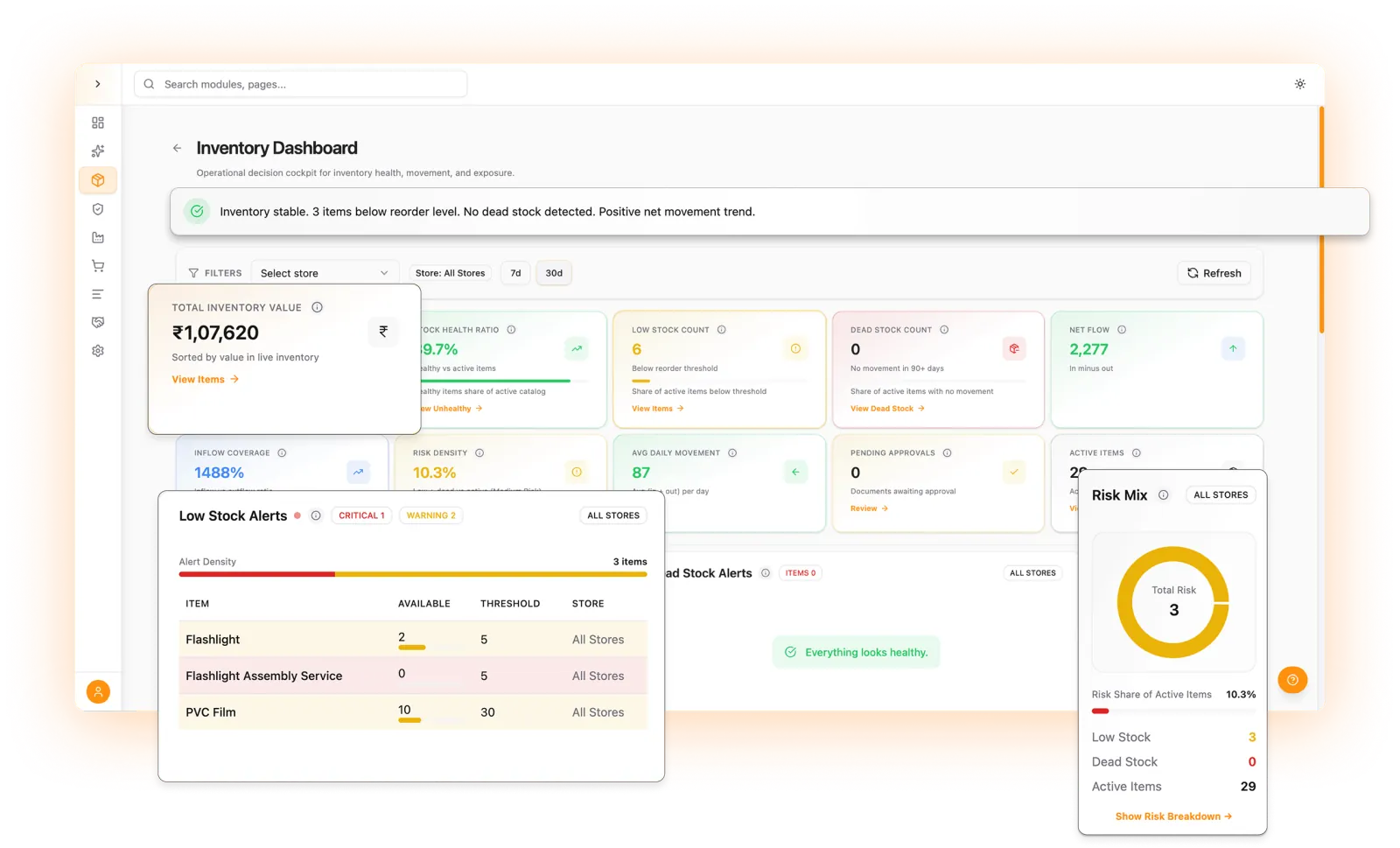
See your factory workflow in Optiwise
Bring your product, process and team requirements. We’ll walk you through the connected material and stock workflow and map it to your factory.
Book your Optiwise demo · Meet your AI agents · Explore no-code workflows
Questions about Zoho Inventory and Optiwise
Does Zoho Inventory support assemblies?
Yes. Its assembly workflow consumes component stock and adds finished-item stock. Optiwise also connects production routing, process execution, subcontracting and quality to the material workflow.
Why choose Optiwise for manufacturing inventory?
Choose Optiwise to keep inventory connected with BOM planning, work orders, machine and worker execution, purchasing, subcontracting and quality in one operating system.
Does Optiwise include industrial IoT and AI?
Yes. Optiwise combines manufacturing ERP and shop-floor execution with industrial IoT and specialized AI agents. Connect machines through gateways and sensors, track OEE, downtime and energy, and use natural-language queries and actions across production, purchasing, inventory, sales and tasks. No-code modules and automations let you extend the workflow.
Related Posts

Will AI Replace My Procurement Job?
AI will change procurement work, but it is more likely to automate repetitive tasks than replace procurement professionals who build supplier judgment and strategy.
14 Jun 2026Read more →Cloud Procurement | Optiwise
Learn cloud procurement for SMEs and manufacturers, including purchase requests, approvals, supplier follow-up, inventory linkage, and how AICAN Optiwise improves control.
12 Jun 2026Read more →Benefits Of Inventory Management | Optiwise
Learn the benefits of inventory management for SME manufacturers, including stock accuracy, lower working capital blockage, fewer stockouts, better production planning, and dispatch control.
9 Jun 2026Read more →Automated Inventory Management System | Optiwise
Learn how automated inventory management systems help manufacturers improve stock accuracy, low-stock alerts, warehouse control, material planning, and reporting.
7 Jun 2026Read more →