
Manufacturing AI Case Studies: How to Test the Evidence
Manufacturing AI Case Studies. Use a worked manufacturing test, explicit inputs and exception checks before rollout.
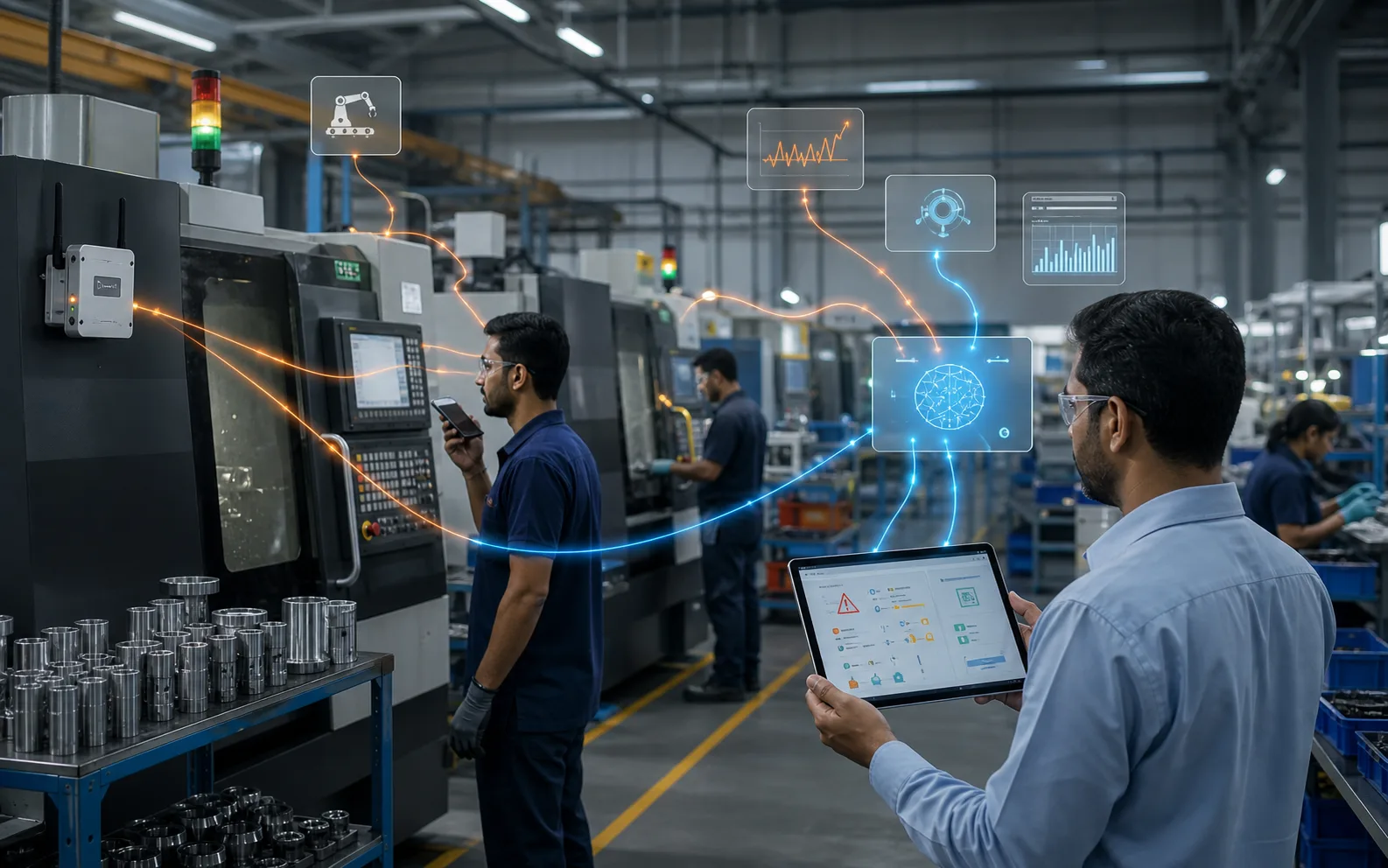
Manufacturing AI Case Studies: How to Test the Evidence helps you judge an AI case study without treating vendor outcomes as universal proof. Test one real order and one exception before expanding scope.
If a case reports fewer shortages, ask whether planners also corrected BOMs, counted stock or changed suppliers. Record the baseline period and denominator before attributing the change to AI.
Start with the decision the system must support
Separate the starting condition, intervention, measured outcome, time window and outside changes.
Optiwise AI agents can query connected operational data and propose or perform permitted actions. Results still depend on the customer’s records, rules, adoption and review process.
Use NIST AI Risk Management Framework as an external reference for the relevant process or control model. It does not prove an Optiwise feature or business result; our product statements come from the current feature record.
| # | Input to prepare | Evidence to retain |
|---|---|---|
| 1 | Baseline and business question | Owner and last update |
| 2 | AI input and human decision | Definition and source |
| 3 | Metric, denominator and time window | Acceptance rule |
| 4 | Confounders and failed cases | Exception owner |
Run one controlled workflow
- 1. Baseline and business question. Name the owner and authoritative record.
- 2. AI input and human decision. Use the current value from the test order.
- 3. Metric, denominator and time window. Write the pass condition before the demo.
- 4. Confounders and failed cases. Assign the person who resolves a mismatch.
Keep the first test small enough to reconcile by hand. When the result differs from the source documents, identify whether the problem is master data, timing, transaction ownership or configuration.
Test exceptions with the normal flow
- Baseline scope changes
- Only successful examples are shown
- Outcome is not reproducible
For every exception, record the expected status, permitted action, approver and audit trail. The workflow should expose a problem without allowing an unapproved shortcut to rewrite history.
Verify the connected Optiwise workflow
Review workflow details, product capability, supporting guide, implementation context, connected process, book a demo. In the demo, ask us to run the scenario with your roles and sample records. Confirm the source transaction, resulting status, action, correction method and report.
Questions to ask before rollout
What should we test first?
Choose one current order with a known complication. Prepare the four inputs above, run the sequence and reconcile the result with the source documents.
What result should we accept?
Accept the workflow only when the normal path and named exceptions leave a complete, role-appropriate record. Keep feature validation separate from a promised outcome.
Manufacturers often ask for AI case studies because they want proof that the technology works in real factories. That is sensible. But case studies should be read carefully. A result from one factory may not copy exactly into another because products, data quality, team discipline, machinery, and workflows differ.
Instead of looking only for dramatic numbers, manufacturers should study the pattern behind successful AI implementation: a clear problem, reliable data, workflow ownership, trained users, and measurable review.
Artificial intelligence in manufacturing succeeds when it solves a specific operating problem and becomes part of daily work.
Case Pattern 1: Inventory Shortage Reduction
A factory struggling with production delays due to material shortages starts by connecting sales orders, production plans, stock, purchase orders, and supplier lead times. AI-supported alerts identify items at risk before production stops.
The value comes from earlier purchase follow-up, better reorder decisions, and fewer emergency substitutions. The lesson is that inventory AI needs connected demand and supply data, not only stock balances.
Case Pattern 2: Quality Defect Reduction
A manufacturer facing repeat defects begins recording defect reasons consistently by product, batch, machine, supplier, and process stage. AI analyses patterns and highlights likely causes.
Quality teams use these insights to adjust process checks, review supplier material, and track corrective actions. The lesson is that AI quality improvement depends on disciplined defect classification.
Case Pattern 3: Predictive Maintenance
A factory with frequent unplanned downtime starts with critical machines. It records downtime reasons, maintenance history, operating hours, and sensor data where available. AI flags rising risk based on repeated stoppages or abnormal patterns.
Maintenance teams plan intervention earlier. The lesson is that predictive maintenance should begin with machines where downtime cost is high.
Case Pattern 4: Production Scheduling
A factory with frequent schedule changes connects order priorities, machine capacity, material readiness, and quality holds. AI helps planners identify bottlenecks and reschedule with better visibility.
The lesson is that scheduling AI needs cross-functional information. A schedule that ignores purchase or quality reality will fail.
Case Pattern 5: Management Reporting
A manufacturer dependent on manual reports introduces connected dashboards and AI-supported exception summaries. Owners and managers review late orders, stock risk, production delays, and quality issues without waiting for end-of-day consolidation.
The lesson is that better visibility alone can create value when management acts on it consistently.
How Optiwise Supports the Workflow
AICAN Optiwise supports these implementation patterns by connecting production, inventory, purchase, sales, finance, reporting, IoT readiness, and AI workflows. This gives manufacturers the operating foundation needed to turn AI from a pilot into daily execution.
Explore aican.co.in and About AICAN to understand AICAN’s real shopfloor orientation.
Founder’s Note
AICAN’s founder-led view is that useful case studies should teach manufacturers how value was created, not only display a result. The repeatable lesson is always operational: clean data, clear ownership, trained users, and steady review.
AI is not successful because it is installed. It is successful when the factory changes how it decides.
FAQ
What should I look for in an AI case study?
Look for the problem solved, data used, implementation approach, user adoption, measurable outcome, and time period.
Can I copy another factory’s AI results?
Not exactly. You can learn from the pattern, but your results depend on your data, process discipline, and use case.
Which AI use case is easiest to prove?
Inventory risk, reporting visibility, quality trends, and downtime analysis are often easier to measure than broad transformation goals.
Should vendors provide case studies?
Yes, but manufacturers should also ask how the case study maps to their own factory’s reality.
Final Thought
The best AI case studies are not success stories to admire from a distance. They are operating lessons. Use them to choose a focused problem, prepare the right data, and build adoption carefully.
Next step: Explore AICAN Optiwise to see how connected workflows can support practical AI implementation in your factory.

Related Posts
Is AI Worth the Investment for My Factory?
Learn how to decide if AI is worth the investment for your factory by evaluating use cases, data readiness, costs, risks, ROI, and operational impact.
13 Jun 2026Read more →Manufacturing AI Mistakes to Avoid Before You Start
List manufacturing AI mistakes and controls for unclear use case, messy data, unsafe automation, no owner, weak security and unreviewed recommendations.
13 Jun 2026Read more →What's the Difference Between AI and Regular Automation?
Understand the difference between AI and regular automation in manufacturing, with practical examples for workflows, decisions, alerts, and predictive operations.
13 Jun 2026Read more →What Are the Risks of Using AI in Manufacturing?
Understand the risks of AI in manufacturing, including bad data, wrong recommendations, safety issues, security, job fear, over-automation, and implementation failure.
13 Jun 2026Read more →