
What If AI Recommendations Contradict My Managers' Decisions?
Learn how factories should handle conflicts between AI recommendations and manager decisions without weakening accountability, trust, or production control.

What If AI Recommendations Contradict My Managers' Decisions?
AI recommendations will sometimes contradict your managers’ decisions. That is not automatically a problem. In fact, it can be useful. A contradiction may reveal a hidden risk, a data gap, a process assumption, or a genuine difference between system logic and human experience.
AI driven factory management should not remove authority from managers. It should improve the quality of decisions by giving managers better context. The final responsibility for important production, purchase, quality, maintenance, and customer decisions should remain with accountable people, especially during early adoption.
The goal is not to decide whether AI or humans are always right. The goal is to create a process for resolving disagreement intelligently.
Treat Contradictions as Review Points
When AI disagrees with a manager, do not ignore it immediately and do not follow it blindly. Treat it as a review point. Ask what data the AI is using, what the manager knows from experience, and whether both are seeing the same reality.
For example, AI may suggest delaying one order because material risk is high. A manager may know that the supplier has already confirmed dispatch informally. In that case, the manager has context the system may not have. But if the informal confirmation is not recorded, the process still needs improvement.
Check the Data First
Many disagreements happen because the data is incomplete or delayed. Stock may not be updated, production status may be old, quality holds may not be recorded, or purchase delivery dates may be inaccurate.
Before judging the AI recommendation, check whether the system has the latest information. If the data is wrong, fix the data flow. If the data is right and the manager still disagrees, then the difference deserves deeper discussion.
Define Decision Authority Clearly
Factories should define which decisions AI can recommend, which actions can be automated, and which decisions require human approval. Low-risk reminders may be automated. High-risk production changes, vendor commitments, customer communication, and quality releases should usually involve responsible managers.
Clear authority prevents confusion. AI should support the chain of responsibility, not blur it.
Use Disagreement to Improve Rules
If managers repeatedly override AI for the same reason, the system may need better data, updated rules, or new business logic. If AI repeatedly catches risks managers missed, the management process may need change.
The best factories learn from these disagreements instead of turning them into ego battles.
Build Trust Gradually
Trust grows when AI recommendations are reviewed against real outcomes. Track when the AI was right, when the manager was right, and why. Over time, the factory learns which recommendations can be trusted more confidently.
This creates practical governance around AI.
Where AICAN Optiwise Fits
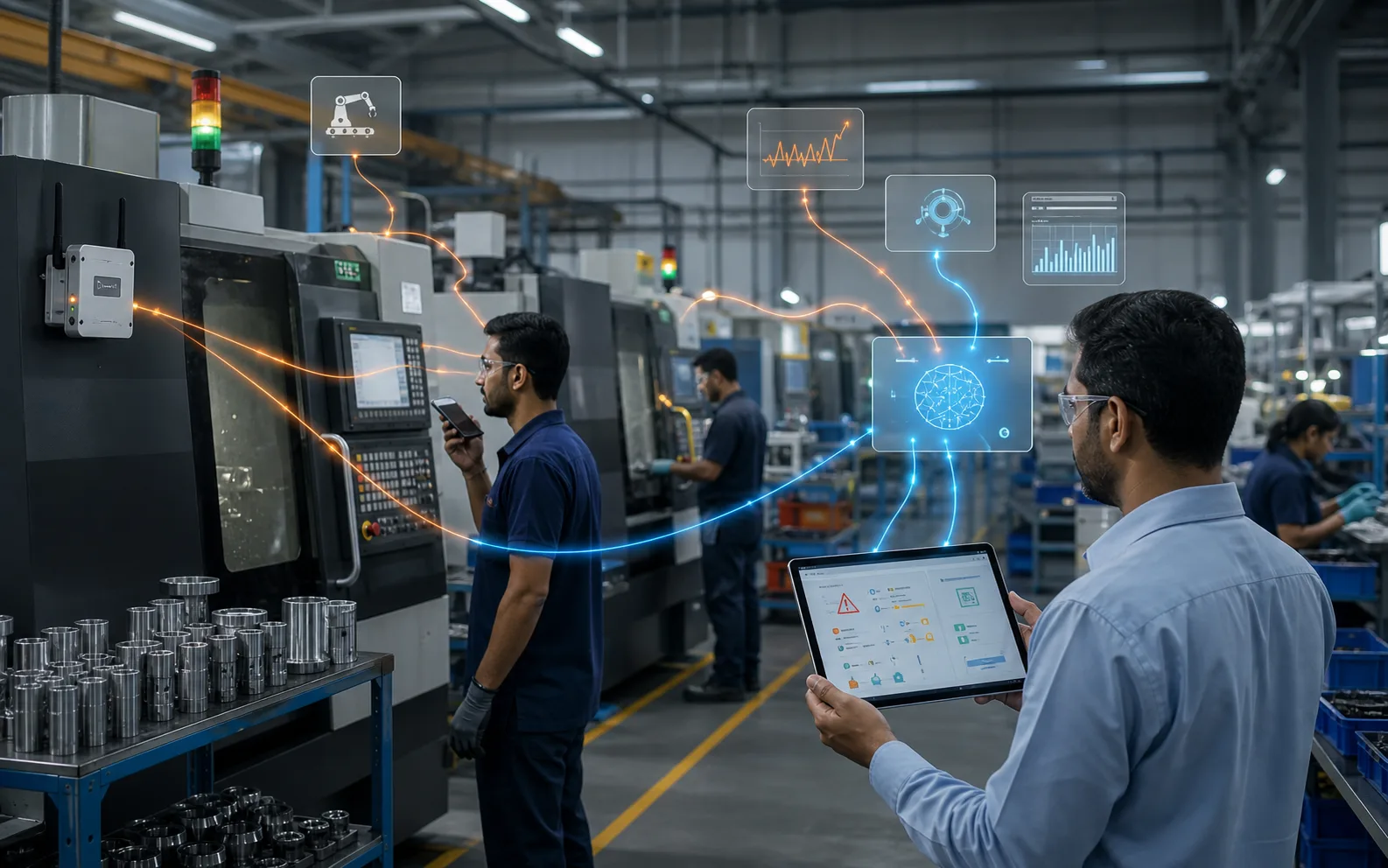
AICAN Optiwise supports AI driven factory management by connecting production, inventory, purchase, sales, finance, reporting, IoT readiness, and AI workflows. This connected context helps managers evaluate recommendations with clearer operational evidence instead of scattered updates.
Explore AICAN Optiwise and learn about AICAN’s shopfloor-led approach at About AICAN.
Founder’s Note
AICAN’s founder-led view is that AI should sharpen human decision-making, not replace accountability. Factory managers carry operational judgement that comes from experience. The system should bring better evidence to that judgement.
Strong factories do not silence managers or ignore data. They make both work together.
FAQ
Should managers always follow AI recommendations?
No. Managers should review AI recommendations, especially for high-impact decisions. AI is a decision-support layer, not an automatic authority for every situation.
What if AI is often wrong?
Check data quality, business rules, workflow updates, and whether the use case is properly defined. Repeated wrong recommendations usually point to an implementation or data issue.
What if managers ignore useful AI alerts?
Track outcomes and review ignored alerts in operations meetings. If AI repeatedly identifies real risks, management behaviour should change.
Can AI and managers both be right?
Yes. AI may be right based on recorded data, while managers may know unrecorded context. The solution is to bring that context into the system.
Final Thought
AI-human disagreement is not failure. It is a chance to improve data, rules, and decision discipline. The best factories use AI to challenge assumptions while keeping responsible people in control.
Next step: Explore AICAN Optiwise to see how connected factory workflows can support better human-AI decision-making.

Related Posts
Is AI Worth the Investment for My Factory?
Learn how to decide if AI is worth the investment for your factory by evaluating use cases, data readiness, costs, risks, ROI, and operational impact.
13 Jun 2026Read more →Manufacturing AI Mistakes to Avoid Before You Start
List manufacturing AI mistakes and controls for unclear use case, messy data, unsafe automation, no owner, weak security and unreviewed recommendations.
13 Jun 2026Read more →What's the Difference Between AI and Regular Automation?
Understand the difference between AI and regular automation in manufacturing, with practical examples for workflows, decisions, alerts, and predictive operations.
13 Jun 2026Read more →What Are the Risks of Using AI in Manufacturing?
Understand the risks of AI in manufacturing, including bad data, wrong recommendations, safety issues, security, job fear, over-automation, and implementation failure.
13 Jun 2026Read more →