
Can AI Monitor Temperature and Vibration in Real Time?
Learn how AI monitors temperature and vibration in real time, what sensors are needed, how alerts work, and how manufacturers can use machine data safely.

Can AI Monitor Temperature and Vibration in Real Time?
Yes, AI can help monitor temperature and vibration in real time, but it needs the right sensors, clean data, and a clear maintenance workflow. AI does not magically know how a machine is behaving. It needs signals from the machine or connected devices.
Temperature and vibration are two of the most useful machine health indicators because many equipment problems show early warning signs there.
Why Temperature and Vibration Matter
Machines often give signals before they fail.
Rising temperature can indicate friction, overload, lubrication problems, electrical issues, cooling problems, or bearing wear.
Abnormal vibration can indicate imbalance, misalignment, looseness, bearing damage, foundation problems, or rotating component issues.
A human operator may notice some signs, but real-time monitoring captures trends continuously.
How Real-Time Monitoring Works
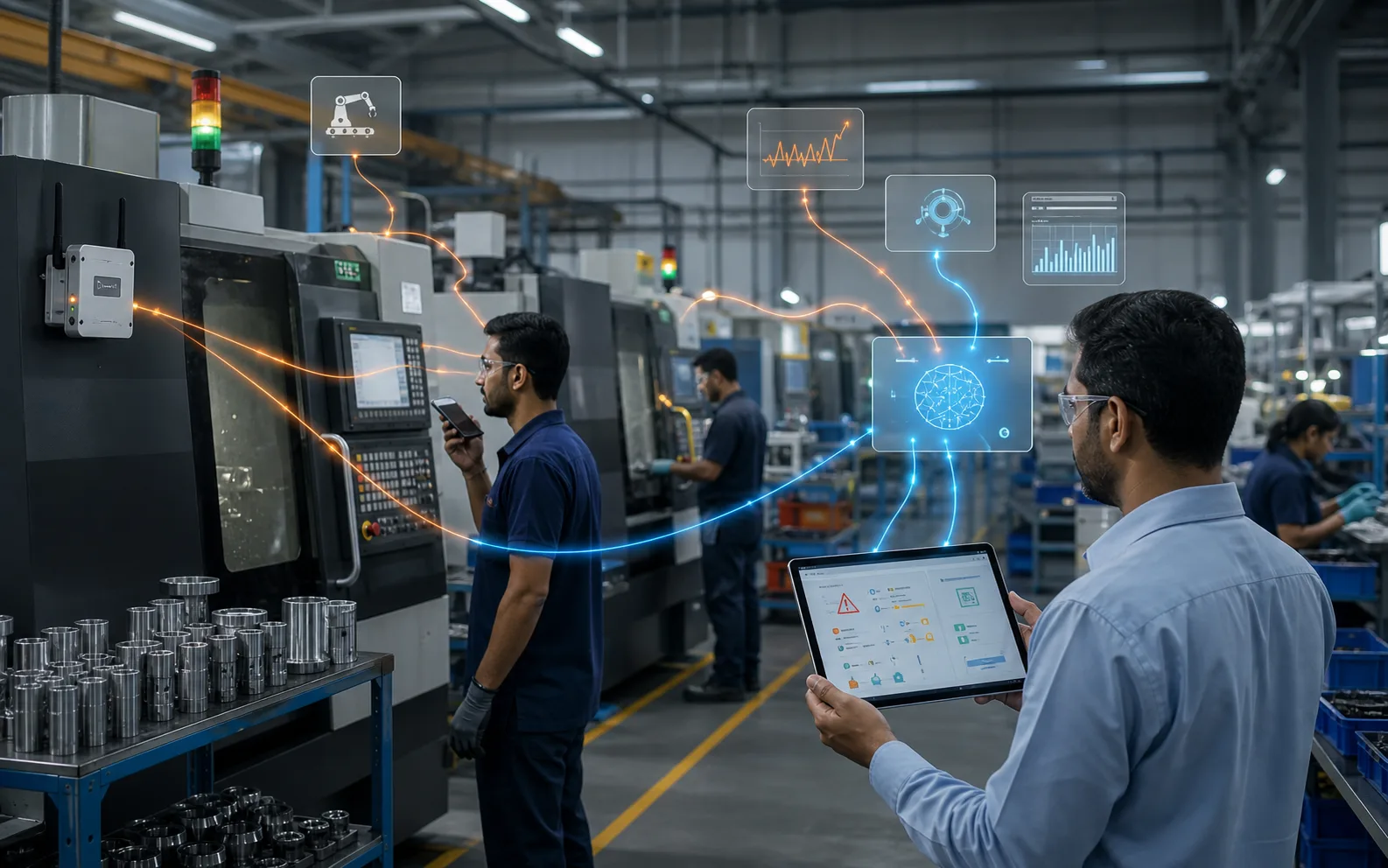
A typical setup includes:
- Sensors attached to machines
- A gateway or device that sends readings
- A software platform that stores the data
- Dashboards showing live and historical trends
- AI or rules that identify abnormal patterns
- Alerts sent to maintenance or production teams
The system may monitor readings every few seconds, minutes, or based on machine cycles.
What AI Adds Beyond Simple Alerts
A simple system can alert when temperature crosses a fixed threshold. That is useful, but limited.
AI can go further by learning what is normal for a specific machine, product, shift, or operating condition.
For example, a machine may normally run hotter during a specific process. A fixed alert may create false alarms. AI can compare current readings with historical patterns and flag unusual behavior more intelligently.
Real-Time Does Not Mean Automatic Shutdown
This is important. Real-time monitoring does not mean AI should automatically stop machines without review.
In some high-risk situations, automatic shutdown rules may be necessary, but most manufacturers should begin with alerts and human review.
Maintenance and production teams should decide what action to take based on machine criticality, safety, production load, and inspection results.
What Data Is Needed?
For temperature and vibration monitoring, manufacturers need:
- Sensor readings
- Machine identity
- Timestamped data
- Operating condition
- Production context
- Maintenance history
- Downtime records
- Alarm history
- Inspection notes
The more context AI has, the more useful the alerts become.
Common Use Cases
AI-based temperature and vibration monitoring can help with:
- Predictive maintenance
- Early bearing issue detection
- Motor health monitoring
- Pump and compressor monitoring
- Fan imbalance detection
- Gearbox issue alerts
- Machine overload detection
- Maintenance planning
- Downtime prevention
It is most useful for critical machines where failure creates high cost.
Mistakes to Avoid
Do not install sensors without defining what decision the data will support.
Do not create too many alerts. Alert fatigue is real. If teams receive constant low-quality alerts, they will ignore them.
Do not assume sensor data is always clean. Sensors can fail, drift, disconnect, or capture noise.
Do not skip maintenance team involvement. The people who know the machines must help define what matters.
Can Small Manufacturers Use This?
Yes, but they should start with critical machines. A small manufacturer does not need to monitor every machine on day one.
Start with one or two machines where downtime is expensive. Capture data, compare it with maintenance history, and evaluate whether alerts help prevent failures.
Where AICAN Optiwise Fits
AICAN Optiwise is designed as an AI-native manufacturing operating system with ERP, IoT readiness, workflows, reports, and AI agents. Real-time machine signals become more valuable when they connect with production schedules, inventory, dispatch commitments, and management visibility.
A vibration alert is useful. A vibration alert connected to delayed orders, machine loading, spare availability, and dispatch risk is much more useful.
Learn more at AICAN Optiwise and About AICAN.
Founder’s Note
AICAN’s belief is that IoT and AI should not create another disconnected dashboard. Manufacturers already have enough scattered information.
The real value appears when machine health data connects with factory decisions. Optiwise is built so AI and IoT signals can become part of the operating workflow, not just a screen someone checks once a week.
FAQ
Can AI monitor temperature and vibration without sensors?
No. Real-time monitoring needs sensors or connected machine data. AI needs readings to analyze.
Is vibration monitoring useful for every machine?
It is most useful for rotating equipment and critical machines where failure creates high downtime cost.
Can AI shut down machines automatically?
It can be designed that way, but most factories should start with alerts and human review unless safety requires automatic action.
What causes false alerts?
Poor sensor placement, noisy data, wrong thresholds, lack of operating context, and sensor faults can create false alerts.
Should small manufacturers invest in this?
Yes, if downtime on critical machines is costly. Start small with the highest-impact equipment.
Final Thought
AI can monitor temperature and vibration in real time, but the value is not in the sensor alone. The value is in turning machine signals into timely maintenance and production decisions.
Next step: Explore AICAN Optiwise if your factory wants machine data connected with ERP, production, and operational visibility.

Related Posts
Is AI Worth the Investment for My Factory?
Learn how to decide if AI is worth the investment for your factory by evaluating use cases, data readiness, costs, risks, ROI, and operational impact.
13 Jun 2026Read more →Manufacturing AI Mistakes to Avoid Before You Start
List manufacturing AI mistakes and controls for unclear use case, messy data, unsafe automation, no owner, weak security and unreviewed recommendations.
13 Jun 2026Read more →What's the Difference Between AI and Regular Automation?
Understand the difference between AI and regular automation in manufacturing, with practical examples for workflows, decisions, alerts, and predictive operations.
13 Jun 2026Read more →What Are the Risks of Using AI in Manufacturing?
Understand the risks of AI in manufacturing, including bad data, wrong recommendations, safety issues, security, job fear, over-automation, and implementation failure.
13 Jun 2026Read more →