
Can AI Help Me Reduce Production Downtime?
Learn how AI can reduce manufacturing downtime through early warning signals, maintenance planning, material readiness, production monitoring, and root cause analysis.

Can AI Help Me Reduce Production Downtime?
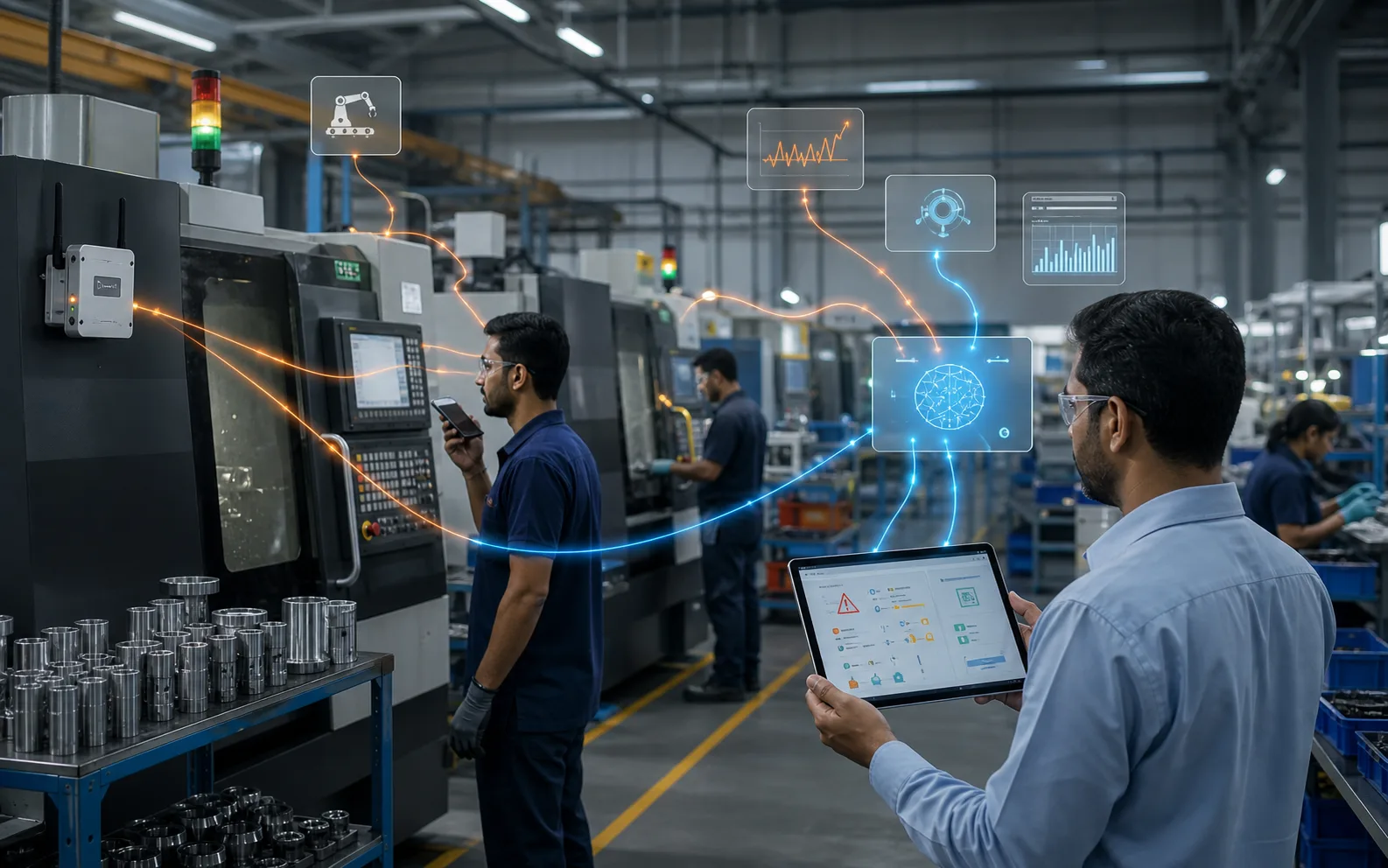
Yes, AI can help reduce production downtime, but not by itself. It helps by finding early warning signals, connecting causes, and giving teams more time to act.
Downtime rarely comes from one reason alone. A machine may stop because maintenance was delayed. Maintenance may be delayed because spares were unavailable. Spares may be unavailable because purchase did not see the risk early. Production may lose time because material, machine, manpower, and planning signals were not connected.
AI becomes useful when it helps the factory see these signals before the line stops.
Machine Risk Alerts
AI can study machine history, breakdown frequency, downtime duration, maintenance schedules, spare replacement patterns, and production load. If a machine shows risk patterns similar to previous failures, the system can alert maintenance teams earlier.
This does not replace inspection. It prioritizes attention.
Material Readiness
Downtime is not always a machine problem. Many production delays begin with material unavailability.
AI can compare planned production with stock availability, open purchase orders, vendor lead times, and consumption trends. If a critical item may run short, the team can act before production is affected.
Production Delay Monitoring
AI can compare planned versus actual production and flag jobs that are slipping. It can also help identify whether the delay is linked to machine stoppage, material shortage, quality hold, manpower constraint, or approval delay.
The earlier a delay is visible, the more options the team has.
Root Cause Pattern Detection
Factories often solve downtime case by case. AI can help find repeated causes across months: one machine repeatedly failing during heavy loads, one vendor causing material issues, one shift facing higher stoppage, or one product routing creating bottlenecks.
This shifts the conversation from “what stopped today?” to “what keeps stopping us?”
Better Maintenance Planning
AI can help maintenance teams prioritize inspections based on risk and business impact. A machine used for critical customer orders may need earlier attention than a less critical asset.
Downtime reduction is not only about predicting failure. It is about planning limited resources wisely.
Where AICAN Optiwise Fits
AICAN Optiwise connects production, inventory, purchase, maintenance-related records, sales commitments, and reporting so downtime risk can be seen in business context. A machine issue matters more when it affects a priority order or critical dispatch.
AICAN helps manufacturers move from reactive firefighting to connected operational visibility. Learn more at About AICAN.
Founder’s Note
Downtime is expensive because it steals time from everyone: operators, supervisors, planners, maintenance, sales, and customers.
AI is valuable when it gives that time back. Even a few hours of early warning can change the outcome from crisis to planned action.
FAQ
Can AI eliminate downtime completely?
No. But it can reduce avoidable downtime by identifying risks earlier and improving planning.
What data is needed?
Machine history, downtime reasons, production load, maintenance records, spare usage, stock data, and production plans are helpful.
Is predictive maintenance the only way AI reduces downtime?
No. AI also helps with material readiness, production monitoring, quality holds, and planning alerts.
How should a factory start?
Start with critical machines and recurring downtime causes, then expand as data improves.
Final Thought
AI reduces downtime by improving visibility before stoppage becomes unavoidable. It does not replace maintenance discipline; it strengthens it.

Related Posts
Is AI Worth the Investment for My Factory?
Learn how to decide if AI is worth the investment for your factory by evaluating use cases, data readiness, costs, risks, ROI, and operational impact.
13 Jun 2026Read more →Manufacturing AI Mistakes to Avoid Before You Start
List manufacturing AI mistakes and controls for unclear use case, messy data, unsafe automation, no owner, weak security and unreviewed recommendations.
13 Jun 2026Read more →What's the Difference Between AI and Regular Automation?
Understand the difference between AI and regular automation in manufacturing, with practical examples for workflows, decisions, alerts, and predictive operations.
13 Jun 2026Read more →What Are the Risks of Using AI in Manufacturing?
Understand the risks of AI in manufacturing, including bad data, wrong recommendations, safety issues, security, job fear, over-automation, and implementation failure.
13 Jun 2026Read more →