
Can IoT Monitor Injection Molding Machines?
Learn how IoT can monitor injection molding machines, what data can be captured, how machine signals connect with ERP, and how factories use the data for production control.

Can IoT Monitor Injection Molding Machines?
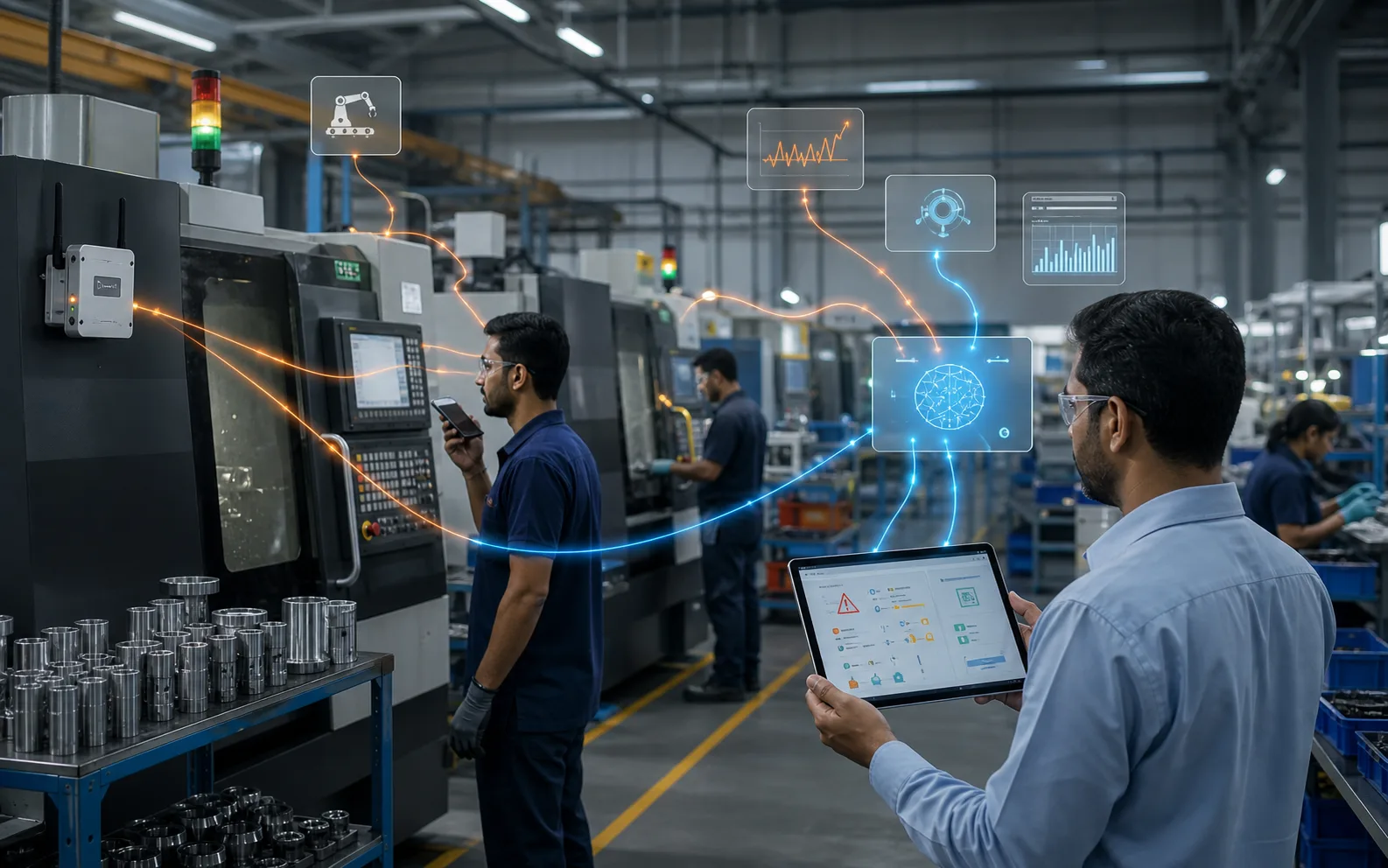
Yes, IoT can monitor injection molding machines. It can capture machine status, cycle time, shot count, downtime, alarms, production output, and sometimes deeper process signals depending on the machine and controller.
For injection molding factories, this is valuable because production depends on time-sensitive conditions. A machine may be running slower than expected. A mold change may take too long. A machine may stop repeatedly. Rejection may rise during a certain shift. If these issues are captured only through manual entries, the factory sees them late.
IoT monitoring gives the team live visibility. When connected with ERP through AICAN Optiwise, machine data can be linked to production orders, molds, resin batches, quality status, dispatch commitments, and costing.
What IoT Can Capture
The exact data depends on machine capability and integration method, but common signals include:
- Running status
- Idle status
- Stop or breakdown status
- Cycle time
- Shot count
- Production quantity
- Alarm status where available
- Downtime duration
- Utility or energy indicators
- Mold change time
- Operator or shift data
Older machines may provide fewer direct signals, but useful monitoring is often still possible through sensors or electrical signal capture.
How The Data Is Collected
IoT data can be collected through:
- Machine controller integration
- PLC signals
- IoT gateways
- Electrical current monitoring
- External sensors
- Operator input for reasons and context
In real factories, a mixed setup is common. Some machines support direct data access. Others need simpler monitoring.
Why Machine Status Alone Is Not Enough
Knowing that a machine is running is useful, but not enough. The plant also needs to know what it is running.
The monitoring system should ideally connect machine data to:
- Production order
- Part number
- Mold number
- Resin batch
- Shift
- Planned cycle time
- Produced quantity
- Rejection
- Quality status
This turns IoT data into production visibility.
Cycle Time And Shot Count
Cycle time and shot count are important for injection molding. They help compare expected output with actual performance.
If shot count is lower than expected, the team can check downtime, slow cycle, mold issue, machine fault, or material delay.
If cycle time is higher than planned, costing and delivery assumptions may need review.
Downtime Monitoring
IoT can detect downtime faster than manual reporting. But the factory must also capture downtime reason.
Common reasons include:
- Machine breakdown
- Mold problem
- Mold change
- Material not ready
- Dryer issue
- Utility problem
- Quality adjustment
- Operator unavailable
- No production plan
Reason-wise downtime makes improvement possible.
ERP Integration
IoT monitoring becomes stronger when connected to ERP. Instead of seeing only machine state, the team sees business impact.
For example: Machine 6 stopped during production order 284, mold M-18, resin batch R-472, dispatch due tomorrow.
That context helps supervisors act faster.
Where AICAN Optiwise Fits
AICAN Optiwise helps injection molding companies connect machine monitoring with molds, production batches, resin inventory, rejection, quality, dispatch, and costing.
The goal is not only to see machines. It is to manage production with better timing and fewer assumptions.
Founder’s Note
At AICAN, we believe IoT monitoring should fit the factory’s reality. Some machines can share rich data. Some can share basic signals. Both can be useful if the data connects to the right decisions.
AICAN Optiwise is built to turn machine signals into factory visibility. Learn more on About AICAN.
FAQs
Can old injection molding machines be monitored with IoT?
In many cases, yes. Older machines may need sensors, electrical signal monitoring, or operator-assisted data entry.
What is the most useful IoT data for molding?
Machine status, cycle time, shot count, downtime, mold change time, and rejection context are useful starting points.
Does IoT replace operator updates?
No. Operators may still need to enter downtime reasons, quality remarks, or job context.
Can IoT data connect to ERP?
Yes. ERP integration connects machine data to production orders, molds, material batches, quality, dispatch, and costing.
Is IoT monitoring expensive?
Cost depends on machine count, data depth, hardware, and integration needs. A phased rollout on critical machines is often practical.
How can AICAN Optiwise help?
AICAN Optiwise helps connect IoT-monitored machine data with ERP workflows for injection molding operations.

Related Posts
Is AI Worth the Investment for My Factory?
Learn how to decide if AI is worth the investment for your factory by evaluating use cases, data readiness, costs, risks, ROI, and operational impact.
13 Jun 2026Read more →Manufacturing AI Mistakes to Avoid Before You Start
List manufacturing AI mistakes and controls for unclear use case, messy data, unsafe automation, no owner, weak security and unreviewed recommendations.
13 Jun 2026Read more →What's the Difference Between AI and Regular Automation?
Understand the difference between AI and regular automation in manufacturing, with practical examples for workflows, decisions, alerts, and predictive operations.
13 Jun 2026Read more →What Are the Risks of Using AI in Manufacturing?
Understand the risks of AI in manufacturing, including bad data, wrong recommendations, safety issues, security, job fear, over-automation, and implementation failure.
13 Jun 2026Read more →