
Can IoT Really Prevent Equipment Breakdowns Before They Happen?
Learn how IoT supports predictive maintenance by detecting early warning signs, reducing surprise downtime, and helping manufacturers plan maintenance better.
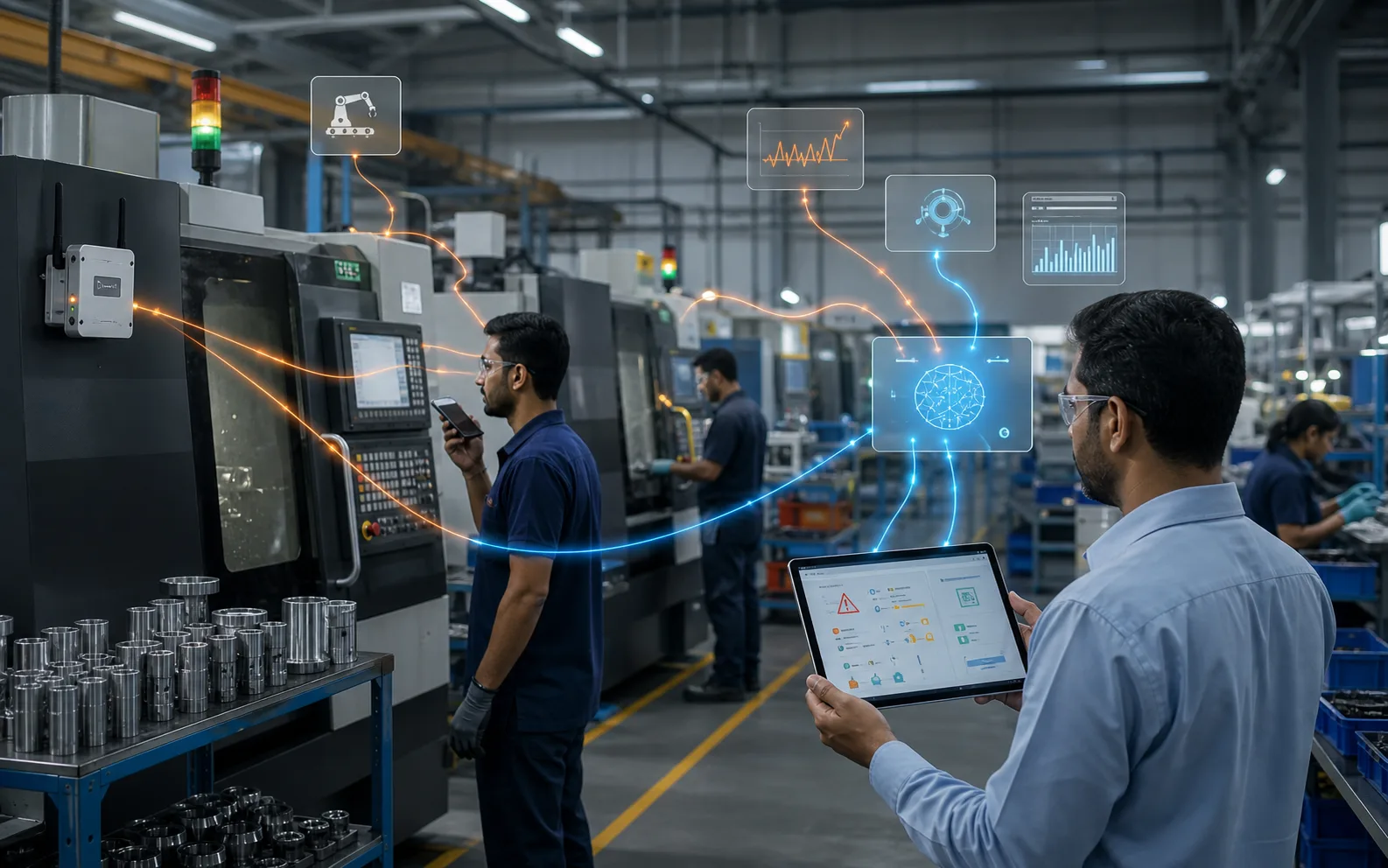
Can IoT Really Prevent Equipment Breakdowns Before They Happen?
IoT can help prevent some breakdowns before they happen, but it is important to say this honestly. It does not predict every failure. It does not remove the need for maintenance teams. It does not turn old machines into self-healing machines.
What IoT can do is detect early warning signs, reveal patterns, and help maintenance teams act before a small issue becomes a production stoppage.
For manufacturers, that is already valuable. A breakdown is not only a machine problem. It affects production output, manpower, dispatch, customer promises, overtime, spare parts, quality, and cash flow. If IoT helps reduce even a portion of surprise downtime, the business impact can be significant.
Breakdowns Usually Give Signals Before They Stop Production
Many failures do not appear from nowhere. Machines often show signs before they fail:
- vibration increases
- temperature rises
- current draw changes
- pressure becomes unstable
- cycle time increases
- speed fluctuates
- repeated short stoppages appear
- energy consumption rises for the same output
- operators report unusual sound or behavior
In a traditional setup, these signs may be noticed but not recorded consistently. An experienced operator may sense something is wrong, but the information may not reach maintenance in time. A maintenance engineer may suspect a pattern, but without data it becomes hard to prove.
IoT helps by continuously capturing signals and turning them into trends, alerts, and records.
Predictive Maintenance Is Not Guesswork
Predictive maintenance is often misunderstood. It is not a system randomly guessing failure dates. It is a disciplined approach to using equipment condition data to decide when maintenance should happen.
For example, if vibration on a motor increases beyond its normal range, the system can flag it. If temperature rises gradually across several days, the team can investigate lubrication, load, alignment, or cooling. If current draw increases while output remains the same, the machine may be working harder than expected.
The key is baseline behavior. The system must understand what normal looks like for that asset, process, and operating condition. Without a baseline, alerts become noisy.
IoT Helps Prioritize Maintenance Work
Maintenance teams often face more requests than they can handle immediately. Some issues are urgent. Some are routine. Some are repeated complaints with unclear cause.
IoT data helps prioritize.
If two machines have complaints, but one also shows abnormal vibration, rising temperature, and repeated stoppages, that machine deserves attention first. If another machine has a one-time operator complaint but no abnormal trend, it may be monitored rather than stopped immediately.
This improves maintenance productivity. Teams spend more time on the assets that carry real risk and less time chasing vague reports.
Early Alerts Reduce Surprise Downtime
The biggest value of IoT is often not perfect prediction. It is earlier warning.
An alert can tell maintenance that a bearing may need inspection. It can show that a compressor is running outside normal behavior. It can reveal that a motor is drawing more current than usual. It can show that a machine has more micro-stoppages this week than last week.
Earlier warning gives the factory choices:
- inspect during planned downtime
- arrange spare parts before failure
- shift urgent production to another machine
- adjust production scheduling
- prevent quality risk
- inform planning before dispatch is affected
Without early warning, the factory reacts after the machine stops.
Operator Input Still Matters
Sensors can detect conditions, but operators often provide context. A vibration increase may happen because of tool wear, fixture issue, product change, load variation, or machine fault. A temperature change may relate to ambient conditions, lubrication, cooling, or overload.
A good IoT maintenance setup combines automatic signals with human knowledge.
Operators should be able to record observations such as unusual noise, repeated jamming, tool change, material issue, or abnormal behavior. Maintenance teams should be able to add inspection notes, actions taken, parts replaced, and follow-up dates.
This creates a richer maintenance history than sensor data alone.
Maintenance Data Should Connect With Production Impact
A machine alert is more useful when the system knows the production context.
If a critical machine is showing abnormal behavior and has a priority order scheduled, the issue is urgent. If the same machine has planned downtime tomorrow, maintenance can inspect it then. If another machine can take the load, planning can adjust.
This is why IoT maintenance should connect with production planning, orders, inventory, and dispatch. Maintenance decisions are business decisions.
What IoT Can and Cannot Prevent
IoT can help with failures that show measurable warning signs. It can help identify wear, overheating, abnormal vibration, overload, unstable operation, leakage, repeated stoppage, and performance degradation.
It may not prevent sudden failures with no visible signal, human mistakes, accidental damage, power events, or failures caused by external factors the system does not measure.
This honest boundary is important. IoT should be judged by whether it reduces risk and improves response, not by whether it eliminates all breakdowns.
Start With Critical Assets
Do not begin predictive maintenance by monitoring every machine. Start with critical assets where breakdowns are expensive.
Good candidates include:
- bottleneck machines
- machines with repeated breakdown history
- equipment with long spare lead times
- high-energy machines
- machines that affect quality or safety
- utility equipment such as compressors, chillers, pumps, or furnaces
For each asset, define the failure modes you care about and the signals that may indicate them. This keeps the project practical.
Where AICAN Optiwise Fits
AICAN Optiwise helps manufacturers connect maintenance visibility with the broader factory operation. A breakdown does not affect only maintenance; it affects production, inventory, sales commitments, finance, and customer trust.
With Optiwise, manufacturers can bring operational data into a connected manufacturing workflow so alerts and insights lead to action. You can explore AICAN and learn more about the company on About AICAN.
FAQ
Can IoT predict every breakdown?
No. IoT can detect many early warning signs, but it cannot predict every failure. Its main value is reducing surprise downtime and improving maintenance decisions.
What data is useful for predictive maintenance?
Useful data may include vibration, temperature, current, pressure, speed, cycle time, energy consumption, stoppage frequency, maintenance history, and operator observations.
Do we need expensive sensors on every machine?
No. Start with critical assets and the failure modes that matter most. Some machines need advanced sensors, while others may need simpler monitoring.
How long does predictive maintenance take to become useful?
The system becomes more useful as it builds baseline data. Some alerts can be useful quickly, but trend-based prediction improves over weeks and months.
Will IoT replace maintenance staff?
No. It supports them. Maintenance teams still diagnose, inspect, repair, plan, and improve. IoT gives them better evidence.
Founder’s Note
At AICAN, we see maintenance as one of the clearest examples of why connected data matters. A machine problem becomes a business problem very quickly when it delays output or dispatch.
Our view is that maintenance teams deserve better evidence, not more pressure. IoT should help them see risk earlier, plan better, and work with production instead of only reacting after failure.
Final Thought
IoT does not remove breakdown risk. It reduces blindness.
If your factory can see early warning signs, connect them with production impact, and act before failure, maintenance becomes less reactive and production becomes more dependable.

Related Posts
Is AI Worth the Investment for My Factory?
Learn how to decide if AI is worth the investment for your factory by evaluating use cases, data readiness, costs, risks, ROI, and operational impact.
13 Jun 2026Read more →Manufacturing AI Mistakes to Avoid Before You Start
List manufacturing AI mistakes and controls for unclear use case, messy data, unsafe automation, no owner, weak security and unreviewed recommendations.
13 Jun 2026Read more →What's the Difference Between AI and Regular Automation?
Understand the difference between AI and regular automation in manufacturing, with practical examples for workflows, decisions, alerts, and predictive operations.
13 Jun 2026Read more →What Are the Risks of Using AI in Manufacturing?
Understand the risks of AI in manufacturing, including bad data, wrong recommendations, safety issues, security, job fear, over-automation, and implementation failure.
13 Jun 2026Read more →