
What Data Can IoT Sensors Collect From My Factory Floor?
Understand the types of factory-floor data IoT sensors can collect, from machine status and downtime to energy, quality, maintenance, safety, and production context.

What Data Can IoT Sensors Collect From My Factory Floor?
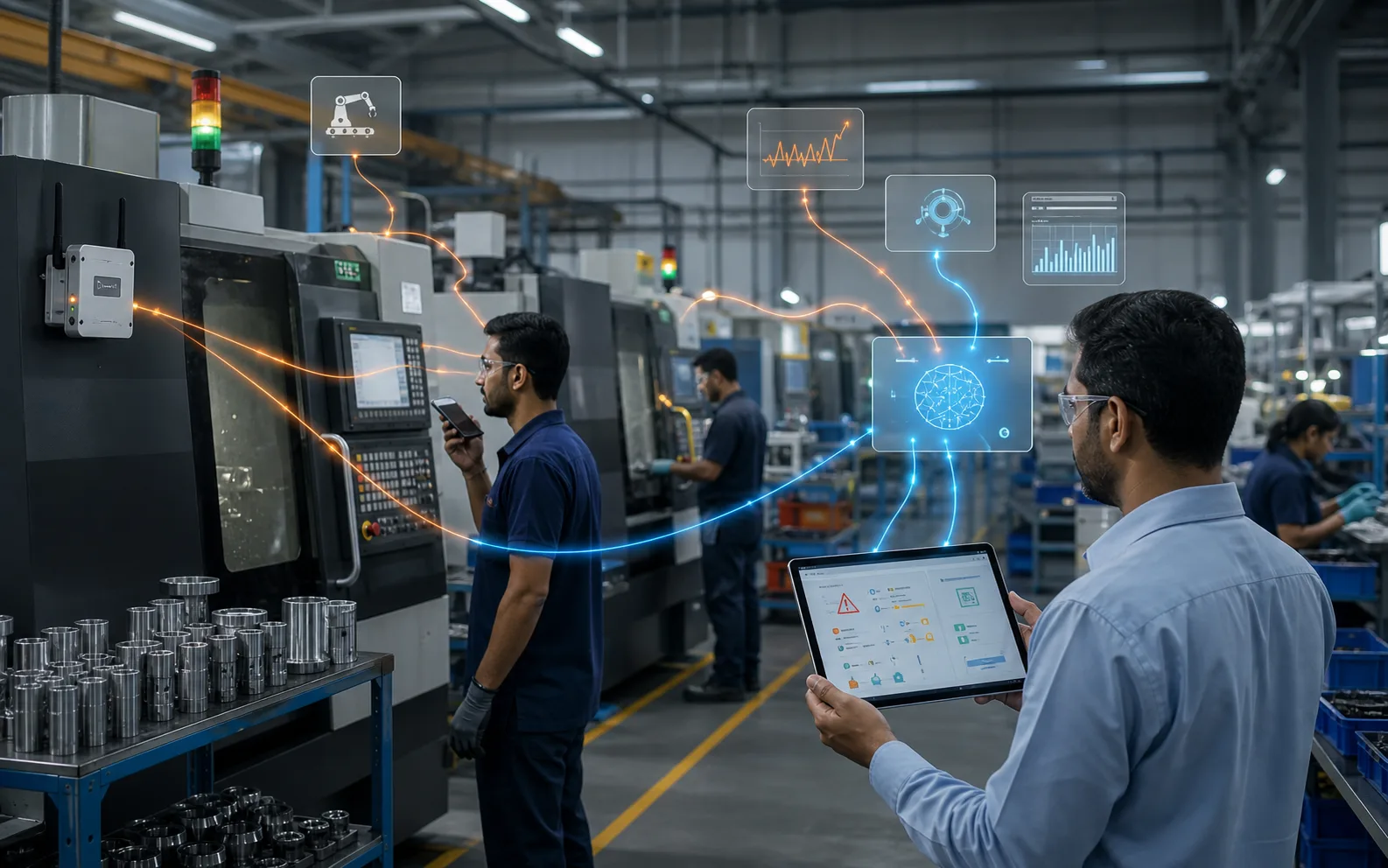
IoT sensors can collect far more than a simple machine on/off signal, but the best projects do not collect data just because it is possible. They collect data that helps the factory make better decisions.
On a manufacturing floor, useful data usually falls into a few groups: machine condition, production output, downtime, energy consumption, quality signals, maintenance indicators, environmental conditions, and operator context. When these data points are connected properly, the factory gets a clearer picture of what is happening, why it is happening, and what needs attention.
The value is not in the sensor alone. The value is in turning sensor readings into operating intelligence.
Machine Status Data
The most basic and useful data is machine status. Is the machine running, idle, stopped, under maintenance, waiting for material, or blocked by quality hold?
This can be captured through machine signals, current sensing, PLC data, production counters, or operator inputs. Once machine status is visible, supervisors can understand where production is flowing and where it is stuck.
Machine status data helps answer:
- which machines are active right now?
- which machines are stopped?
- how long has the stoppage lasted?
- is the machine idle even though it is powered on?
- is production waiting for material, manpower, tool, maintenance, or inspection?
This is often the first layer of factory visibility.
Production Count and Cycle Data
IoT sensors can track production counts, cycle completion, speed, and cycle time. This helps compare planned output with actual output during the shift, not only after the shift ends.
Useful production data includes:
- units produced
- cycles completed
- cycle time variation
- speed loss
- target vs actual output
- good quantity vs rejected quantity
- shift-wise and machine-wise output
This data helps supervisors identify slowdowns earlier. If cycle time is increasing, the team can investigate machine condition, operator practice, material issue, tool wear, or product complexity.
Downtime and Reason Data
A sensor can detect that a machine has stopped. But the reason usually needs context.
IoT platforms can combine automatic stoppage detection with operator reason codes. For example, the system may detect the stop, then ask the operator or supervisor to select a reason such as material wait, tool change, maintenance, no manpower, quality hold, power issue, setup, cleaning, or breakdown.
This creates downtime intelligence:
- downtime by machine
- downtime by reason
- downtime by shift
- repeated stoppages
- average response time
- top losses by duration
Without reason data, the factory only knows time was lost. With reason data, the factory knows what to improve.
Energy Consumption Data
Energy monitoring is one of the most practical IoT use cases in manufacturing. Sensors and meters can collect machine-wise, line-wise, department-wise, or utility-level energy consumption.
Useful energy data includes:
- power consumption by machine
- idle power usage
- peak load events
- energy per unit produced
- shift-wise energy use
- compressor or utility consumption
- abnormal energy trends
Energy data becomes stronger when linked with production. A machine consuming more energy is not automatically inefficient; it may also be producing more. The meaningful metric is often energy per good unit, per batch, or per process.
Condition Monitoring Data
For maintenance, IoT sensors can capture condition signals that may indicate wear, stress, or abnormal operation.
Common condition data includes:
- vibration
- temperature
- pressure
- current
- voltage
- speed
- load
- flow
- humidity
- noise level where relevant
These readings help maintenance teams detect changes before failure. For example, rising vibration may suggest imbalance, bearing wear, looseness, or alignment issues. Rising temperature may suggest overload, lubrication issues, cooling problems, or friction.
The goal is not to create alerts for every small variation. The goal is to understand normal behavior and identify meaningful deviations.
Quality and Process Data
IoT can support quality by connecting inspection results with production conditions.
Depending on the process, quality-related data may include:
- temperature during processing
- pressure during operation
- torque or force values
- humidity or environmental condition
- inspection results
- rejection reason
- batch number
- material lot
- operator and machine information
- setting changes
This helps the quality team investigate defects more quickly. Instead of asking only what failed, the team can ask what conditions were present when it failed.
Environmental and Safety Data
Some factories need to monitor environmental conditions such as temperature, humidity, dust, gas, air quality, noise, or water levels. These may matter for process stability, worker safety, product quality, or compliance.
For example, humidity may affect packaging, electronics, powder handling, or certain raw materials. Temperature may affect curing, storage, or dimensional stability. Air pressure or flow may affect clean areas or utilities.
The key is relevance. Environmental data should be collected when it affects quality, safety, energy, or compliance.
Operator and Workflow Context
Not all important factory data comes from sensors. Some of it comes from people.
Operators can provide context that machines cannot:
- reason for stoppage
- quality observation
- tool change note
- setup completion
- material issue
- abnormal sound or behavior
- maintenance request
- manual inspection result
A good IoT platform should make this input easy. Too many fields, unclear reason codes, or slow screens will reduce adoption.
Data Is Most Valuable When Connected
Each data type is useful on its own. The real value appears when data is connected.
Machine status plus production order tells you which customer job is affected. Energy plus output tells you cost per unit. Quality plus batch context improves traceability. Maintenance signals plus downtime history helps prioritize assets. Operator reasons plus automatic stoppage detection turns lost time into improvement actions.
This is why IoT should not remain isolated from ERP and manufacturing workflows.
Where AICAN Optiwise Fits
AICAN Optiwise helps manufacturers connect factory data with business workflows such as production, inventory, purchase, sales, finance, and reporting. Sensor data becomes more useful when it supports decisions across the company, not only on one dashboard.
Optiwise is built for practical manufacturing control. You can explore AICAN and learn more on About AICAN.
FAQ
What is the most important IoT data to collect first?
Start with the data connected to your biggest loss. For many factories, that means downtime, production count, machine status, energy, or quality defects.
Can IoT sensors collect data from old machines?
Yes. Many legacy machines can be connected using retrofit sensors, counters, meters, gateways, or operator input.
Is sensor data useful without ERP integration?
It can be useful for visibility, but integration makes it stronger. ERP context connects sensor data with orders, inventory, costing, quality, and dispatch.
How much data is too much?
Data becomes too much when no one knows what decision it supports. Collect enough to act, then expand after the first use case is stable.
Do operators still need to enter information?
Yes, in many cases. Sensors can show that something happened, but operators often explain why it happened.
Founder’s Note
At AICAN, we believe factory data should be useful to the people who run the factory, not buried in technical complexity. The right data should make decisions clearer for operators, supervisors, maintenance, owners, and finance teams.
That is why connected manufacturing systems matter. Data should move from the shop floor into the business rhythm.
Final Thought
IoT sensors can collect many signals, but the best starting point is not the biggest list. It is the data that explains your most expensive uncertainty.
Measure what matters. Add context. Turn it into action.

Related Posts
Is AI Worth the Investment for My Factory?
Learn how to decide if AI is worth the investment for your factory by evaluating use cases, data readiness, costs, risks, ROI, and operational impact.
13 Jun 2026Read more →Manufacturing AI Mistakes to Avoid Before You Start
List manufacturing AI mistakes and controls for unclear use case, messy data, unsafe automation, no owner, weak security and unreviewed recommendations.
13 Jun 2026Read more →What's the Difference Between AI and Regular Automation?
Understand the difference between AI and regular automation in manufacturing, with practical examples for workflows, decisions, alerts, and predictive operations.
13 Jun 2026Read more →What Are the Risks of Using AI in Manufacturing?
Understand the risks of AI in manufacturing, including bad data, wrong recommendations, safety issues, security, job fear, over-automation, and implementation failure.
13 Jun 2026Read more →