
Practical Factory AI: Start With Four Decisions You Can Verify
Practical Factory AI: Start With Four Decisions You Can Verify. Use a worked factory scenario, explicit inputs and exception checks before rollout.
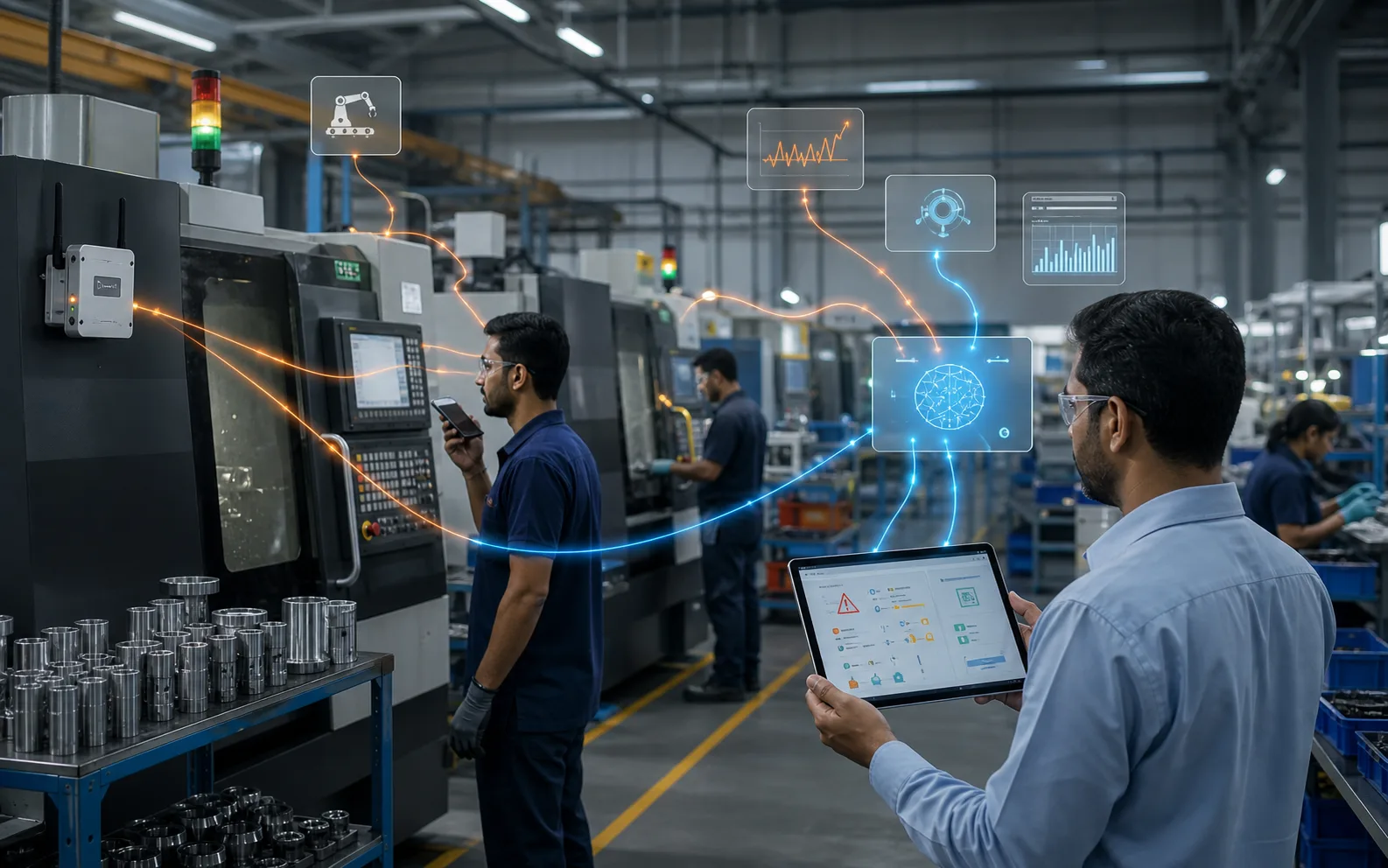
Practical Factory AI: Start With Four Decisions You Can Verify gives you a practical way to apply AI to current records and accountable actions. Use a representative order, the real roles who perform the work and at least one difficult exception.
A planner asks which due orders are at risk. The assistant should show the affected orders, shortage or capacity evidence, the time of each source record, a recommended next action and the role that can approve it.
Make the decision before choosing the screen
Choose a narrow decision, define its authoritative records and keep human approval where the action changes supply, production or customer commitments.
Our AI agents work on connected sales, production, purchasing, inventory and task records; permissions control the records and actions available to each user.
NIST AI Risk Management Framework is the external process or control reference for this guide. It does not prove an Optiwise feature or a business result; our product statements come from our current product record.
| Step | Required input | Evidence to capture |
|---|---|---|
| 1 | Decision and accountable user | Named owner and definition |
| 2 | Authoritative records and freshness | Current source record |
| 3 | Recommendation and reason | Acceptance rule |
| 4 | Permission, approval and fallback | Correction and escalation |
Run the workflow with accountable roles
- 1. Decision and accountable user. Name the role that owns this record and decision.
- 2. Authoritative records and freshness. Use a current value from the representative order.
- 3. Recommendation and reason. Write the passing condition before the test.
- 4. Permission, approval and fallback. Assign correction and escalation responsibility.
Reconcile the result by hand. When the system differs from the source record, classify the gap as master data, timing, transaction ownership, permissions or configuration before changing the process.
Test the exceptions that disrupt a normal day
- Records conflict: record the expected status, permitted action, approver, correction path and audit evidence.
- Confidence is insufficient: record the expected status, permitted action, approver, correction path and audit evidence.
- Action exceeds the user’s role: record the expected status, permitted action, approver, correction path and audit evidence.
A quick normal transaction is useful. A controlled exception shows whether the workflow can survive real factory conditions.
Connect this task to the operating workflow
review the first product workflow, check the connected module, prepare the supporting records, see the control step, read the related guide. Book a connected Optiwise demo and ask us to run your scenario with the normal path, exception and correction.
Questions to settle during the demo
What should we prepare?
Prepare one representative order, the four inputs above and one complication your team encounters today. You can remove confidential values while keeping the record relationships intact.
What is a passing result?
Accept the workflow when the normal path and exceptions leave a complete, role-appropriate record another person can reconcile. Validate the configured capability separately from any promised commercial or operational outcome.
Many manufacturers hear about AI in a way that feels too far away from daily factory life. The discussion becomes full of future promises: autonomous plants, fully predictive systems, and machines making every decision automatically.
But most factories do not need science fiction. They need practical help right now. They need fewer surprises, faster reporting, better stock control, clearer production visibility, and earlier warnings when something is going wrong.
That is where AI can already help.
Start With the Problems You Already Feel
AI should not begin as a technology experiment. It should begin with operational pain.
Where does your team waste time every day? Which reports are always late? Which stock items create repeated confusion? Which machines cause unplanned stoppages? Which customers keep asking for status updates because internal visibility is weak?
The best AI use cases are usually hidden inside these everyday frustrations.
Production Visibility
AI can help managers understand production performance faster. Instead of manually comparing planned output with actual output, AI can highlight delays, underperforming lines, repeated stoppages, and unusual production patterns.
For example, if a job is falling behind schedule, the system can flag the delay early and show possible reasons: material shortage, machine downtime, pending quality approval, or manpower mismatch.
This does not replace the production team. It gives them earlier signals.
Inventory Planning
Inventory is one of the easiest places to see practical AI value. AI can identify fast-moving and slow-moving items, suggest reorder points, detect unusual consumption, and warn when stock levels may affect production or dispatch.
Many factories lose money because inventory decisions are made reactively. AI helps move the team from “what is missing today?” to “what may become a problem next week?”
Maintenance Alerts
AI can support maintenance by studying patterns in machine usage, breakdown history, stoppage frequency, and production interruptions. Even before advanced sensor data is available, historical ERP and maintenance records can reveal useful patterns.
A simple alert that says “this machine has caused repeated delay before similar production loads” can help teams plan inspection earlier.
Quality and Rework Monitoring
Quality teams can use AI to detect repeated defect patterns, compare rejection reasons, identify suppliers linked to higher issues, and summarize inspection trends.
The value is not only in catching defects. It is in helping teams see recurring causes faster so corrective action becomes more focused.
Customer and Sales Updates
AI can also help customer-facing teams. It can prepare order status summaries, highlight delivery risks, draft customer updates, and show which orders need attention.
This reduces the pressure on sales teams to chase production, stores, and dispatch separately. Better internal visibility leads to better customer communication.
Reporting and Decision Support
Daily reports often consume too much management time. AI can prepare first drafts of MIS summaries, exception reports, stock alerts, and pending approval lists.
Instead of reading ten reports, a manager can start with a focused summary: what changed, what is delayed, what needs approval, and what risk is emerging.
How Optiwise Supports the Workflow
AICAN Optiwise gives manufacturers a connected operational base across production, inventory, purchase, sales, finance, and reporting. AI becomes more useful when it works with reliable business data instead of scattered spreadsheets and message threads.
AICAN helps factories move from reactive firefighting to clearer operational control. With the right ERP foundation, AI can support decisions in the places where teams already need help today. Learn more at About AICAN.
Founder’s Note
A factory does not need to become “AI-first” overnight. It needs to become more aware, more connected, and less dependent on last-minute chasing.
The best AI use case is often not the most glamorous one. It is the one that saves a planner two hours, prevents a material shortage, catches a delay early, or helps a manager make a decision before the day is already lost.
FAQ
What is the easiest AI use case for a factory to start with?
Reporting, inventory alerts, production delay summaries, and pending approval tracking are usually practical starting points.
Does a factory need sensors before using AI?
Not always. Useful AI insights can begin with ERP data, production records, inventory movement, maintenance logs, and order history.
Can AI improve customer delivery?
Yes, by identifying dispatch risks earlier and helping teams communicate order status more clearly.
Is AI only for large manufacturers?
No. Smaller manufacturers can also benefit if they choose focused use cases and maintain clean operational data.
Final Thought
AI can help your factory right now if it is applied to real problems. Start with visibility, reporting, inventory, maintenance, quality, and customer updates. Small wins build trust, and trust creates the path for larger transformation.

Related Posts
Is AI Worth the Investment for My Factory?
Learn how to decide if AI is worth the investment for your factory by evaluating use cases, data readiness, costs, risks, ROI, and operational impact.
13 Jun 2026Read more →Manufacturing AI Mistakes to Avoid Before You Start
List manufacturing AI mistakes and controls for unclear use case, messy data, unsafe automation, no owner, weak security and unreviewed recommendations.
13 Jun 2026Read more →What's the Difference Between AI and Regular Automation?
Understand the difference between AI and regular automation in manufacturing, with practical examples for workflows, decisions, alerts, and predictive operations.
13 Jun 2026Read more →What Are the Risks of Using AI in Manufacturing?
Understand the risks of AI in manufacturing, including bad data, wrong recommendations, safety issues, security, job fear, over-automation, and implementation failure.
13 Jun 2026Read more →